
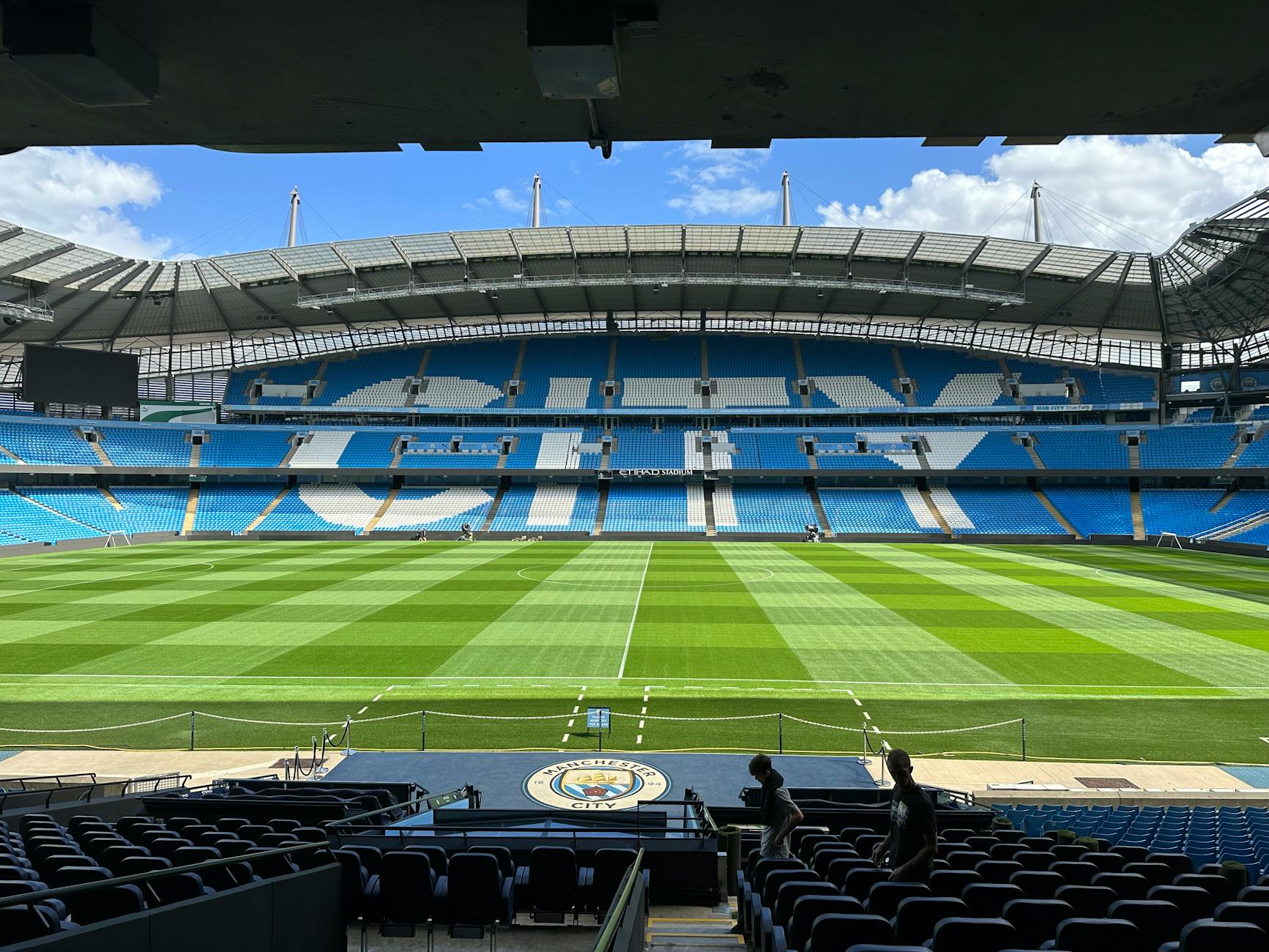
\n\nOn May 13, 2012, in the 93rd minute and 20 seconds of the final Premier League match, Sergio Agüero clipped in a curled shot that landed in QPR’s net. Manchester City became English champions for the first time in 44 years, winning on goal difference over Manchester United. That “/\/\/\/”Aguerooooo” shouted by broadcaster Martin Tyler perfectly sums up City’s modern history: a club long in the shadow of their red neighbors, turned in just a few years into the new European benchmark under Abu Dhabi and Pep Guardiola.\n\nThe story of Manchester City is that of a longtime neighborhood club born in 1880 at St. Mark’s in West Gorton, which spent decades moving between lower divisions and the spotlight, before being propelled to the top of world football by the September 2008 takeover. Ten league titles (including seven in eight seasons under Guardiola), a Champions League in 2023 and a continental treble that same year: no English club has seen such rapid acceleration in so little time.\n
 \n
\n\n
\n
1880, founded at St. Mark’s parish
\nThe story begins in 1880, in the working-class district of West Gorton, east of Manchester. The Anglican St. Mark’s parish, led by Reverend Arthur Connell, saw its idle young men slip into alcoholism and violence. The reverend’s daughter, Anna Connell, and two parishioners created a football team to give them a healthy activity. The club was first called St. Mark’s (West Gorton).\n\nThe club quickly changed names: Gorton AFC in 1884, Ardwick Association FC in 1887 (after moving to Hyde Road in Ardwick), and finally Manchester City Football Club in 1894. The club joined the Football League in 1892, in the new Second Division. First major title: the 1904 FA Cup, a 1-0 win over Bolton at Crystal Palace. It was also the first major trophy brought to Manchester by a club, before Manchester United.\n\nMaine Road, the future iconic City stadium, was inaugurated in 1923 in Moss Side. Its peak capacity once exceeded 80,000 seats, making it one of England’s biggest stadiums. The club stayed there until 2003.\n
The 1968 title and the long journey
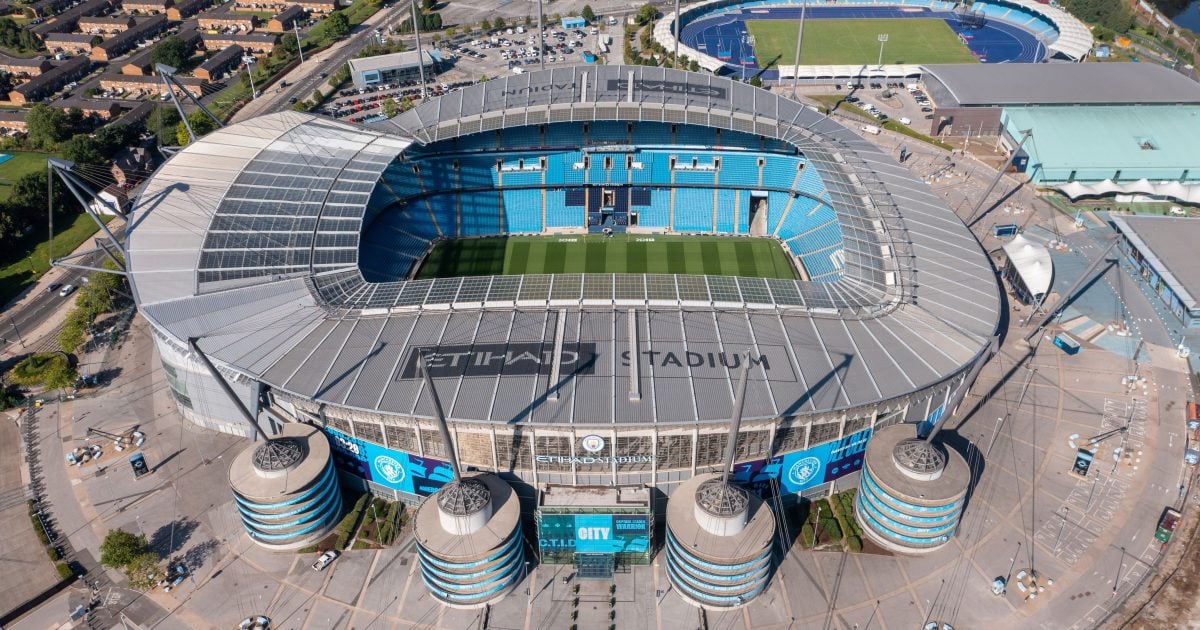
\nManchester City experienced its first golden era at the end of the 1960s, under the manager duo Joe Mercer and Malcolm Allison. The team won the league in 1967-1968 ahead of Manchester United in a dramatic race that captivated the city. This was followed by the 1969 FA Cup (against Leicester) and the 1970 Cup Winners’ Cup (against Górnik Zabrze in Vienna). The club shone with Colin Bell, Mike Summerbee and Francis Lee, the attacking trio dubbed the \”Holy Trinity\” by supporters.\n\nBut after that high, the 1970s ended in free fall. City dropped to the Second Division in 1983, then climbed back up, dropped again in 1996, and even to the Third Division (equivalent to France’s Ligue 2) in 1998. For the first time in its history, Manchester City played below the English top flight. Relegation was not just a sporting humiliation: it was also the start of a loss of fan base and identity.\n\nThe club gradually climbed back between 1999 and 2002. In 2003, it left Maine Road for the City of Manchester Stadium, built for the 2002 Commonwealth Games and later adapted for football. The stadium was renamed Etihad Stadium in 2011, after the sponsor from the Abu Dhabi airline company. It then held 47,000 seats, expanded to 53,400 after several extension phases.\n
 \n
\n\n
September 2008: the takeover by Abu Dhabi
\nOn September 1, 2008, on the final day of the English transfer window, the announcement came: Manchester City was bought by the Abu Dhabi United Group, owned by Sheikh Mansour bin Zayed Al Nahyan, a member of the Abu Dhabi royal family. A few hours later, City announced the transfer of Robinho for 32.5 million pounds, an all-time Premier League record at the time, and snapped him from Real Madrid.\n\nThe effect was immediate. City became one of the most expensive destinations in world football. Transfers multiplied: Carlos Tévez (snapped from United in 2009), Yaya Touré, David Silva, Sergio Agüero (in 2011, for 38 million pounds). In 2011, City won the FA Cup, its first major trophy since 1976. The machine was set in motion. Italian coach Roberto Mancini prepared the conquest of the league.\n
93:20, the Agüero moment that changed everything
\nMay 13, 2012. Final day of the Premier League. Manchester City hosted Queens Park Rangers at the Etihad. At the other end, Manchester United played Sunderland. Both clubs were level on points before matchday 38, but City were ahead of United on goal difference. Any draw or loss for the Citizens would have given the title to United.\n\nCity led 1-0 through Pablo Zabaleta, but QPR equalized through Djibril Cissé and then took the lead through Jamie Mackie (66′). Manchester United, already mentally champion, were leading 1-0 at Sunderland. At the Etihad, anxiety was total. In stoppage time, Edin Džeko equalized in the 91st (2-2). And in the 93rd minute and 20 seconds, after a pass from Mario Balotelli, Sergio Agüero clipped in a curled shot that went into the net. Manchester City were champions.\n\nNo English league title has ever been won in such a dramatic fashion in modern times. For the club, it was the first national title since 1968, a 44-year wait. For the Manchester rivalry, it was a historic turning point: for the first time, City finished ahead of United in the final standings.\n
Pep Guardiola’s arrival in 2016
\nCity added a second title in 2014 under Manuel Pellegrini, but the ultimate goal remained the Champions League. The club did not go beyond European semifinals. Management made its most important recent decision: recruit Pep Guardiola, probably the best coach in the world, from Bayern Munich. The deal was signed in February 2016, with a start date in the summer.\n\nGuardiola’s first months were mixed. The 2016-2017 season ended without a trophy. The Catalan adapted his style to English football and reshaped his squad (Ederson, Kyle Walker, Aymeric Laporte, Bernardo Silva). The 2017-2018 season was a statement: City won the Premier League with 100 points, an outright record, and became the \”Centurions\”. The 2018-2019 title followed (97 points), then titles in 2021, 2022, 2023 and 2024. Six titles in seven seasons, a level of dominance never seen in the Premier League.\n\nThe squad progressively grew with global stars: Kevin De Bruyne, a Belgian creative midfielder turned maestro, and Erling Haaland, a Norwegian striker signed from Dortmund in 2022 for 60 million euros. In his first season at City, Haaland scored 36 league goals, a record high, and 52 in all competitions.\n
 \n
\n\n
2023, the continental treble and the first Champions League
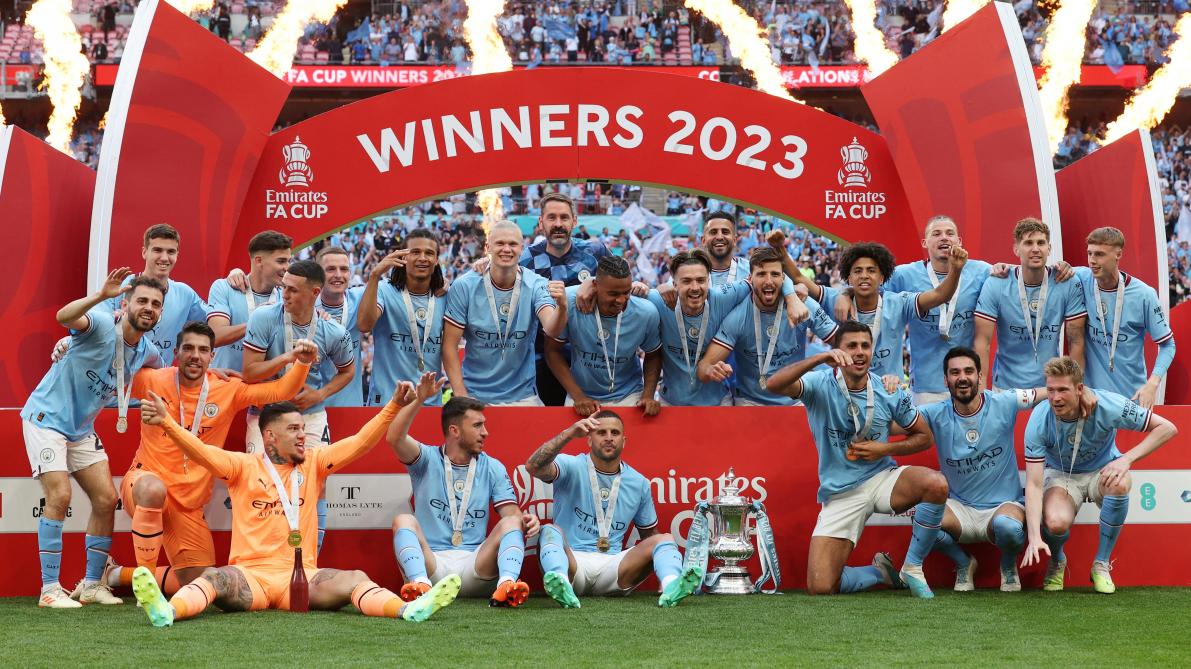
\nThe 2022-2023 season was the ultimate result of the Abu Dhabi project. Manchester City won the Premier League for the fifth time in six seasons, lifted the FA Cup on June 3, 2023 against Manchester United (2-1, a double from Gündoğan including a goal after twelve seconds, an all-time record), then won their first Champions League on June 10, 2023 in Istanbul.\n\nThe final against Inter Milan was played at Istanbul’s Atatürk Olympic Stadium, in the same stadium where Liverpool beat AC Milan in 2005. Tight scoreline: 1-0 to City, Rodri goal in the 68th minute. Manchester City became the second English club, after Manchester United, to complete the Premier League – FA Cup – Champions League treble, exactly 24 years after the first in 1999. Pep Guardiola became the first Spanish manager to win the Champions League with two different clubs (Barcelona, City).\n\nThe 2023-2024 season set a new record: four consecutive Premier League titles, never before in English league history. City’s dominance seemed total. But the last months also brought some clouds: a Premier League investigation into 115 alleged breaches of Financial Fair Play, filed in 2023, with a verdict expected in 2024 or 2025.\n
City identity: sky blue, City Football Group and controversies
\nCity’s visual identity has remained stable despite the sporting revolution: sky blue has dominated since the early years, inherited from the city’s attachment to this color. The current crest, redesigned in 2016, includes the Manchester flag (White Rose of Lancaster) and a ship. The motto \”Superbia in Proelio\” (pride in battle) dates from the same redesign.\n\nThe City Football Group, a holding company controlled by Abu Dhabi, now owns around ten clubs worldwide: New York City FC, Melbourne City, Yokohama F. Marinos, Mumbai City, Girona FC, Lommel SK, Troyes, and several others. This global network strategy allows it to share scouting, coaching and some transfers between satellite clubs.\n\nThe Abu Dhabi project nonetheless generates major controversy. In February 2023, the Premier League filed more than 115 charges of alleged financial fair play violations from 2009 to 2018. The proceedings could lead to sanctions up to and including relegation. City has denied all charges and defends the legality of its economic model. The verdict is still awaited.\n
 \n
\n\n
Today: the fourth consecutive Premier League title
\nCity remains one of the world’s football powerhouses. The 2024-2025 transfers focused on increasing bench depth (Savinho, and Ilkay Gündoğan returning on loan). Pep Guardiola, whose contract was renewed in November 2024 through 2027, continues to run the machine. Among players, Erling Haaland remains the no-question striker, Rodri (Ballon d’Or 2024 winner) the metronome in midfield, and Phil Foden the offensive creativity.\n\nWith 10 English league titles, 7 FA Cups, 9 League Cups and 1 Champions League, Manchester City has joined, in just a few years, the ranks of the greatest clubs in the world. The question by the end of the 2020s: what would become of City if Guardiola left, or if the Premier League severely sanctioned the club after the ongoing investigations?\n
What to remember
\n
- \n \t
- Manchester City was born in 1880 as St. Mark’s (West Gorton), became Ardwick AFC in 1887 and then Manchester City in 1894.
- The first English league title came in 1968 under the Mercer-Allison duo, followed by a long downturn that included relegation to the Third Division in 1998.
- On September 1, 2008, Sheikh Mansour bin Zayed Al Nahyan bought City via the Abu Dhabi United Group, transforming the club into a world giant.
- On May 13, 2012, at 93 minutes and 20 seconds, Sergio Agüero scored the goal for City’s first Premier League title against QPR.
- Pep Guardiola, who arrived in July 2016, won 7 Premier League titles in 8 seasons, including four in a row (2021 to 2024), an outright record.
- The 2022-2023 treble (Premier League, FA Cup, Champions League) is the second achieved by an English club after Manchester United in 1999.
- The Premier League opened proceedings in 2023 for 115 alleged Financial Fair Play violations from 2009 to 2018.
\n \t
\n \t
\n \t
\n \t
\n \t
\n \t
\n
\n
Further reading
\n
To go deeper into the Premier League world, we recommend our pieces on Manchester United’s history, a neighbor and eternal rival, Liverpool’s history, a main rival for the title in the Guardiola era, and Arsenal’s history. Our ranking of the best Premier League jerseys also revisits City’s iconic sky-blue jerseys worn since 1990.
\n\n
\n
Frequently asked questions
\n
When was Manchester City founded?
Manchester City was born in 1880 as St. Mark’s (West Gorton), created by Anna Connell to engage young parishioners of the Anglican parish St. Mark’s. The club became Gorton AFC in 1884, Ardwick AFC in 1887 and finally Manchester City Football Club in 1894.\n\n
When did Abu Dhabi buy Manchester City?
On September 1, 2008, on the final day of the English summer transfer window, Sheikh Mansour bin Zayed Al Nahyan bought Manchester City through the Abu Dhabi United Group. A few hours later, the club announced record Robinho transfer to Real Madrid for 32.5 million pounds.\n\n
How many Premier League titles has Manchester City won?
Manchester City has 10 English league titles, including 8 in the modern era: 2012 (Mancini), 2014 (Pellegrini), 2018, 2019, 2021, 2022, 2023 and 2024 (Guardiola). The four consecutive titles between 2021 and 2024 are an absolute Premier League record.\n\n
When did Manchester City win its first Champions League?
On June 10, 2023, at the Atatürk Olympic Stadium in Istanbul, Manchester City beat Inter Milan 1-0 in the Champions League final, with a Rodri goal in the 68th minute. It is the club’s first European Cup.\n\n
What does Agüero’s 93:20 mean?
On May 13, 2012, in the 93rd minute and 20 seconds of the final Premier League match against QPR (3-2), Sergio Agüero scored the goal that gave Manchester City its first English league title since 1968. The goal remains engraved in the club’s culture.\n\n
\n
Does City’s sky-blue jersey catch your eye?
\n
The Manchester City collection at our store brings together the home, away and third jerseys of the current season, plus a selection of retro jerseys that marked the Mancini, Pellegrini and Guardiola eras.
\n