
In October 1886, workers at the Royal Arsenal in Woolwich, in southeast London, created a football team called Dial Square. They were armament workers, makers of cannons and ammunition, which is where the nickname Gunners comes from, and it stayed with the club throughout its history. A hundred and forty years later, Arsenal plays in north London, in a state-of-the-art 60,000-seat stadium, and is among the ten most valuable clubs in the world.
Arsenal’s story is one of a unique geographic migration in the Premier League: the only major English club to have crossed London to settle elsewhere. It is also the story of an impressive domestic record (13 league titles, record 14 FA Cups), of two visionary coaches (Herbert Chapman in the 1930s, Arsène Wenger from 1996 to 2018), and of a legendary team, the 2003-2004 Invincibles, who remained unbeaten all season in the Premier League.
1886, the Woolwich gunners create Dial Square
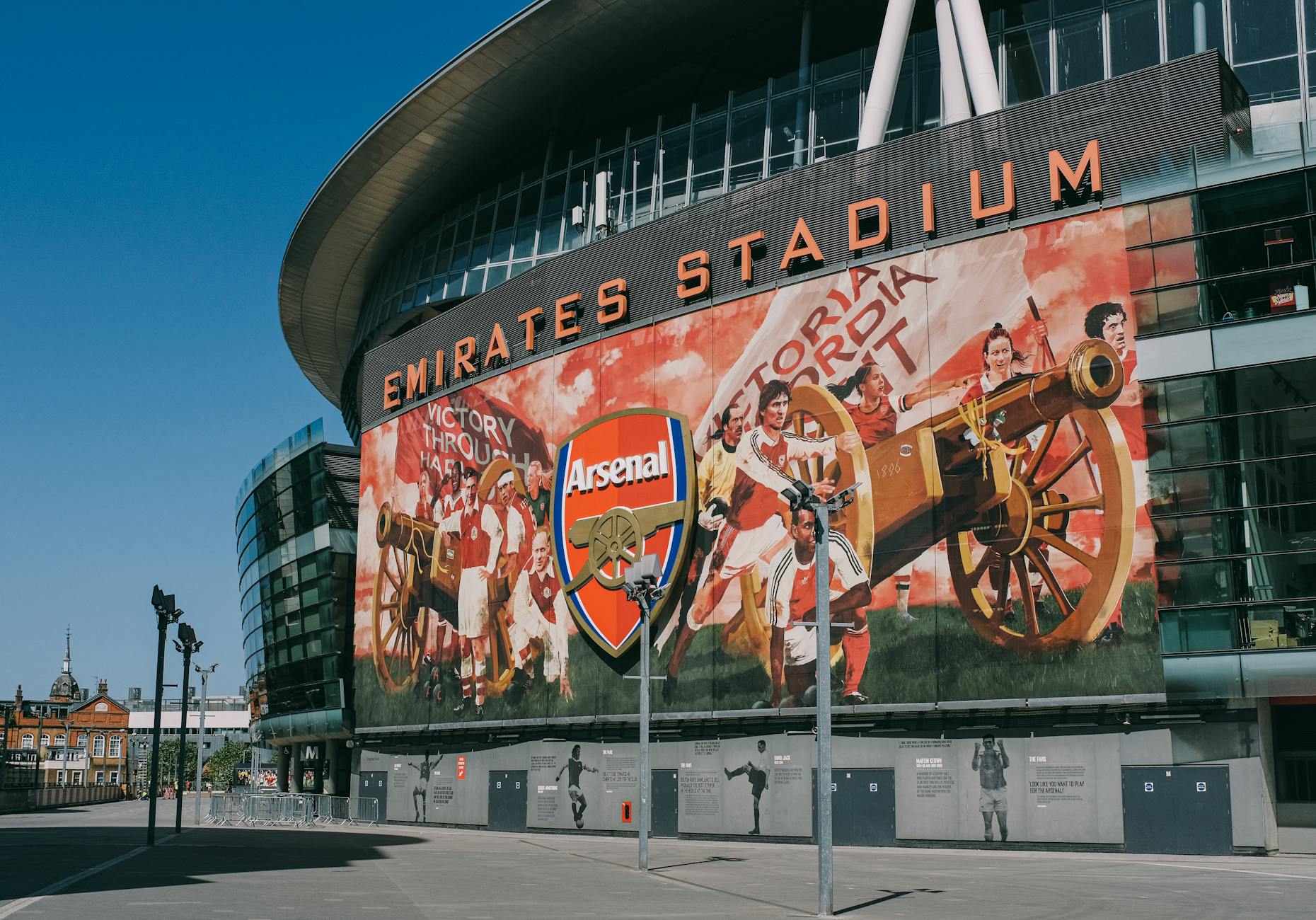
Everything began in October 1886 in southeast London, in Woolwich, near a crown-owned armaments factory. Workers, including David Danskin and Jack Humble, pooled their interest in football and created a team called Dial Square. The first match was played against Eastern Wanderers and ended in a 6-0 victory.
The club was renamed Royal Arsenal in January 1887, in tribute to the armaments works that employed its players. In 1891, it became Woolwich Arsenal and turned professional. It was the first professional club in southern England, at a time when professional football was dominated by the north and center of the country. In 1893, it joined the Football League and played its matches at Manor Ground in Plumstead.
The first years were financially difficult. Travels to the north of the country were expensive, commercial appeal was weak, and the club came close to bankruptcy several times. It was this precariousness that pushed the new owners, in 1913, to make a decision as radical and unprecedented in English football.
1913, the big move to North London
In 1910, Henry Norris, a London businessman and politician, took control of Woolwich Arsenal as it stood on the edge of liquidation. He made a simple assessment: the club would never be profitable in Woolwich, too far out, too far from the economic heart of London. His decision was unprecedented: move north of the Thames, to the Highbury district, in the heart of the capital.
The new stadium, Arsenal Stadium (better known as Highbury), was built on land rented from a Catholic seminary. The move took place in the summer of 1913. Tottenham supporters, based very nearby in north London, were furious: they considered a club from another district trampling their territory. That rivalry, the North London Derby, was born then and remains one of the fiercest in English football.
In 1914, the club permanently dropped the prefix “Woolwich” and would no longer be called anything but Arsenal Football Club. The nickname Gunners remained, in homage to the gunnery origins. The transition was a success: Arsenal finally found a stable fanbase and enough revenue to grow. What remained was winning silverware. For that, the arrival of a man who would change everything was still needed.
Herbert Chapman, the wizard of the 1930s
In 1925, Herbert Chapman left Huddersfield Town, which he had just led to two consecutive titles, to become Arsenal manager. He was 47, had strong opinions, and a reputation as an innovator. He would stay at the club for nine years, until his untimely death in 1934, and lay the groundwork for modern football.
Chapman invented the jersey number, which he enforced in 1928. He introduced floodlights in stadiums, white referees, and a white ball, and even got the Underground station closest to Highbury renamed Arsenal (still today the only English club with a station carrying its name). Tactically, he developed the WM (3-2-2-3), a revolutionary formation that would dominate English football into the 1950s.
On the field, the silverware followed. Arsenal won five English league titles in the 1930s (1931, 1933, 1934, 1935, 1938) and two FA Cups (1930, 1936). Chapman died suddenly of pneumonia in January 1934, at 55, mid-season. The club owes its rise to the top ranks to him. A bust of him has stood since then in the entrance hall at Highbury, then at the Emirates.
Arsène Wenger arrives in 1996
The post-Chapman period was marked by highs and lows. The league-FA Cup double of 1971 marked the return to the top. George Graham won two titles in 1989 and 1991, in a defensive style that annoyed purists. But it was in September 1996 that Arsenal entered a new dimension. Club vice-president David Dein went to France in search of a manager barely known in England: Arsène Wenger, who was then in charge of Grampus Eight in Japan after a spell at Monaco.
“Arsène Who?” wrote the Evening Standard. The Frenchman arrived with his square glasses, impeccable French, an obsession with nutrition and a love of attacking football. He revolutionized players’ everyday life: strict diet, no more third halves at the pub, mandatory stretching, and systematic video analysis. Tony Adams, the iconic captain of the era, says he was ten kilos lighter six months after Wenger arrived.
Results came quickly. A league and FA Cup double in 1998, already in the first full season. Another double in 2002. Wenger won three Premier Leagues (1998, 2002, 2004) and seven FA Cups in 22 years at Arsenal. But his masterpiece is this 2003-2004 team, remembered forever by one name: the Invincibles.
The 2003-2004 Invincibles
The 2003-2004 season is unique in Premier League history: Arsenal finished matchday 38 without a single defeat. 26 wins, 12 draws, 0 losses. No English club had managed this since Preston North End in 1888-1889, when the league had only 22 matches.
The team was a perfect blend. Up front: Thierry Henry, the league’s top scorer with 30 goals, and Robert Pires on the left flank. In midfield: captain Patrick Vieira, Gilberto Silva, Freddie Ljungberg. Behind: Sol Campbell, Kolo Touré, Lauren and Ashley Cole. In goal: Jens Lehmann, a calm and reliable German. Dennis Bergkamp, the Dutch playmaker, orchestrated the game.
The title was sealed on April 25, 2004 at White Hart Lane, on the pitch of fierce rivals Tottenham, in a dramatic 2-2 draw. The unbeaten run carried into the start of the following season until October 2004, totaling 49 consecutive matches without a defeat, another all-time record. Our article dedicated to the Invincibles recounts the season match by match.
2006, the Emirates and the difficult transition
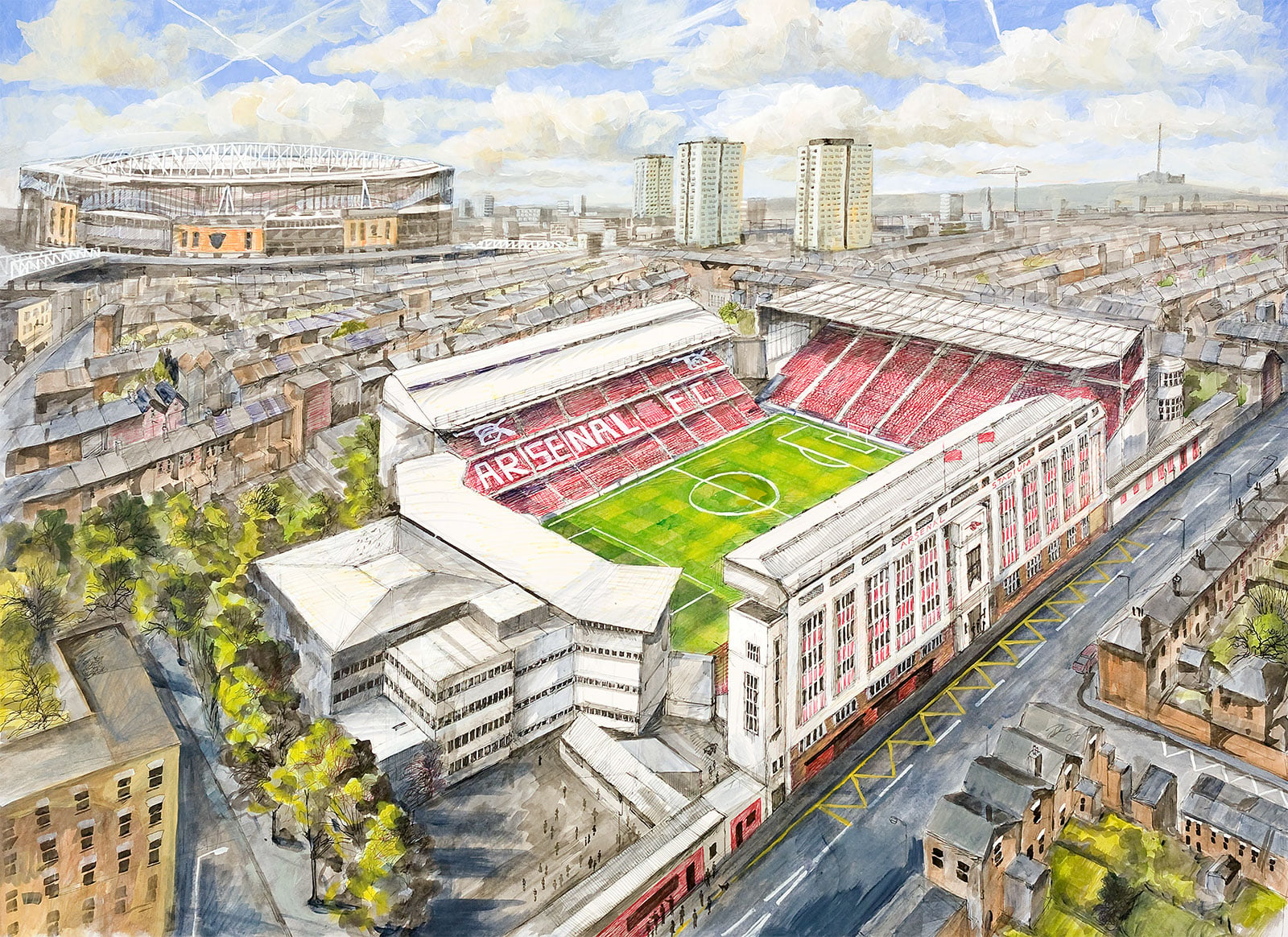
The summer of 2006 marked the end of an era. Highbury, the iconic stadium since 1913, closed its doors. Arsenal moved into the Emirates Stadium, a state-of-the-art 60,704-seat arena built just a few hundred meters from the old ground. Total cost exceeded 470 million pounds, hurting the club’s finances and limiting transfers for almost a decade.
The next nine seasons were frustrating. Wenger consistently qualified Arsenal for the Champions League, which stabilized the books, but the club did not win the league again. Cesc Fàbregas, Robin van Persie, and Samir Nasri were sold to direct rivals. The club still won three consecutive FA Cups (2014, 2015, 2017) and the Emirates became the first Wenger era trophy home for the first major silverware.
In May 2018, after 22 years in charge, Wenger announced his departure. He left Arsenal with 17 trophies, a new stadium, a modernized setup, and no league title since 2004. Unai Emery took over, before handing the reins to Mikel Arteta in December 2019.
The Arteta era: rebuilding since 2019
Mikel Arteta, former Arsenal captain and former assistant to Pep Guardiola at Manchester City, took over in December 2019. He inherited an aging squad and a structure to rebuild. His method, inspired by Guardiola, relies on absolute ball control, position rotation, and demanding every detail. The 2020 FA Cup, won at Wembley during the pandemic, was his first silverware.
Arsenal has gradually become a title contender again. 2022-2023: second behind Manchester City. 2023-2024: second again. 2024-2025: still second. The club has not won the Premier League since the Invincibles, but its young talents (Bukayo Saka, captain Martin Ødegaard, Declan Rice, William Saliba) make it one of Europe’s most promising squads. Winning the English top spot, and especially a first European Cup, remains the driving goal.
Financially, American billionaire Stan Kroenke became majority owner in 2018 with more than 90% of shares. His management, long criticized for not investing enough, has shifted to a more ambitious policy since Arteta’s arrival.
The Gunners identity: red, cannon and North London
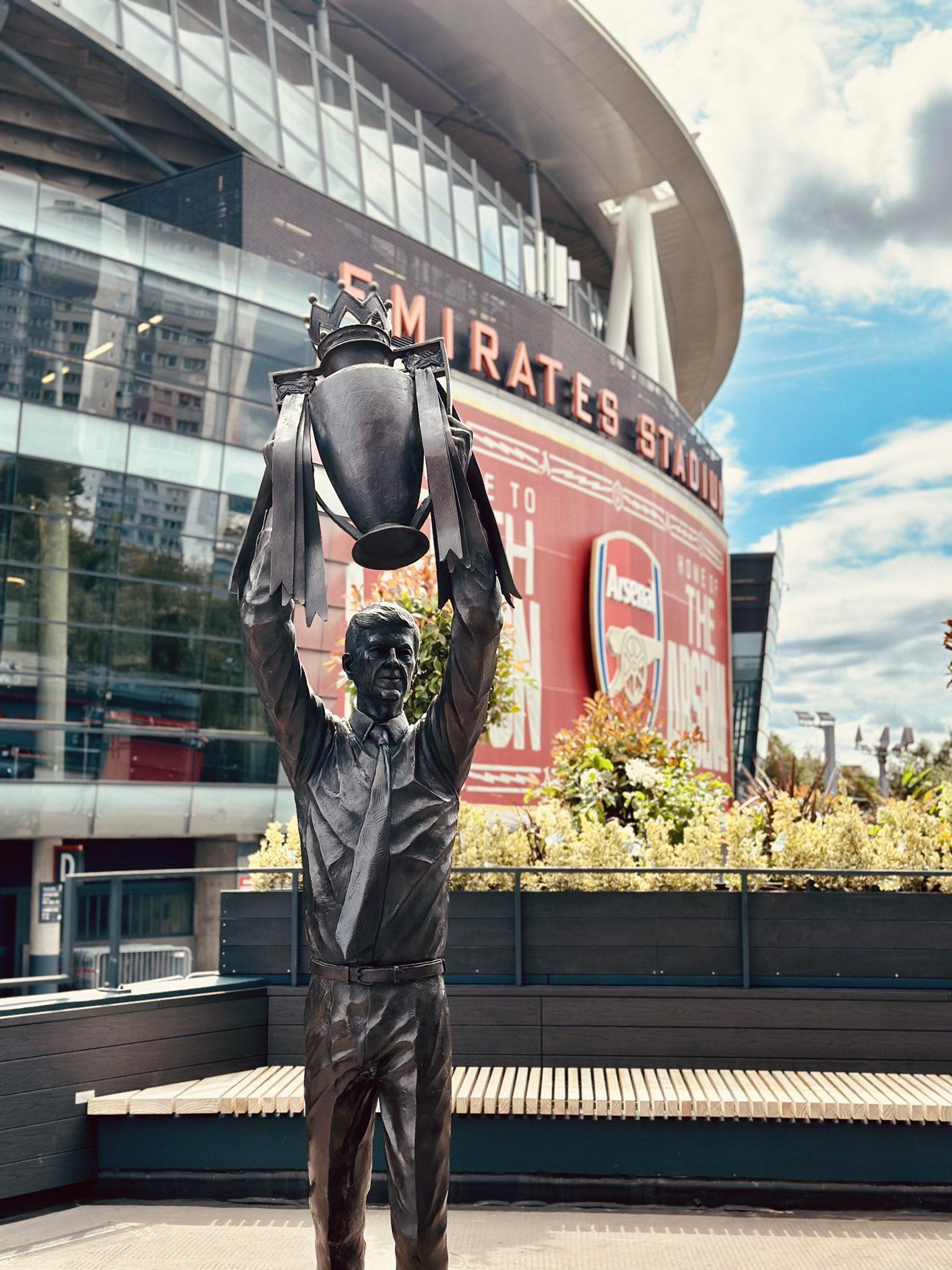
Arsenal’s visual identity has changed little in 140 years. The deep red, inherited from Nottingham Forest who donated the first jerseys to the Woolwich workers, has remained the dominant color since the beginning. The white sleeves, added in the 1930s by Chapman to distinguish Arsenal from other all-red clubs, have become one of the most recognizable signatures.
The cannon, an obvious symbol of Arsenal’s gunnery origins, has appeared on the club badge since 1888. The official motto, Victoria Concordia Crescit (victory grows through harmony), dates from 1949. The north of London, home since 1913, remains the club’s beating heart, despite a global fanbase that now rivals those of the biggest clubs.
Arsenal is now valued at around $3.4 billion, making it the eighth most valuable club in the world. A remarkable financial performance for an institution born in an armaments factory 140 years ago, and one that has never benefited from massive state funding or petrodollars like its direct rivals.
What to remember
- Arsenal was founded in October 1886 under the name Dial Square by workers at the Royal Arsenal in Woolwich, in southeast London.
- The club became Woolwich Arsenal in 1891, and Arsenal Football Club in 1914 after moving to Highbury in 1913.
- Herbert Chapman (1925-1934) won 5 league titles in the 1930s and introduced the jersey number, floodlights, and the WM system.
- Arsène Wenger led the club from 1996 to 2018, winning 3 Premier Leagues (1998, 2002, 2004) and 7 FA Cups.
- The 2003-2004 Invincibles finished the Premier League season without any defeat (26 wins, 12 draws, 0 losses).
- Arsenal moved to Emirates Stadium (60,704 seats) in summer 2006, leaving Highbury after 93 years.
- The club holds the record for most FA Cups in England with 14 trophies and has 13 league titles.
To go further
To explore other sides of the Arsenal universe, we recommend our pieces on the invincible 2003-2004 season, on Thierry Henry’s career, and on the story of their biggest rival, Tottenham. Our ranking of the best Premier League jerseys also revisits the iconic kits worn by the Gunners since 1990.
Frequently asked questions
When was Arsenal FC founded?
Arsenal was founded in October 1886 under the name Dial Square by workers from the Royal Arsenal in Woolwich. It was renamed Royal Arsenal in January 1887, then Woolwich Arsenal in 1891, and finally Arsenal Football Club in 1914.
Why is Arsenal called the Gunners?
The nickname Gunners (cannon men) comes from the club’s origins: the founders were workers at the Royal Arsenal in Woolwich, an armaments factory that manufactured, among other things, cannons for the British Crown. The cannon has been on the badge since 1888.
Why did Arsenal move to Highbury?
In 1913, owner Henry Norris decided to move the club from Woolwich to the Highbury area, in north London, for financial reasons. Woolwich was too far from the center, the fan base too limited, and the revenue not enough to sustain the club.
How many league titles has Arsenal won?
Arsenal has won 13 English league titles. Five were won under Herbert Chapman in the 1930s (1931, 1933, 1934, 1935, 1938), three under Arsène Wenger (1998, 2002, 2004), and the others between 1948 and 1991.
Who are Arsenal’s Invincibles?
The Invincibles refers to the Arsenal team that won the 2003-2004 Premier League season without a single defeat (26 wins, 12 draws, 0 losses in 38 matches). It is the only team to have achieved this since Preston North End in 1888-1889.
Want the Arsenal jersey in your collection?
Our store offers the Arsenal home, away, and third jerseys from the current season, as well as a selection of retro jerseys, including the iconic kits from the Wenger era and the 2003-2004 Invincibles.