
May 2024, the last matchday of La Liga. Girona FC, a modest Catalan club from a city of around 100,000 people, secured a historic third-place finish in the Spanish league. It finished ahead of FC Barcelona, Atlético Madrid and Sevilla FC. It earned direct qualification for the 2024-2025 Champions League, the club’s first-ever European appearance, 94 years after it was founded. It took almost a century to achieve this milestone.
The story of Girona FC is like an improbable fairy tale. A small club from Girona that spent most of its history in the lower Spanish divisions, first reached La Liga in 2017, was relegated in 2019, promoted again in 2022, and then exploded onto the scene in 2023-2024. This article traces this unique journey, from the 1930 foundation to the 2024 La Liga sensation, including the arrival of the City Football Group.
1930: the founding in Girona
Girona Futbol Club was founded on July 23, 1930 in Girona, a mid-sized city in Catalonia located about 100 kilometers northeast of Barcelona. The club was founded at a time when Catalan football was on the rise, while FC Barcelona already dominated the regional football scene and many secondary cities wanted their own football representative.
The colors adopted from the beginning were red and white in vertical stripes. This was a choice that evokes the traditional colors of Catalonia without copying Barcelona’s blue-and-maroon palette. The nickname “Blanc-i-Vermells” (white and red in Catalan) naturally became the team’s unofficial name.
The club’s Catalan identity has been central from the start. Girona, the capital of its namesake province, strongly claims its Catalan roots, with its own language (Catalan), traditions, and culture. The club is part of this regional identity dynamic, without the institutional scale of the Barcelona giant.
Decades in the lower divisions
Girona’s history before 2017 is mainly that of a club playing in Spain’s lower divisions: Tercera División (3rd division), Segunda División B (equivalent to 3rd or 4th tier depending on the period), with a few spells in Segunda División (2nd division). No top-flight appearances for more than 80 years.
This stability in the lower half was explained by the economic constraints of a mid-sized city, which has neither the commercial appeal of Barcelona nor the population base of other Catalan clubs. Girona then had very modest budgets, limited facilities, and sporting goals focused mainly on survival in its division.
Several local coaches and players marked this long period without really entering the national football memory. Girona remained a local sporting institution, loved by its supporters, but without a reputation beyond Girona province. This anonymity changed dramatically from the 2010s.
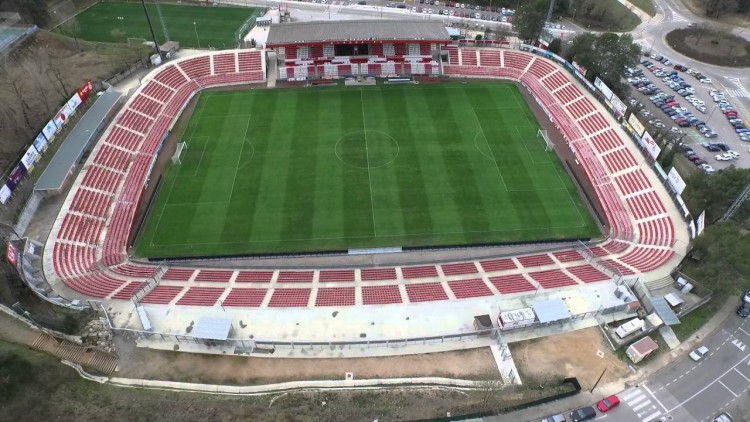
The Montilivi stadium, a modest venue
Girona’s stadium is Estadi Montilivi, located on the southeast edge of the city. It opened in 1970 and has only had partial expansions since. Its current capacity is about 14,624 seats, making it one of the smallest venues in La Liga during seasons when the club is in the top tier.
This compact venue has become a key part of Girona’s identity. Hosting Real Madrid, FC Barcelona or Atlético Madrid in a close-to-the-field, bubbling atmosphere is a completely different experience from giant cathedrals like the Bernabéu or Camp Nou. Several visiting coaches have acknowledged the difficulty of playing at Montilivi.
A stadium expansion project is under way to support the club’s sporting growth, but urban and budget constraints limit how much can be done. Girona therefore continues to use its intimate atmosphere to give the heavyweights of La Liga trouble, which contributes to its reputation as a difficult team to beat at home.
2017: the first historic promotion to La Liga
The 2016-2017 season marks the first big chapter in the club’s history. Under Pablo Machín, Girona finished 2nd in Segunda División and gained promotion to La Liga for the first time in its history. A historic rise celebrated as a major event throughout Girona province, after 87 years of waiting.
The first season in the top flight (2017-2018) surpassed all expectations. The club finished 10th, posting remarkable results such as a home win over Real Madrid (2-1) in October 2017, in a Montilivi in full frenzy. Cristhian Stuani, the Uruguayan striker, became the face of Girona and scored 21 La Liga goals that season.
This successful integration into La Liga immediately attracted the attention of European football. Girona became a model case: a small club that organized itself, relied on smart signings (often on loan from bigger clubs), and managed to exist in a league very much dominated by the top clubs. Its path was praised at the highest levels of world football.
The arrival of the City Football Group
In August 2017, just before the start of that historic La Liga season, the club’s ownership changed hands. The City Football Group (CFG), the group that owns Manchester City and several other clubs around the world, acquired 44.3% of the shares, while Pere Guardiola (Pep Guardiola’s brother) obtained 44.3% as well through his company Media Base Sports. The rest remains with longtime socios.
This arrival of CFG, then led by Khaldoon Al Mubarak with Manchester City as a flagship, changed the club’s institutional dimension. Girona became part of a global ecosystem that also includes New York City FC, Melbourne City, Yokohama F. Marinos, Mumbai City and several other teams. The goal was to create a network of clubs sharing methods, data and talent.
This integration was not without controversy. Longtime supporters feared a loss of identity, and UEFA even prevented Girona from playing in the 2024-2025 Champions League at the same time as Manchester City without specific safeguards linked to multi-club ownership. But from a sporting perspective, the addition of modern professional methods clearly helped the recent rise.

Relegation in 2019 and promotion in 2022 via the playoffs
Girona’s rise was not all smooth. At the end of the 2018-2019 season, the club was relegated to Segunda División after finishing 18th. A harsh setback after two seasons in La Liga, which forced the club to rebuild its sporting project at a lower level.
It took three seasons to return to the top flight. The comeback came in 2021-2022 via the playoffs, after a 6th-place finish in Segunda. Girona knocked out Eibar and then Tenerife in tense two-legged ties, with a return match at Montilivi sealing the club’s return to La Liga. Another public celebration in Girona.
This sporting and institutional resilience showed the club project, backed by CFG, is not dependent on a single level. Girona rebuilt methodically, and the second season back in La Liga (2023-2024) would see the team reach unexpected heights. For another club in full progression under different circumstances, our article on Celta Vigo highlights another regional Spanish path.
The Míchel era and positive football
The arrival of Míchel Sánchez Muñoz as manager in July 2021 (initially in Segunda) marked a turning point. This former Spanish attacking midfielder, trained at Rayo Vallecano, preaches attacking football based on possession, high pressing and risk-taking. It was a bold philosophy for a club with limited resources, and it proved to be effective.
Under Míchel, Girona produced some of the most attractive football in La Liga in certain seasons. Smart recruitments (Aleix García in midfield, Tsygankov from Ukraine, Savinho on loan from CFG, Yangel Herrera in defensive midfield, Artem Dovbyk up front), bold tactics and collective chemistry transformed a theoretically modest squad into a formidable team.
The coach managed to stay true to his convictions despite occasional poor performances, and his credit with players and management only grew. It is a coaching case now inspiring other European clubs looking to balance game identity and sporting results.
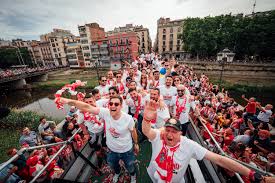
2023-2024: the historic third-place finish
The 2023-2024 season goes straight into the club’s legend. Girona finished 3rd in La Liga, behind Real Madrid (champion) and FC Barcelona, ahead of Atlético Madrid. With 81 points, the Catalan club recorded the best season in its history and secured direct qualification for the 2024-2025 Champions League, the club’s first European participation.
Many were the architects of that performance: Artem Dovbyk, Ukrainian forward signed from Dnipro, who finished as La Liga top scorer with 24 goals; Aleix García, technical midfield leader; Cristhian Stuani, loyal veteran captain; Savinho, Brazilian winger on loan from Troyes (another CFG club); and Tsygankov and Yangel Herrera. Collective chemistry made the difference.
Participation in the 2024-2025 Champions League remains a historic moment, despite the early exit. Girona played at Montilivi against giants like AC Milan, PSV Eindhoven and Liverpool, proving that a small Catalan club could compete among the continental elite. For more on other recent La Liga achievements, our article on Atlético Madrid tells the story of the last team to shake up the Real-Barça duopoly.
What to remember
- Girona Futbol Club was founded on July 23, 1930 in Girona, a Catalan city of around 100,000 residents, about 100 km northeast of Barcelona.
- Before its first promotion to La Liga in 2017, the club spent most of its history in Spain’s lower divisions.
- In August 2017, the City Football Group (owner of Manchester City) acquired 44.3% of the club, becoming the main shareholder alongside Media Base Sports (Pere Guardiola).
- Montilivi Stadium, opened in 1970, holds about 14,624 spectators, making it one of the smallest stadiums in La Liga.
- Relegation to Segunda División in 2019, and a return to La Liga via the playoffs in 2022.
- Under Míchel, coach since 2021, the club finished 3rd in La Liga 2023-2024 (81 points), earning its first historic European qualification.
- Artem Dovbyk finished as La Liga top scorer in 2023-2024 with 24 goals, contributing heavily to the club’s collective achievement.
To go further
Girona’s story is inseparable from the new economic geography of European football. To dig deeper, we recommend our articles on Atlético Madrid, which also disrupted the Real-Barça duopoly, on Celta Vigo, another beautiful Spanish regional story, and on the best Liga jerseys, where Girona’s red-and-white appears in style.
Frequently asked questions
When was Girona FC founded?
Girona Futbol Club was founded on July 23, 1930 in Girona, a mid-sized city in Catalonia about 100 kilometers northeast of Barcelona. The club spent the vast majority of its history in lower divisions before its recent rise in La Liga.
Why is Girona FC linked to Manchester City?
Since August 2017, the City Football Group (CFG), owner of Manchester City and several other clubs around the world, has held 44.3% of Girona. Pere Guardiola (Pep’s brother) also holds 44.3% through Media Base Sports. This integration into a multi-club network has supported the club’s sporting rise.
What is Girona FC’s best La Liga performance?
The 2023-2024 season remains the club’s best performance: a final 3rd place in La Liga with 81 points, behind champion Real Madrid and FC Barcelona, ahead of Atlético Madrid. This position allowed Girona to earn its first historic qualification for the Champions League.
Where does Girona FC play?
Girona plays at Montilivi Stadium, located on the southeast edge of the city. Opened in 1970, it holds around 14,624 spectators, making it one of the smallest stadiums in La Liga. Its intimate atmosphere and close stands-to-pitch proximity make it a challenging venue for visitors.
Who is Girona FC’s coach?
Míchel Sánchez Muñoz has been Girona’s manager since July 2021. He guided the club from Segunda to La Liga through the playoffs in 2022, then achieved the historic 3rd-place finish in 2023-2024. His attacking, possession-based philosophy has transformed the club’s identity.
Keep the Blanc-i-Vermell sensation going
The complete Girona FC collection is in the store: home red-and-white striped jersey, away, third, player edition, fan edition, and retro jerseys that recall the club’s historic seasons.