
May 24, 2014, at the Estádio da Luz in Lisbon. For the first time in history, two clubs from the same city faced each other in the Champions League final: Real Madrid against Atlético Madrid. In the 36th minute, Diego Godín scored for the Colchoneros. The people’s Madrid club led 1-0 over the Bernabéu giant. Up to the 93rd minute. Sergio Ramos equalized with a header from a corner. Real won 4-1 after extra time. For Atlético supporters, it is one of the biggest traumas in club history.
The Madrid derby is this unique rivalry: an aristocratic club with 15 Champions Leagues versus a popular club that has never won one. Power versus people. The upscale Bernabéu neighborhood against the Metropolitano in east Madrid. This article traces 95 years of rivalry, from the first derby in 1929 to the two Champions League finals lost by Atlético in 2014 and 2016.
Origins: 1902 and 1903, two neighboring clubs
Madrid Football Club (future Real Madrid) was founded on March 6, 1902. Atlético Madrid came to life on April 26, 1903, one year apart, as the Madrid branch of Athletic Club Bilbao, founded by Basque students enrolled at the School of Mines of Madrid. The two clubs were therefore born almost at the same time, in a Spanish capital that was then rapidly developing.
During the first years, Madrid FC received the title “Real” from King Alfonso XIII in 1920, officially becoming Real Madrid Club de Fútbol. Atlético, on the other hand, legally emancipated from Bilbao in 1921 and adopted the bear and holm oak on its crest, a symbol of the city of Madrid, from 1917. The two clubs were then based in the same city, but their trajectories diverged quickly.
Real Madrid attracts the wealthier classes of the capital, supported by the royal court. Atlético became the club of popular neighborhoods, workers, and immigrants from the provinces. This social divide, which has widened over the decades, still structures today’s perception of the derby and largely explains the passion it generates.
1929: the first La Liga derby
La Liga was created for the 1928-1929 season. Real and Atlético faced each other for the first time in the league on February 17, 1929. Real Madrid won 2-1 at home. A few weeks later, on May 5, Real repeated with a 3-0 away win. The first derbies immediately set the Merengue-dominance dynamic that would characterize the whole history of the rivalry.
The historical context of the derby’s first decades is turbulent. The Spanish Civil War (1936-1939) destabilized both clubs, with Madrid being one of the main theaters of the conflict. The postwar Franco era (1939-1975) increased the perception of Real as a “club of the regime,” even if the historical reality was more nuanced (Atlético also had ties to power, and Barça as well).
The derby became a must-see date in La Liga. The two yearly meetings (home and away) are eagerly expected by supporters and often determine season summaries. Many Madrilenians consider that a successful season starts with two derby wins, regardless of final standings.
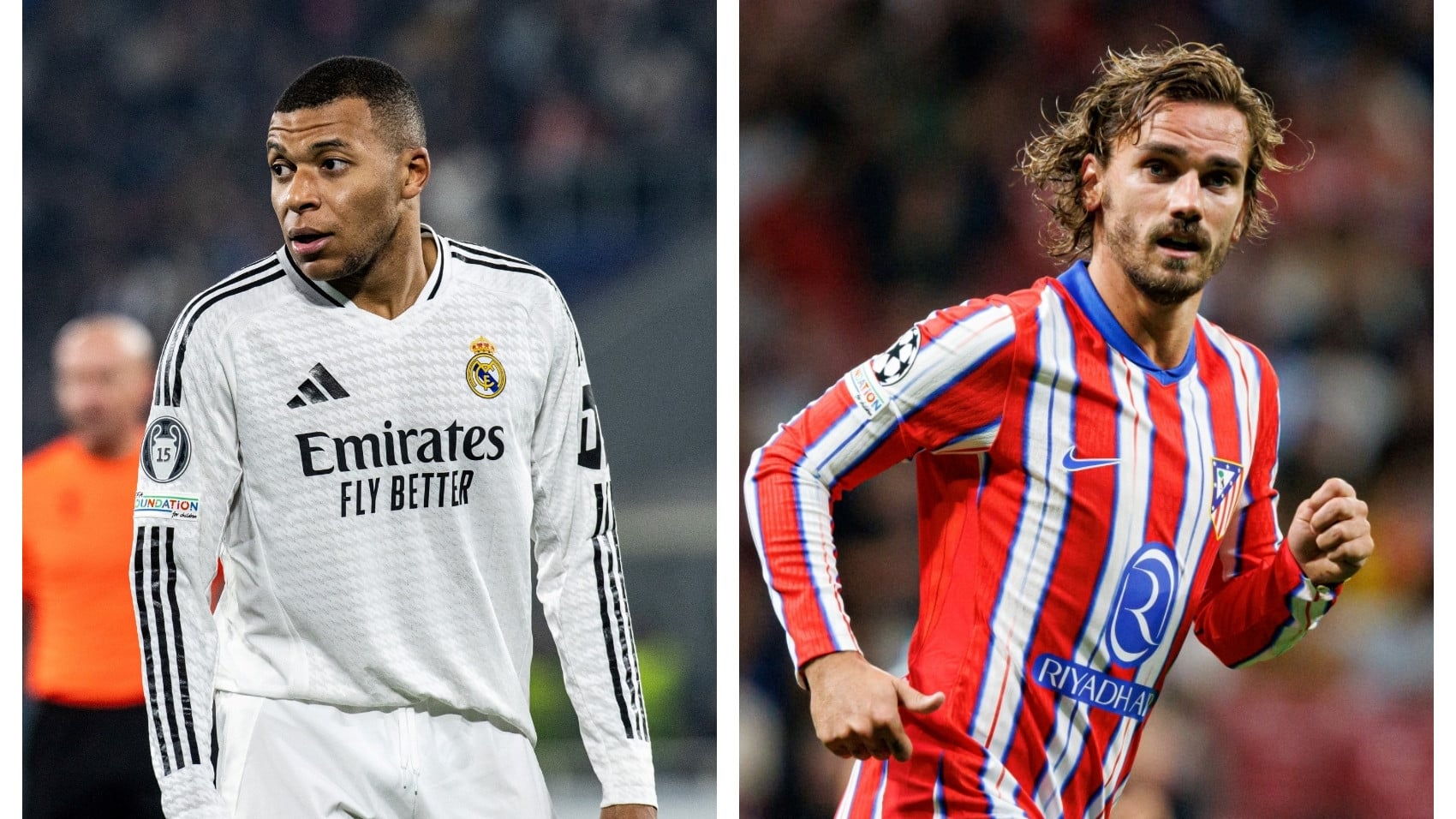
The historical tally in numbers
The overall historical La Liga head-to-head is clearly in favor of Real Madrid: in roughly 175 league matches played, Real has around 91 wins, 43 draws and 41 Atlético wins. In goals, Real has scored around 298 times, Atlético around 218.
This Merengue domination is explained by trophy and resource gaps. Real has won 36 La Liga titles, compared with 11 for Atlético. Real has 15 Champions Leagues, while Atlético has none. Financial gaps between the two clubs have been huge for years, although Atlético has narrowed part of the gap in the Diego Simeone era starting in 2011.
Across all competitions (La Liga, Copa del Rey, Supercops, European competitions), the record remains in Real’s favor, but Atlético has managed to rack up symbolic victories: the 2013 Copa del Rey, won 2-1 at the Santiago Bernabéu after extra time, and the 2014 Spanish Super Cup, Diego Simeone’s first trophy over Real. To explore Atlético in depth, our article on the history of Atlético Madrid details the key moments.
Power versus people
The social dimension of the Madrid derby is one of the most pronounced in world football. Real has long been seen as the club of the wealthy, the political and economic elite. Chamartín, where the Bernabéu stadium is located, is one of the capital’s most affluent areas. Several Spanish presidents (Adolfo Suárez, Felipe González, José María Aznar) were openly known as Real supporters.
Atlético, by contrast, has remained the sporting expression of Madrid’s popular neighborhoods. For decades, Vicente Calderón stadium, on the banks of the Manzanares, was home to supporters mainly from the south of the capital, from working-class districts such as Carabanchel, Usera, and Vallecas. The move to the Metropolitano in 2017 shifted the club geographically to east Madrid, but the popular identity remains intact.
This class divide should not be over-simplified: Real has fans in every social group, and Atlético also has them in middle- and upper-class circles. But the overall perception, fueled by chants and culture on both sides, remains that of a power-versus-people showdown. That is what makes the Madrid derby so distinctive in the European football landscape.
2014: the Lisbon Champions League final
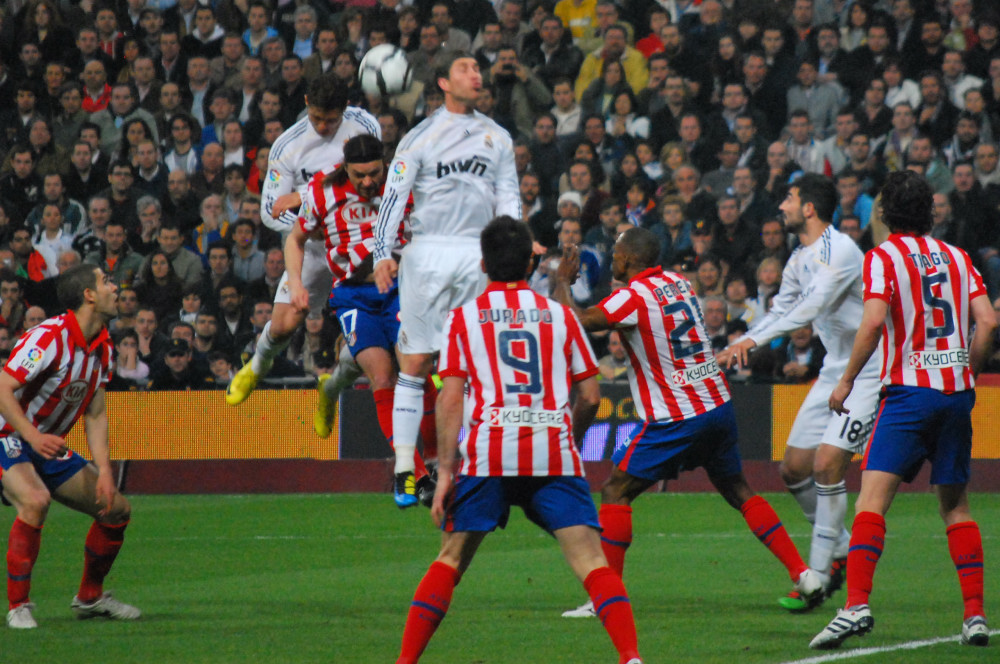
On May 24, 2014, in Lisbon, Real and Atlético faced each other in the Champions League final. It was the first C1 final between two clubs from the same city in history. Atlético, champion of La Liga only weeks earlier, was slight favorites after having played better throughout the season. The match started from this momentum: Diego Godín scored for the Colchoneros in the 36th minute after an Iker Casillas error.
For 56 minutes, Atlético held the 1-0 lead with authority. The historic dream seemed within reach. But in the 93rd minute, from a corner, Sergio Ramos came in and equalized with his head. A chill. In extra time, Real pulled away. Bale (110th), Marcelo (118th) and Cristiano Ronaldo (120+1, penalty) scored. Final score 4-1. Real Madrid won the tenth European Cup, its 10th European title.
For Atlético supporters, the trauma is immense. This match remains in memory as one of the most painful in club history, alongside the 1974 final lost to Bayern. The cruelty of the defeat, with only 30 seconds left in regulation time, still fuels debate among Colchoneros today.
2016: back to San Siro
Two years after Lisbon, it was off again. On May 28, 2016, in Milan’s San Siro, Real and Atlético faced each other again in the Champions League final. Atlético looked for revenge. Sergio Ramos opened the scoring for Real in the 15th minute. In the 79th, Yannick Carrasco equalized for Atlético. Time regulation and extra time finished 1-1.
Penalty shootout. Atlético played its modern history down that final stretch. Juanfran sent his attempt against the post. Cristiano Ronaldo scored the decisive penalty. Real Madrid won 5-3 on penalties and lifted its 11th Champions League title. For Atlético, it was the second consecutive C1 final defeat to the big rival. The wound opened in 2014 never healed; it worsened.
These two finals have become a reference point in derby history. They symbolize Atlético’s ability to compete with Real at the highest level, but also its recurring inability to finish in decisive moments against this particular rival. To understand the other side of the derby, our article on the full history of Real Madrid details the all-white dynasty.
La Liga 2013-2014, sealed at Camp Nou
A few weeks before the Lisbon final, on May 17, 2014, Atlético pulled off a historic feat anyway. On the last matchday of La Liga, the Colchoneros traveled to Camp Nou needing a draw to be crowned champions of Spain, edging Real Madrid and Barça.
Final score: 1-1, with a Diego Godín goal in the 49th minute. At the final whistle, Atlético lifted its first La Liga title since 1996. And, most importantly, it was the first La Liga title won by any club other than Real Madrid or FC Barcelona since 2004 (Valencia). Diego Simeone achieved the unthinkable: breaking the supposedly unbreakable Castilian-Catalan duopoly.
This La Liga season remains one of Atlético’s most beautiful moments and marks the peak of Cholismo. Six years later, in 2020-2021, Atlético repeated, winning a second La Liga under Simeone and confirming the durability of the project built since his arrival at the end of 2011. To explore La Liga more broadly, our ranking of the best jerseys of La Liga provides additional context on this competition.
The players who wore both jerseys
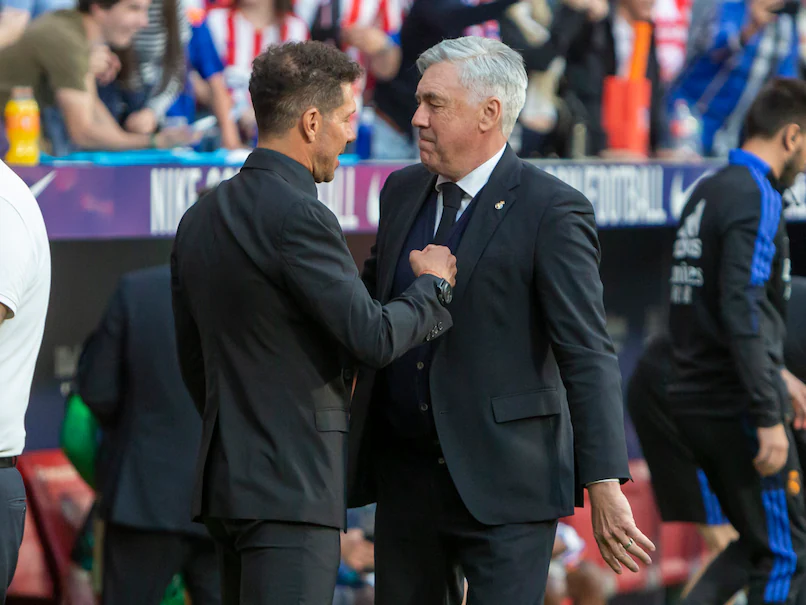
At least thirteen players at least have worn, at some point in their careers, the two Madrid jerseys, which remains rare given the rivalry’s intensity. Hugo Sánchez is the most iconic example: a star of Atlético in the 1980s (1981-1985), then of Real (1985-1992), where he became a five-time Pichichi (top La Liga scorer). His move between clubs marked derby history.
Bernd Schuster, a German midfielder, played for Real from 1988 to 1990, then for Atlético from 1990 to 1993. More recently, Álvaro Morata took the reverse path: trained at Real, then left and returned, and also wore Atlético’s jersey from 2019 to 2024. Thibaut Courtois, Real’s current goalkeeper, passed through Atlético from 2011 to 2014 (on loan from Chelsea).
These transfers between the two clubs are rarely calm. Supporters often see betrayal when a player changes camp. Hugo Sánchez was especially targeted after his move to Real in 1985. These generational hostilities are part of derby folklore and fuel its emotional charge. For a wider overview, our article on the Seville derby discusses the same issue of players who betrayed their colors.
Key takeaways
- Real Madrid (founded in 1902) and Atlético Madrid (founded in 1903) have coexisted in La Liga for 95 years.
- The first official La Liga derby took place on February 17, 1929, won 2-1 by Real Madrid at home.
- Historical La Liga head-to-head: about 175 matches played, 91 Real wins, 43 draws, 41 Atlético wins.
- First Champions League final between two clubs from the same city in 2014 in Lisbon, won by Real (4-1 a.e.t.).
- Second C1 final in 2016 at San Siro, won by Real on penalties (1-1, 5-3 on a penalty shootout).
- Atlético won La Liga 2013-2014 on the final day at Camp Nou (1-1 against Barça), ending 10 years of Real-Barça duopoly.
- Hugo Sánchez, Bernd Schuster, Álvaro Morata and Thibaut Courtois are among the few players who have worn both Madrid jerseys.
To go further
The history of the Madrid derby is inseparable from that of the Spanish capital. To explore the topic further, we recommend our articles on the full history of Real Madrid, on the history of Atlético Madrid, on the Seville derby (Betis-Sevilla) that shares the dimension of urban rivalry, and on the best jerseys in La Liga.
Frequently asked questions
When was the first Madrid derby in La Liga played?
The first official La Liga derby between Real Madrid and Atlético Madrid was played on February 17, 1929, in the first La Liga season. Real Madrid won 2-1 at home. The two clubs had already faced each other before in friendlies and the Copa del Rey.
What is the Madrid derby record?
In around 175 La Liga matches played, Real Madrid is clearly ahead with about 91 wins, versus 41 for Atlético and 43 draws. Real has scored roughly 298 goals, Atlético about 218. Across all competitions, Real remains comfortably ahead, despite a few symbolic victories by Atlético, such as the 2013 Copa del Rey at Bernabéu.
How many Champions League finals between Real and Atlético have taken place?
The two clubs have met in the Champions League final twice: in 2014 in Lisbon (Real 4-1 after extra time) and in 2016 in San Siro (1-1, then 5-3 on penalties for Real). These two finals remain traumatic moments for Atlético supporters.
Why do people talk about class rivalry in the Madrid derby?
Historically, Real Madrid has been seen as a club of the wealthy, backed by the royal court and then the political-economic elite. Atlético, on the other hand, remained the sporting expression of popular and working-class neighborhoods (Carabanchel, Usera, Vallecas). This social dimension, still palpable today, shapes how the derby is perceived and feeds its emotional power.
Which players have worn the jerseys of Real and Atlético?
At least thirteen players have made the move between the two clubs. The most famous are Hugo Sánchez (Atlético 1981-1985, then Real 1985-1992), Bernd Schuster (Real 1988-1990, then Atlético 1990-1993), Álvaro Morata (trained at Real, also played Atlético between 2019 and 2024) and Thibaut Courtois (Atlético 2011-2014 on loan, then Real since 2018).
Choose your Madrid side
Whether you back the white side or the Colchonero side, both collections are in the store: Real Madrid jerseys (home, away, third, player version, fan version, retro) and Atlético Madrid jerseys in all their variations.