
On November 6, 1887, in the parish hall of St. Mary’s Church in the Calton district of Glasgow, an Irish Marianist priest named Brother Walfrid gathered a few parishioners around a specific idea: to create a football club to raise funds to feed poor children in the East End. Celtic Football Club was born, with a charitable and community mission that would remain its founding principle. No other major European club has such an explicitly social origin.
One hundred and thirty-eight years later, Celtic has won 55 Scottish league titles, 42 Scottish Cups, and a historic European Cup in 1967, won by the Lisbon Lions—the first British team to be crowned European champions. This article traces the history of Celtic Glasgow, a club inextricably linked to the Irish and Catholic identity of the Scottish diaspora.
Brother Walfrid and the founding in 1887
To understand Celtic, we must look back at the context of Glasgow in the late 19th century. At that time, the city was home to a large Irish community, most of whom had arrived after the Great Famine of the 1840s. This diaspora, predominantly Catholic, lived in the poor neighborhoods of the East End, including Calton, and faced both economic hardship and religious discrimination in a Scotland that was then largely Protestant.
Brother Walfrid, whose real name was Andrew Kerins, was a Marianist priest from Ireland who had settled in Glasgow as a teacher. Witnessing the poverty affecting the children in his community, he conceived the idea of a soccer club that could raise funds for the “Poor Children’s Dinner Table,” a soup kitchen. On November 6, 1887, in the parish hall of St. Mary’s Church in Calton, he officially founded Celtic Football Club.
The name “Celtic” was a deliberately inclusive choice: it evokes both the Irish and Scottish Celtic heritage, reflecting a desire to unite the two communities. The first official match took place on May 28, 1888, against Rangers—already a symbolic rival—and Celtic won 5–2. The Old Firm rivalry was born on the very day of the club’s first match.
The club’s Irish and Catholic identity
From its earliest years, Celtic established itself as the club of Glasgow’s Irish and Catholic community—and, more broadly, of Scotland. This identity is visually reflected in the green and white colors, the Irish flag that regularly flies at Celtic Park, and a repertoire of songs steeped in references to Ireland, its history, and its nationalist struggles.
This religious aspect has never been an official recruitment policy: the club welcomed Protestant and non-Catholic players from very early on, unlike its rival, the Rangers, who maintained a strict Protestant recruitment policy for many years before changing course in the 1980s. Celtic has thus historically presented itself as a club with a Catholic identity without being exclusively Catholic—an important distinction for understanding its position.
This identity remains alive today. Many fans take pride in their Irish heritage, and the ties between the Celtic community and Ireland are maintained, even though the club does not officially take a stance on political or religious issues. It is this cultural uniqueness that makes Celtic a special case in European soccer.
Celtic Park, a fan's paradise
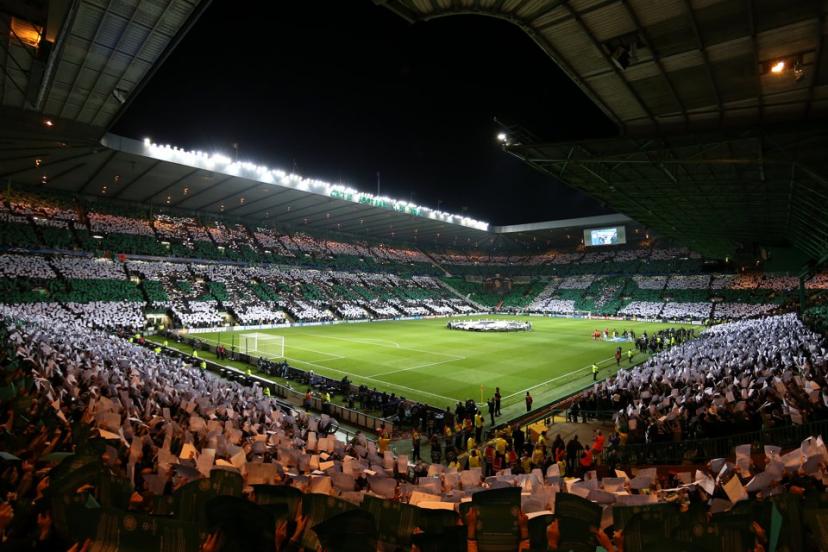
Celtic plays its home games at Celtic Park, located in the Parkhead neighborhood of Glasgow. The current stadium, which has been in use at this site since 1892 (in two successive versions, the last of which was completely rebuilt in the 1990s), has a capacity of 60,411. It is the largest football stadium in Scotland and the eighth-largest stadium in the United Kingdom.
Nicknamed “Paradise” by its fans, Celtic Park is renowned for its atmosphere during major European matches and Old Firm derbies. The traditional chants, the wall of tifos in the North Stand (the North Curve, led by the Green Brigade), and the ever-present Irish flag make it a unique venue. Several opposing players who have visited Celtic Park, including Lionel Messi in 2008 and again in 2012, have publicly acknowledged experiencing one of the most intense atmospheres of their careers there.
The stadium is also adjacent to a club museum and facilities dedicated to the youth academy. For fans, going to Celtic Park is not just about enjoying a sporting event: it is an expression of community and cultural identity, a direct legacy of Brother Walfrid’s founding mission.
The Old Firm: The Rivalry with Rangers
It is impossible to talk about Celtic without mentioning its rivalry with Glasgow Rangers, founded in 1872. This rivalry, dubbed the Old Firm since the late 19th century, extends far beyond the realm of sports. It encompasses three dimensions: geographical (two clubs from the same city), sporting (both have largely dominated Scottish soccer for over a century), and identity-based (Celtic, representing an Irish Catholic identity on one side, and Rangers, representing a Protestant unionist identity on the other).
In terms of football, Celtic and Rangers have shared the overwhelming majority of Scottish titles since the Scottish League was founded in 1890. No other Scottish club has managed to establish itself as a lasting contender against this duopoly. Head-to-head matches draw crowds of up to 60,000 at Celtic Park or Ibrox Stadium and are regularly ranked among the greatest derbies in the world.
However, the religious and political dimensions of this rivalry have led to sectarian excesses and violent incidents over the decades. Both clubs, with the support of Scottish authorities, have implemented educational programs and disciplinary measures to curb discriminatory chants and behavior. While tensions are now better managed, the historical roots of the rivalry have not disappeared.
Jock Stein, the legendary coach
Celtic’s golden age is inextricably linked to one name: Jock Stein. A former player for the club and the first Protestant manager to lead Celtic, he was appointed in March 1965. His arrival immediately transformed the team. Stein instilled an attacking style of play based on high pressing, coordinated movement, and a reliance on local talent.
Under his leadership, Celtic won nine consecutive Scottish league titles between 1966 and 1974, a feat that tied the world record at the time. He also led the team to consecutive National Cup and League Cup titles. His management style was characterized by high daily standards, but also by an ability to foster a team spirit among players who had known each other since childhood, almost all of whom were from the Glasgow area.
Stein remained Celtic’s manager until 1978, winning a total of 25 major trophies. He then became manager of the Scottish national team, a position he held until his death in 1985, on the sidelines during a qualifying match against Wales in Cardiff. This tragic death cemented Stein’s almost mythical status in the collective memory of Scotland and Celtic.
The Lisbon Lions: The 1967 European Campaign
The Stein era reached its peak on May 25, 1967, at the Estádio Nacional in Lisbon. Celtic faced Helenio Herrera’s Inter Milan, two-time defending European champions and the leading exponents of the Italian defensive catenaccio. In front of 45,000 spectators, the Italians opened the scoring in the 7th minute on a penalty kick converted by Sandro Mazzola. Everything seemed to be going according to the expected script: Celtic dominated by the Lombard defensive machine.
But Celtic refused to go along with that script. Under relentless pressure from the Scots, Inter cracked in the second half. Tommy Gemmell equalized with a powerful strike in the 63rd minute. Stevie Chalmers scored the winning goal in the 84th minute, off a cross from Bobby Murdoch. Final score: Celtic 2, Inter Milan 1. Celtic became the first British club to win the European Cup, ten years after Real Madrid’s first triumphs in the same competition.
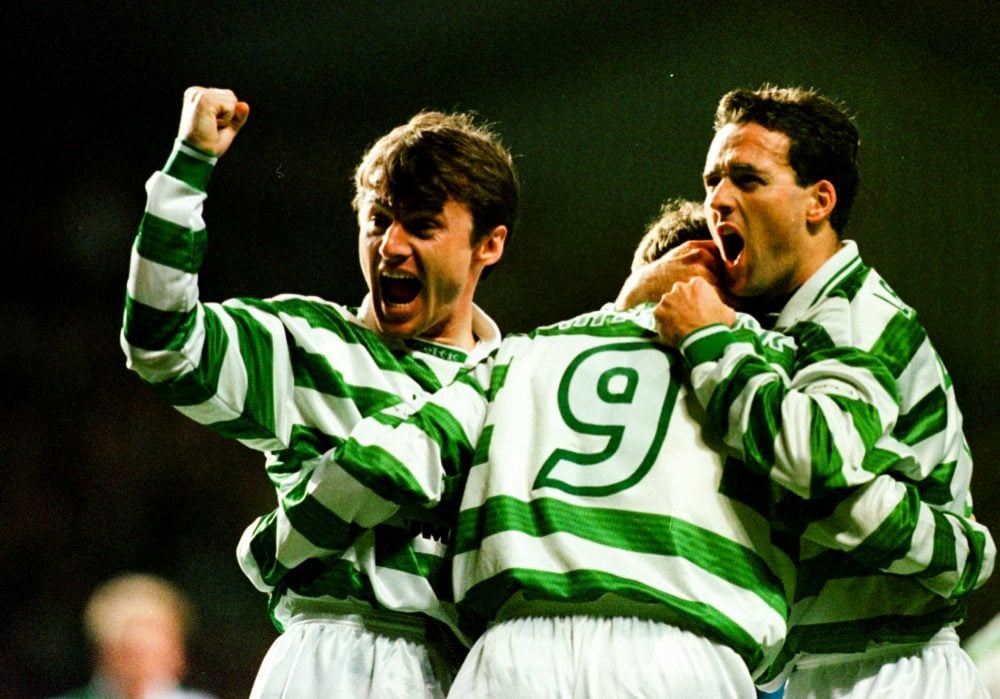
The starting lineup that day went down in history as the Lisbon Lions: Ronnie Simpson, Jim Craig, Tommy Gemmell, Bobby Murdoch, Billy McNeill (captain), John Clark, Jimmy Johnstone, Willie Wallace, Stevie Chalmers, Bertie Auld, and Bobby Lennox. A unique feature in the history of European soccer: all eleven players were born within a radius of less than fifty kilometers of Glasgow. No European champion team, before or since, has displayed such geographical homogeneity.
The 1966–67 season also remains the only one in which a club has won every competition it entered: the Scottish Championship, the Scottish Cup, the Scottish League Cup, the Glasgow Cup, and the European Cup. Five trophies—a feat known as the “Quintuple” and one that has never been matched since.
The Henrik Larsson Era and the Return to the Top
After a difficult period in the 1980s and 1990s, marked by Rangers’ dominance and financial problems that threatened the club’s survival, Celtic returned to form in the late 1990s. The arrival of Swedish striker Henrik Larsson in 1997 marked a turning point. In seven seasons wearing the green and white jersey, Larsson scored 242 goals, became the undisputed idol of Celtic Park, and led the club to the pinnacle of domestic and European success.
Under the management of Martin O’Neill and later Gordon Strachan, Celtic won several Scottish league titles in the early 2000s and reached the 2003 UEFA Cup final in Seville, which they lost 3–2 in extra time to FC Porto. Nearly 80,000 Celtic fans made the trip to Andalusia for what remains one of the largest gatherings of fans in the history of a European final.
More recently, Brendan Rodgers’ tenure as manager from 2016 to 2019 marked a new domestic peak. During the 2016–17 season, Celtic amassed 106 league points without losing a single match, becoming the first Scottish club since Rangers in 1899 to finish a top-flight season undefeated. The club also won several consecutive trebles (league title, Scottish Cup, League Cup), cementing its dominance in Scottish football.
Celtic Today: Legacy and Dominance
Celtic Glasgow boasts an impressive list of achievements: 55 Scottish league titles (a shared record), 42 Scottish Cups (an all-time record), and 22 Scottish League Cups. The club won its 55th title during the 2024–25 season, extending a near-uninterrupted reign of dominance that began in the 1990s. On the European stage, however, the challenge remains: the limited financial competitiveness of the Scottish league prevents Celtic from sustaining a long-term rivalry with the top clubs in the five major leagues.
The club nevertheless retains its global appeal. The Celtic diaspora, present in Ireland, the United States, Canada, and Australia, ensures the club enjoys a level of international support that is rare for a Scottish team. Fans travel in droves to European matches, carrying on the tradition of the green-and-white army that followed the Lisbon Lions across Europe back in 1967.
To explore other European clubs with a rich history, check out our article on Real Madrid’s 120th anniversary or our feature on Johan Cruyff at FC Barcelona. And the Celtic Glasgow collection in our store lets you experience the green-and-white-striped look that has been part of the club since its inception.
Key Takeaways
- Celtic Football Club was founded on November 6, 1887, by Brother Walfrid, an Irish Marianist priest, in the Calton district of Glasgow.
- Its original mission was charitable: to raise funds to feed poor children in the Irish Catholic community of the East End.
- Celtic plays at Celtic Park (capacity: 60,411), nicknamed "Paradise" by its fans, which is Scotland's largest soccer stadium.
- The Old Firm match against the Glasgow Rangers is one of the oldest and most intense derbies in the world, with a historical Catholic versus Protestant dimension.
- Under Jock Stein, Celtic won nine consecutive Scottish league titles between 1966 and 1974.
- On May 25, 1967, the Lisbon Lions defeated Inter Milan 2–1 to become the first British team to win the European Cup: all eleven players were born in the Glasgow area.
- The club has won a total of 55 Scottish league titles, 42 Scottish Cups, and 22 League Cups, with its most recent league title coming in the 2024–25 season.
Learn more
Celtic’s history is a unique case in European soccer, blending a sense of community with sporting achievements. To place this club within the broader narrative of European soccer, we recommend our articles on the complete history of Real Madrid, which dominated Europe just before Celtic’s 1967 triumph; on Johan Cruyff at FC Barcelona, another key figure in European soccer of the 1970s; and on Cruyff’s “Dream Team” as coach at Barça, which extended the tactical revolution of the 1990s.
Frequently Asked Questions
When was Celtic Glasgow founded?
Celtic Football Club was officially founded on November 6, 1887, in the parish hall of St. Mary’s Church in the Calton district of Glasgow. The founder, Brother Walfrid, was an Irish Marianist priest who wanted to fund a soup kitchen for poor children in the Irish Catholic community.
Why is Celtic considered a Catholic club?
Celtic was founded to support Glasgow’s Irish Catholic community, which was severely affected by poverty in the late 19th century. This cultural and religious identity remains strong in the club’s values and among its supporters, even though there has never been an official recruitment criterion based on religion.
Who are the Lisbon Lions?
The Lisbon Lions were the eleven Celtic players who defeated Inter Milan 2–1 in the European Cup final on May 25, 1967, in Lisbon. All were born within a radius of less than fifty kilometers of Glasgow, a unique distinction in the history of any European champion team.
What is the Old Firm?
The Old Firm refers to the historic rivalry between Celtic Glasgow and Glasgow Rangers, two clubs from the same city. This rivalry combines sporting (both have dominated Scottish soccer since 1890), geographical (Glasgow), and identity-based (Catholic-Irish for Celtic, Protestant-Unionist for Rangers) dimensions.
How many titles has Celtic won?
Celtic has won 55 Scottish league titles (a shared record), 42 Scottish Cups (an all-time record), 22 Scottish League Cups, and one European Cup, won in 1967—for a total of 120 major trophies.
Celtic's green and white jersey is waiting for you
The Celtic Glasgow collection is available in our store: the home jersey with green and white stripes, the away jersey, the third kit, and, of course, the retro jerseys that pay homage to the club’s greatest seasons, from the Lisbon Lions to the Larsson era.