
In the early 1970s, the main rival of Bayern Munich was not Borussia Dortmund (then struggling) but Borussia Mönchengladbach. For eight seasons, two German clubs disputed nearly every national title: Bayern with Beckenbauer, Müller and Maier, and Die Fohlen (the Foals) of Mönchengladbach, the most glamorous Bundesliga side under coach Hennes Weisweiler. Five titles between 1970 and 1977, two UEFA Cups and a European Cup final: the pride of a small Rhineland city that held its ground against the giants of German football.
The history of Borussia Mönchengladbach is one of a blazing golden age followed by a slow but real decline. Since becoming a middle-sized Bundesliga club in the 1990s, Gladbach has carefully preserved the memory of its glorious years. This article retraces the unique journey where tactical audacity and elegant play mattered more than the trophy count.
1900: the founding and the youth
Borussia Verein für Leibesübungen 1900 was officially founded on August 1, 1900, in Mönchengladbach in western Germany, near the Dutch border. As with Borussia Dortmund, the name Borussia refers to Prussia (the Latinized form of Prussia). For decades, the club played in the Rhineland regional divisions without ever emerging as a reference point of German football.
The club was not included among the sixteen founders of the Bundesliga in 1963. It reached the top flight in 1965, alongside Bayern Munich, through a promotion that sealed the simultaneous arrival of the two future heavyweight rivals of the 1970s. This historical coincidence would weigh heavily on Gladbach’s identity: for a decade, the club and Bayern rose together to the top and met in every final or nearly every one.
Before this rise, Borussia Mönchengladbach was regarded as a third-tier national football club. Its transformation in just a few years into a European powerhouse remains one of the most unusual phenomena in post-war German football.
The Weisweiler era and the nickname Die Fohlen
The turning point has a name: Hennes Weisweiler. Appointed head coach in 1964, this Rhineland tactician applied a radical attacking philosophy based on possession, short passing, high pressing and technical boldness. At a time when German football promoted realism and defensive discipline, Weisweiler offered Gladbach a spectacular style, sometimes even reckless.
To embody this philosophy, the coach mainly relied on very young players trained at the club. This is what gave Mönchengladbach its mythic nickname: Die Fohlen, literally The Foals. The term appeared in the late 1960s in the press, fascinated by the extremely low average age of the team, its sprints from the dressing room like foals being released, and its carefree enthusiasm.
The nickname has remained. It symbolizes an identity the club still claims even sixty years later: joyful, daring football rooted in local youth development values and tactical courage. The club’s official logo and several current visual elements still use the colt silhouette as an identity totem.
Günter Netzer, the brilliant playmaker
At the heart of the team was an exceptional midfielder: Günter Netzer. Born in Mönchengladbach in 1944 and trained at the club, he became its international face. Long hair, relaxed demeanor, virtuoso technique, genius game vision: Netzer represented a new generation of players who broke with post-war austerity. He looked more like a rock star than a classic footballer.
With the national team, he was a starter in the semi-final of Euro 1972, considered one of the peaks of German football. He left Mönchengladbach in 1973 to join Real Madrid, opening the way to a transfer that surprised all of Europe and brought the Foals a record sum at the time. With Real he won two consecutive Liga titles and kept his icon status.
Netzer remains one of the greatest German midfielders of all time, alongside Beckenbauer, Matthäus and Schweinsteiger in historical rankings. After retirement, he became a very influential TV pundit in Germany and remained close to the Borussia Mönchengladbach institution even after his move to Madrid.
Five Bundesliga titles between 1970 and 1977
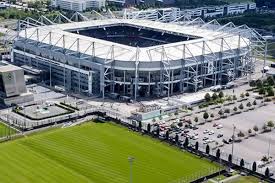
The sporting golden age spans from 1970 to 1977. During this period, Borussia Mönchengladbach won five Bundesliga titles: 1970, 1971, 1975, 1976 and 1977. The club became the first to capture three consecutive Bundesliga titles (1975, 1976, 1977), an achievement Bayern would match only in the early 1980s. The rivalry between the Foals and the Bavarians produced seasons of rare intensity, where each direct match could tilt the league.
This period also saw the rise of several talents who would shape German football history. Berti Vogts, right back then German national team coach (Euro 1996 champion), spent his entire career at Mönchengladbach (1965–1979). Jupp Heynckes, a prolific striker then coach and three-time Champions League winner (Real 1998, Bayern 2013), also wore the club jersey successfully.
The squad also included Wolfgang Kleff in goal, Rainer Bonhof in midfield (world champion 1974), Uli Stielike (future captain and national coach), Allan Simonsen and Jürgen Wegmann. It was an exceptionally technically gifted team that likely would have won more if it had not had to face Beckenbauer’s Bayern in the same decade.
Two UEFA Cups and a European final
On the European stage, Borussia Mönchengladbach won two UEFA Cups: 1975 (against Twente Enschede, 5-1 on aggregate) and 1979 (against Red Star Belgrade, 1-1, 1-0). The club also reached the European Cup final in 1977, losing 3-1 to Bob Paisley’s Liverpool in Rome. That final, played with a slightly weakened team due to injuries, remained the missed chance to join the exclusive club of European champions.
Mönchengladbach is also the German club that won a notorious “Coca-Cola bottle” incident in 1971, during a European Cup match against Inter Milan. A Coca-Cola cup thrown from the stands of Bökelbergstadion hit striker Roberto Boninsegna, who faked a serious injury. FIFA ordered a replay at a neutral stadium, and Gladbach was eliminated. The incident remains one of the best-known moments in European Cup history and has had a lasting impact on stadium safety in European football.
Beyond this regrettable episode, the Foals’ European record is impressive for a small-town club. The UEFA Cups of 1975 and 1979 placed Mönchengladbach among the continental benchmarks of the time, when the Bundesliga was shining across all of Europe.
Allan Simonsen, the 1977 Ballon d’Or winner
Danish striker Allan Simonsen, who arrived in 1972 from Vejle BK, became in 1977 the only Borussia Mönchengladbach player to have won the Ballon d’Or. He followed Franz Beckenbauer (winner in 1976) and preceded Kevin Keegan (1978). This honor crowned his outstanding season: Bundesliga champion, European Cup finalist, decisive performances for the Danish national team.
Simonsen stayed at Mönchengladbach until 1979, contributing to the second UEFA Cup, before joining FC Barcelona in a high-profile transfer. He remains one of Denmark’s greatest football names and later became coach of the Faroe Islands. His stint at Gladbach remains one of the brightest chapters in the club’s history.
In the individual honours list of Germans, Simonsen’s Ballon d’Or holds a special place. He is one of five Ballon d’Ors won by players featuring in the Bundesliga (alongside Beckenbauer, Rummenigge x2, Matthäus, Sammer). A rarity that shows how spectacular the 1970s were for the Foals.
From Bökelbergstadion to Borussia-Park
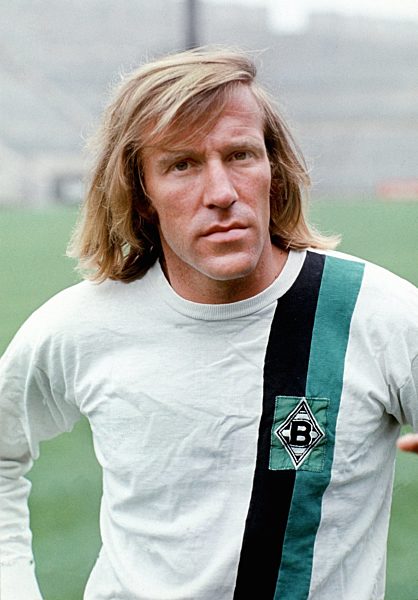
For 85 years, from 1919 to 2004, Borussia Mönchengladbach played at Bökelbergstadion, the iconic venue of the neighborhood with the same name in Mönchengladbach. The stadium, with a maximum capacity of around 40,000 (standing and seats), had one of the most distinctive layouts in Germany, with stands very close to the pitch and a family atmosphere typical of old grounds.
In 2004, the club moved to the brand-new Borussia-Park on the edge of town. The new stadium, more modern and larger (54,022 seats in league configuration), significantly increased matchday revenue. But for part of the supporters, it was also a break with a bygone era: Bökelbergstadion embodied the historic club, while Borussia-Park belongs to modern German football.
The relocation also coincided with a period of stabilization after several difficult years. The club, which had long oscillated between first and second division in the 1990s, regained a stronger footing from the 2000s, helped by increased income linked to the new stadium.
The gradual decline after the 1980s
Sporting decline started at the end of the 1970s. The successive departures of top players (Netzer in 1973, Heynckes retiring in 1978, Simonsen in 1979, Vogts also in 1979) weakened the squad. Coach Weisweiler left already in 1975 for Barcelona. Without its historical pillars, Borussia Mönchengladbach gradually slipped toward the Bundesliga’s mid-table weakness.
The club was even relegated to the second division in 1999, its only time outside the top tier since 1965. It spent two seasons there before returning in 2001. During the 2000s and 2010s, Gladbach moved between disappointing seasons and bright surprises, notably under Lucien Favre (coach from 2011 to 2015), who brought the club back to the Champions League for the first time in a long while.
More recently, under Marco Rose (2019-2021) and André Schubert, the club confirmed its place as a solid European-cup contender without coming close to the national title. A return to the top is still a distant goal, but the institution relies on a renowned academy and a loyal fan base.
The club today: between memory and rebuilding
Borussia Mönchengladbach has continued to play in the Bundesliga without interruption since 2008. Recent seasons have been mixed: European qualification in 2015, 2016, 2017 and 2020, followed by tougher periods with lower-half finishes. The team depends heavily on development cycles and its ability to keep top youngsters from being lured away by larger clubs.
The academy remains one of the most respected in Germany. Several internationals rose at Mönchengladbach before moving to stronger clubs: Marc-André ter Stegen (left for Barça in 2014), Granit Xhaka, Marco Reus (trained at the club before moving to Dortmund), Mahmoud Dahoud. The renewal process continues to work.
The club now represents a “mid-table” Bundesliga model: too small to aim for the title, too established to disappear, loyal to a style of play and management that sets it apart in the German landscape. The pride of having been the main rival of Bayern for a decade remains the glue of an extremely attached fan base. For another Bundesliga trajectory comparison, we also wrote an article on Bayern Munich and its 33 titles.
What to remember
- Borussia Mönchengladbach was founded on August 1, 1900 in Mönchengladbach, in Rhineland.
- Under Hennes Weisweiler, the club won five Bundesliga titles between 1970 and 1977.
- Nicknamed Die Fohlen (the Foals), it represented a generation of young players and bold football.
- Günter Netzer, a brilliant midfielder of the seventies, remains one of the club’s most defining figures.
- Allan Simonsen won the 1977 Ballon d’Or in club colors after an exceptional season.
- Two UEFA Cups won in 1975 and 1979, and a 1977 European Cup final lost to Liverpool.
- The club moved from Bökelbergstadion to Borussia-Park in 2004, with a current capacity of about 54,000 seats.
Learn more
To understand Gladbach’s historical rival, we wrote a full feature on Bayern Munich and its consecutive titles from 2013 to 2023. To explore another major Bundesliga figure from the 1970s and 1980s, our profile of Borussia Dortmund traces the path of the Yellow Wall and the 1997 Champions League. And to discover the colors and designs that shaped the German league, our top of the best Bundesliga jerseys is live.
Frequently Asked Questions
When was Borussia Mönchengladbach founded?
Borussia Verein für Leibesübungen 1900 Mönchengladbach was founded on August 1, 1900, in the Rhineland city of Mönchengladbach. The term Borussia comes from the Latin name of Prussia, a historic kingdom the region once belonged to.
Why is Mönchengladbach called Die Fohlen (the Foals)?
The nickname Die Fohlen appeared in the late 1960s, when the team coached by Hennes Weisweiler relied on very young players from the club’s youth system. The press compared them to foals bursting from the dressing room at full sprint, and the name was fully adopted.
How many Bundesliga titles has Borussia Mönchengladbach won?
The club has won five Bundesliga titles, all in the 1970s: 1970, 1971, 1975, 1976 and 1977. Three of them were won consecutively (1975-1976-1977), a feat that was then unprecedented.
Who are the biggest players in Gladbach history?
Among the historical figures: Günter Netzer (a brilliant midfielder of the seventies), Berti Vogts (fullback and future national coach), Jupp Heynckes (striker then coach and three-time Champions League winner), Allan Simonsen (Ballon d’Or 1977), Rainer Bonhof and Wolfgang Kleff. More recently, Marco Reus and Marc-André ter Stegen were both developed there.
What is the capacity of Borussia-Park?
Opened in 2004 to replace the old Bökelbergstadion, Borussia-Park hosts 54,022 spectators in Bundesliga configuration. It is one of the most appreciated modern stadiums in Germany for comfort and atmosphere.
The Gladbach collection is waiting for you
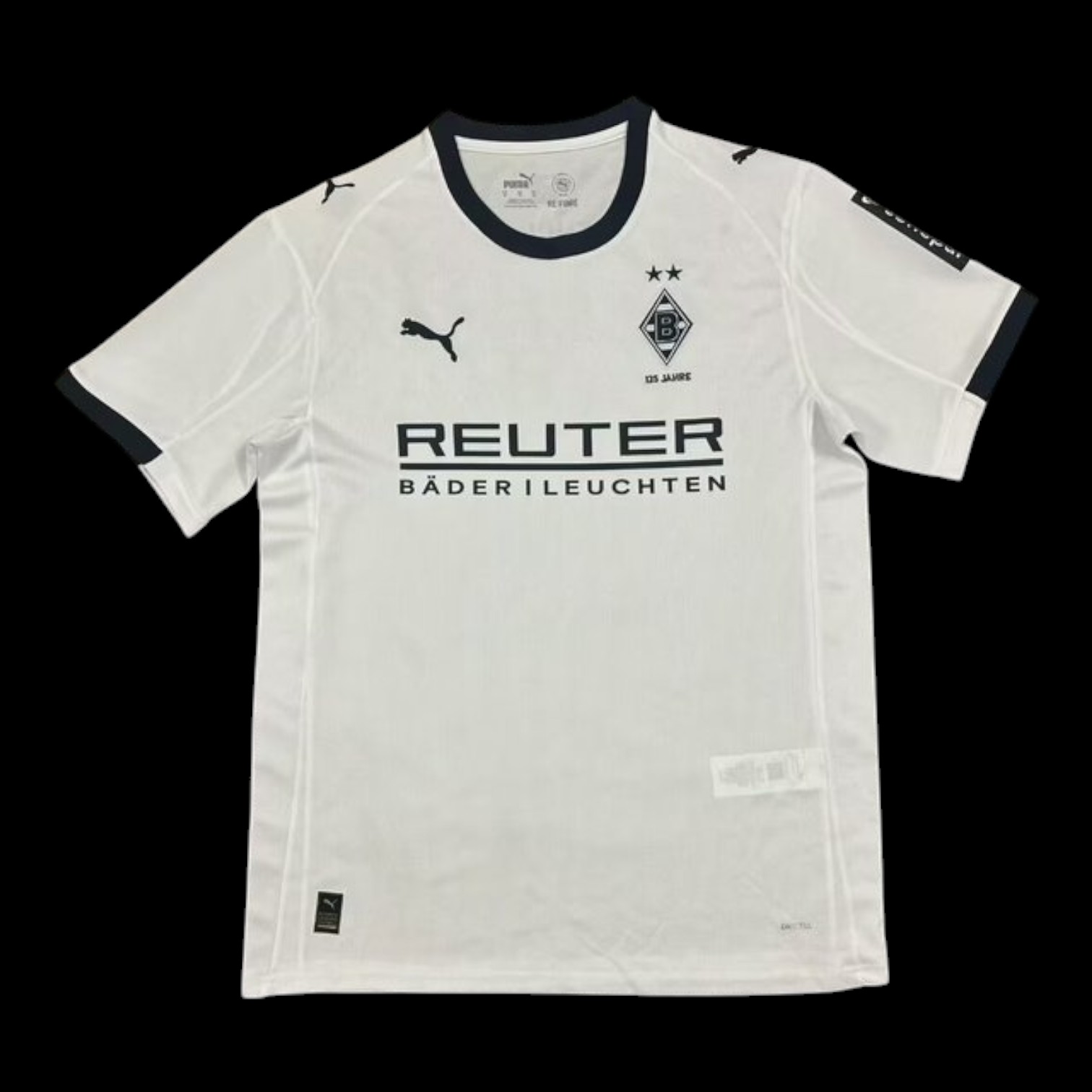
All Borussia Mönchengladbach jerseys are available: traditional home white-and-green, away, third, player version, supporter version, and retro jerseys that recall the dazzling Foals team.