
On May 4, 1904, in Gelsenkirchen, in the Ruhr mining basin, several young mining apprentices founded a football club and named it Westfalia Schalke. The name of the neighborhood (Schalke) and the year (04) eventually became the official name. More than a century later, FC Schalke 04 is still one of the most beloved institutions in German football, rich in its popular roots in the Westphalian working class, and carrying a record that makes it one of the country’s historic giants.
Schalke’s story is one of early brilliance (seven German titles between 1934 and 1958), a long sporting drought, a European revival in the 1990s, and then a fall in the 2020s that was just as quick as it was dramatic. Today in the second division, the club still draws over 60,000 spectators for each match and has more than 200,000 paying members. A wounded giant, but still a giant.
1904: the birth in the mining district
On May 4, 1904, several apprentices and young miners from the Schalke district in Gelsenkirchen founded a football club called Westfalia Schalke. The name changed several times during the first years (Turnverein Schalke, FC Schalke 04 v. 1904) before it settled on its current name in the 1920s. The royal blue color, which would become emblematic of the club, was then chosen in tribute to the uniforms of sailors in the German Imperial Navy.
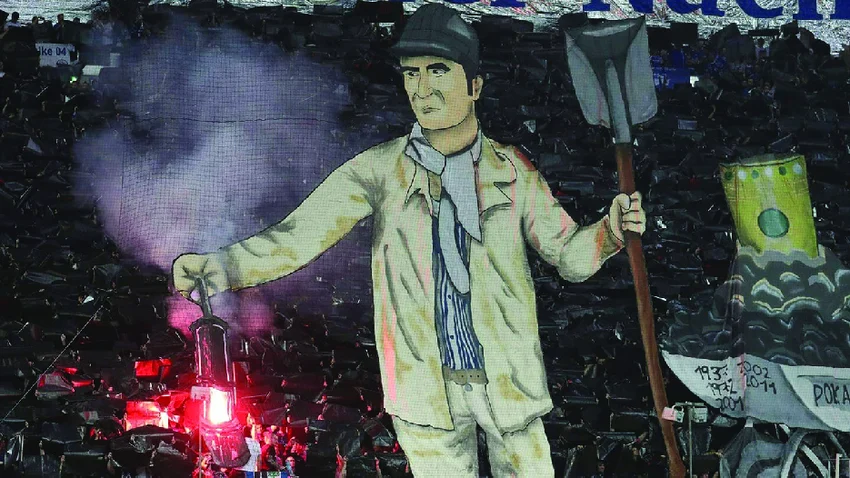
The club’s social roots were immediate. Schalke 04 was the club of the Ruhr miners, which is reflected in the nicknames that stick to it: “Die Knappen” (the apprentice miners) and “Die Königsblauen” (the royal blues). This working-class identity shaped the club throughout the 20th century and largely explains the massive popular loyalty it still generates today.
Over the decades, the club grew in a region where football was the main cultural outlet for heavy-industry workers. Going to the stadium on Saturdays was both entertainment, community pride, and a social time-out. Schalke inherited this passion, which it continues to cultivate even though the Ruhr coal mines have all closed since 2018.
The seven titles between 1934 and 1958
Schalke 04’s golden age stretched from the 1930s through the 1950s. The club won seven German league titles in that period: 1934, 1935, 1937, 1939, 1940, 1942 and 1958. No other German club has seen such dominance in the first half of the 20th century. The innovative system developed by the Schalkers even became famous as the “Schalker Kreisel” (the Schalke spinning top), a short and fast passing system that foreshadowed tiki-taka.
This period was led by players like Fritz Szepan and Ernst Kuzorra, two iconic pre-war German figures. Schalke then dominated the country with near-perfect regularity, benefiting from the huge human pool that industrial Ruhr represented. The club was also a powerful vehicle of regional identity in a turbulent historical context.
The 1958 title remains to this day Schalke’s last national title. Sixty-seven years without a new crown, even though the club has often hovered near the top spots. This historical frustration is now part of the club’s modern identity: the nostalgia of past greatness that has never been regained.
The first pass into the Bundesliga and the desert crossing
When the Bundesliga was founded in 1963, Schalke 04 was one of the sixteen founding clubs. But the following years were difficult: the club no longer took center stage, spent seasons in the middle of the table, and got bogged down in difficulties. In 1981, Schalke was even relegated to the 2. Bundesliga for the first time in its history. A humiliation for a club that had so far been synonymous with national prestige.
The club bounced between the top division and second division during the 1980s and early 1990s (relegation in 1983, return in 1984, relegated again, return in 1991). This period of sporting instability coincided with the major economic crisis in the Ruhr: the progressive closure of mines, deindustrialization, and massive unemployment. The region and its club went through this deep period of turbulence together.
But Schalke kept its popular base. Even in the second division, the club draws tens of thousands of spectators to the Parkstadion (its stadium since 1973). This loyalty from the public, never shaken even in the worst sporting moments, is one of the club’s defining traits.
1997: the Eurofighters and the UEFA Cup
The club’s European high point came in 1997, under Dutch coach Huub Stevens. Schalke 04 won the UEFA Cup that season, its only major European title. In the final, the club beat Inter Milan of Ivan Zamorano, Roberto Carlos and Youri Djorkaeff. First leg in Gelsenkirchen (1-0), return leg at San Siro (0-1), then a penalty shootout won 4-1 by the Germans.
This team entered legend as the “Eurofighters.” It included players like Andreas Müller, Marc Wilmots (the Belgian who later became the national team coach), Olaf Thon, Jiří Němec and Marc Wilmots. Not a star-studded team, but one with a rare collective mindset and relentless tactical discipline.
This victory still carries very strong sentimental resonance for supporters. For many, it is the happiest memory of their fan life, the moment Schalke proved it could still conquer Europe while the Bundesliga was slipping from it.
2001: Vier-Minuten-Meister, the title taken by Bayern
May 19, 2001 remains a date of mourning in Schalke’s collective memory. With one matchday left in the Bundesliga, Schalke 04 had to win its game and rely on a Bayern Munich loss or draw to clinch its first title since 1958. The club won its game against Unterhaching 5-3 at the Parkstadion. At the final whistle, supporters invaded the pitch, convinced they were champions because Bayern was down 1-0 in Hamburg.
But in the 90th minute of the Hamburg-Bayern match, Patrik Andersson equalized from a free kick in stoppage time and handed the title to the Munich club by four points after recalculation. Schalke was robbed of the title in the final four minutes after its own final whistle. That season gave the club the bitter nickname “Vier-Minuten-Meister” (champions for four minutes).
The episode has remained one of the most painful moments in Bundesliga history. Schalke kept the same team the next season but never came so close again to the national title. The club’s historical frustration gained a new symbol.
The Veltins-Arena, a modern jewel
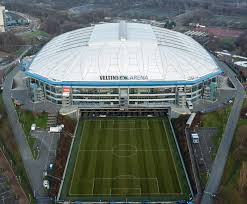
On August 13, 2001, Schalke 04 opened its new venue: Arena AufSchalke (renamed Veltins-Arena in 2005). The stadium, with a retractable roof and movable pitch, can host 62,271 spectators in league setup. It replaced the Parkstadion, which had served the club since 1973 and was demolished in 2008.
The Veltins-Arena quickly became one of the most modern stadiums in Europe. It hosted matches at the 2006 World Cup, including the memorable Argentina-Germany quarter-final, as well as the 2004 Champions League final (Porto-Monaco). During Euro 2024, the stadium also hosted several matches.
The initial stadium investment weakened the club’s finances, which accumulated significant debt over the decades. This financial burden became one of the structural handicaps during subsequent years of sporting crisis. But the Arena remains a major asset: capacity, comfort, and top-level European hosting quality.
The Rangnick era and the strong years 2000-2010
During the 2000s, Schalke 04 alternated between second places in the Bundesliga (2001, 2005, 2007), a Champions League semifinal (2011) and intense European campaigns. Several influential coaches came through the dugout: Huub Stevens (twice), Ralf Rangnick (also twice), Felix Magath, Jens Keller. The club remained regularly in the top 5 of the league, even though it no longer managed to win the national title.
Several top players wore the royal blue colors during this period. Klaas-Jan Huntelaar (Bundesliga top scorer in 2011-2012 with 29 goals), Manuel Neuer (developed at the club before moving to Bayern Munich in 2011), Mesut Özil (who left for Werder Bremen and then Real Madrid), Leon Goretzka, Joel Matip, Raúl (the Spanish star who joined from Real Madrid on a free transfer in 2010), Julian Draxler.
The 2010-2011 Champions League semifinal remains a summit. Schalke knocked out Inter Milan in the quarter-finals (5-2 on aggregate, including a huge 5-2 at San Siro) before falling to Manchester United in the semis (0-2, 1-4). Under Ralf Rangnick and then Felix Magath, the club was at its European best.
The 2020s collapse: relegations and crisis
The collapse began in 2018-2019 with a disappointing season. But it became a sharp drop in 2020-2021. Schalke 04 finished last in the Bundesliga with only 16 points after a run of 30 league matches without a win (including part of the previous season). Relegation to the 2. Bundesliga, the first since 1991, was confirmed in late April.
The causes are many. Poor financial management over several years (debt above 250 million euros), poor sporting choices (multiple coaching and sporting director changes), the heavy impact of Covid on revenue, and the split with Russian sponsor Gazprom in 2022 (after the Ukraine invasion) all weighed heavily. The club even came close to bankruptcy several times.
Schalke returned to the Bundesliga in 2022, but dropped back down the following season in 2023. Since then, the club has been back in the second division again, where it is trying to rebuild structurally. Sporting and financial management has been deeply reformed, and the priority is now to become competitive over the long term rather than forcing an immediate return at any cost.
The Revierderby against Dortmund
Schalke 04’s biggest rival is Borussia Dortmund, located only thirty kilometers to the south. The Ruhr Derby (Revierderby) is one of the most passionate fixtures in German football. More than 150 league meetings since 1925, unforgettable moments, and a football rivalry that transcends generations in the region.
The recent imbalance (Dortmund at the top, Schalke in the second division since 2023) has kept this fixture off the calendar for several seasons. For supporters, it is a major loss. The derby remains one of the strongest arguments for demanding the return of the Königsblauen to the top flight, and each season without the Revierderby makes Schalke’s sporting exile feel even heavier.
Beyond sporting rivalry, both clubs share a strong working-class identity rooted in the industrial Ruhr. But their economic trajectories have diverged sharply since the 1990s. Dortmund, now a publicly traded company, learned to negotiate football’s modernization. Schalke, faithful to a more associative model, paid a higher price for global football modernization.
What to remember
- FC Schalke 04 was founded on May 4, 1904 by young mining apprentices from the Schalke district in Gelsenkirchen.
- Nicknamed “Die Knappen” and “Die Königsblauen,” Schalkers dominated Germany between 1934 and 1958 with seven league championships.
- The 1997 UEFA Cup (the Eurofighters) remains the club’s only major European title, won against Inter Milan.
- In 2001, Schalke lost the Bundesliga title on a last-minute equalizer by Bayern in stoppage time, earning the nickname Vier-Minuten-Meister.
- The Veltins-Arena, opened in 2001, seats 62,271 spectators and features a retractable roof and a movable pitch.
- The club was relegated in 2021 and 2023, and accumulated debt that weakened its structure for years.
- The Revierderby against Borussia Dortmund remains one of the biggest rivalries in German football.
Go further
To learn more about Schalke 04’s historic rival in the Ruhr basin, we published a full feature on Borussia Dortmund and the yellow wall. To explore the club that dominated Germany during the last eleven seasons, our feature on Bayern Munich is online. And to discover the club that broke that dominance in 2024, our portrait of Bayer Leverkusen recounts Xabi Alonso’s unbeaten season.
Frequently asked questions
When was FC Schalke 04 founded?
FC Schalke 04 was founded on May 4, 1904 by young mining apprentices in the Schalke district of Gelsenkirchen in the Ruhr basin. The club name comes from the original neighborhood and the year of its founding.
How many German championship titles has Schalke won?
FC Schalke 04 won seven German league titles between 1934 and 1958: 1934, 1935, 1937, 1939, 1940, 1942 and 1958. No title has been won since 1958, which is over sixty-five years of waiting.
Why do people talk about the Eurofighters and the 1997 UEFA Cup?
The “Eurofighters” refers to the Schalke 04 team that won the 1996-1997 UEFA Cup against Inter Milan, coached by Huub Stevens. The nickname honors the collective spirit and fighting spirit of a team without superstars but with remarkable cohesion.
What is the capacity of the Veltins-Arena?
The Veltins-Arena, formerly Arena AufSchalke, holds 62,271 spectators in league setup. Opened in 2001, it has a retractable roof and a movable pitch. It hosted matches at the 2006 World Cup and Euro 2024.
Why does Schalke 04 play in the second division?
Schalke 04 was relegated to the 2. Bundesliga in 2021 and again in 2023 after several seasons of accumulated sporting and financial difficulty. The loss of Gazprom as a sponsor in 2022, the impact of Covid, and unstable sporting management largely explain this absence from the top flight.
Show your colors with the Königsblauen jersey
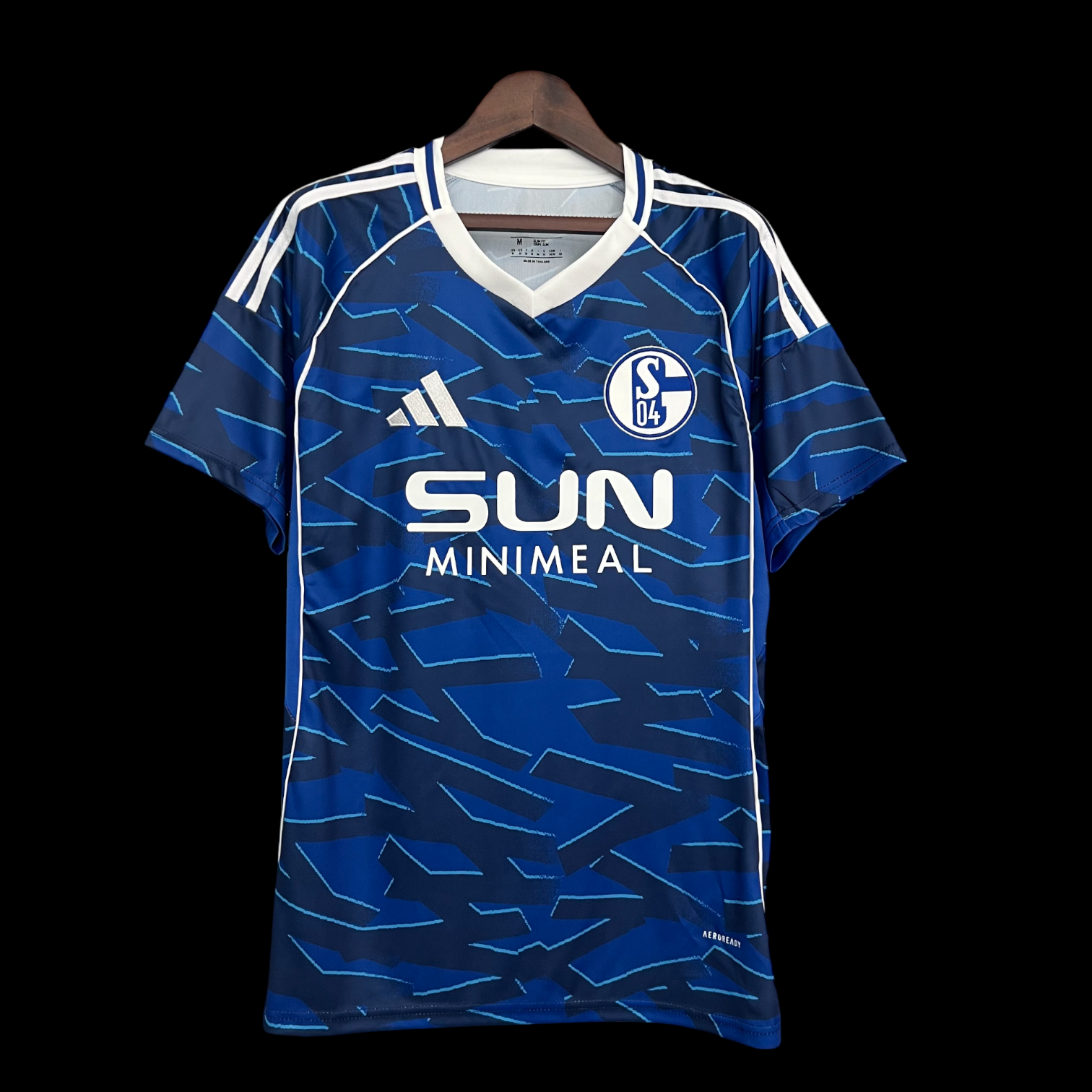
The Schalke 04 collection is complete in our store: iconic royal-blue home, away, third, player version, supporter version, and don’t forget the retro jerseys that accompanied the glory years of the Eurofighters and the great team of 2001.