
On April 26, 1903, a group of Basque students who came to Madrid to attend classes at the School of Mines founded a new football club. They called it Athletic Club de Madrid, in reference to their hometown Bilbao. One hundred and twenty years later, what began as a small provincial affiliate has become one of the most decorated clubs in Spain, with 11 La Liga titles, 10 Copa del Rey titles, three UEFA Europa Leagues and three UEFA Champions League finals on its record.
The story of Atlético Madrid is that of an institution that spent most of its existence in the shadow of neighboring Real Madrid, and eventually turned that position into a strength. This article retraces the major milestones of the rise of a club that became a symbol of working-class resistance in the Spanish capital, from the Vicente Calderón to the new Riyadh Air Metropolitano.
1903: Founded by Basque students
It all began with a small group of Basque students enrolled at the School of Mines in Madrid in the early twentieth century. Far from their native Bilbao, they decided to found a club that would be the Madrid branch of Athletic Club de Bilbao. On April 26, 1903, the founding act was signed. Among the founders were Ramón de Arancibia and the Gortázar brothers, who laid the first stone of what would become Atlético de Madrid.
The early years were modest. The club existed in the shadow of Madrid Football Club (future Real Madrid), founded one year earlier in 1902. For several decades, Athletic de Madrid remained legally tied to Bilbao before formally becoming independent in 1921. It was from that date that the club began to build its own identity, distinct from that of its Basque parent club.
In 1917, Atlético adopted the bear and holm oak on its crest, an ancient symbol of the city of Madrid. This detail matters: it marks the transformation of a provincial branch into a true Madrid club, deeply rooted in the capital.
Colchoneros: The origin of the red and white stripes
The club’s most famous nickname, Los Colchoneros (the mattress makers), was born in the 1920s. At that time, Spanish mattresses were made from red-and-white striped fabric, exactly like Atlético jerseys. Supporters and journalists began using the term mockingly before it became a badge of pride.
The red and white were inherited directly from Bilbao. But the colors of the shorts and socks, blue, remind of the club’s attachment to the capital. This red, white and blue combination is an integral part of the club’s visual identity and has hardly changed in one hundred and twenty years, which is rare in modern football.
In the 1970s, another nickname appeared: Los Indios. It came from the large number of South American players recruited by the club at the time, when Atlético stood out for its unusual strategy of bringing in talent from Argentina, Uruguay, and Brazil while most other European teams remained focused on their own continent.
The Luis Aragonés era and early glories
If Real Madrid dominated Spain in the 1950s and 1960s, Atlético started to collect titles. The club won its first La Liga in 1940, then added several league titles in the following decades. But it was especially the arrival of Luis Aragonés, first as an iconic player and then as a coach, that marked the club’s real rise.
Aragonés was linked to Atlético for more than forty years, first as a player from 1964 to 1974, then on the bench several times. He led the club to the 1974 European Cup final, lost cruelly to Bayern Munich after extra time (1-1, then 4-0 in the replay two days later in Brussels). That final remains one of the biggest traumas in the club’s history, but also proof that it could reach the top of European football.
To console itself, Atlético won the Intercontinental Cup in 1974, with Bayern declining the invitation to face Argentine Independiente. The club also won the European Cup Winners’ Cup in 1962 against Fiorentina, as well as several La Liga titles (1966, 1970, 1973, 1977) that cemented its status as the second force in Spanish football behind Real Madrid.
The 1996 La Liga-Copa del Rey double under Antic
The 1990s started in difficult conditions for Atlético, but 1996 remains a standout season. Under the guidance of Serb Radomir Antic, and with a squad led by Diego Simeone, Kiko, Pantić and Bulgarian forward Penev, the club completed the La Liga plus Copa del Rey double. It was a major feat, as Real and Barça nearly always monopolized domestic trophies.
This triumph is still engraved in fans’ collective memory as one of the club’s most beautiful moments before the modern era. The Ultras, gathered in Frente Atlético, gave Vicente Calderón a fully electric atmosphere all season long. The club confirmed then that it can still, at regular intervals, break the Castilian-plus-Catalan duopoly.
Atlético had also played the 1974 European Cup final (lost to Bayern) long before its two modern finals against Real Madrid. The club had for years stayed a hair’s breadth away from the continental summit without ever reaching it, fueling the frustration and resistance culture that still defines the Colchoneros today.
Relegation to second division in 2000
Only four years after the historic double, Atlético suffered the darkest moment in its history. At the end of the 1999-2000 season, the club was relegated to the Segunda División after a catastrophic sporting and institutional year. At the time, club president Jesús Gil, eccentric and controversial, handed over a club damaged by financial and legal problems.
Atlético spent two seasons in the second division, which seemed unimaginable for a club of this stature. The return to the top tier came in 2002, but it took several years before the club recovered coherent football and a stable project. This desert crossing remains a marker in Colchoneros history, both trauma and catharsis.
The return to the top table was built slowly, under Enrique Cerezo’s presidency and with Miguel Ángel Gil Marín as general manager, Jesús Gil’s son. The club rebuilt itself on healthier foundations, relying on youth development and targeted recruitment. It was in this context that the man who changed everything arrived.
The arrival of Diego Simeone and Cholismo
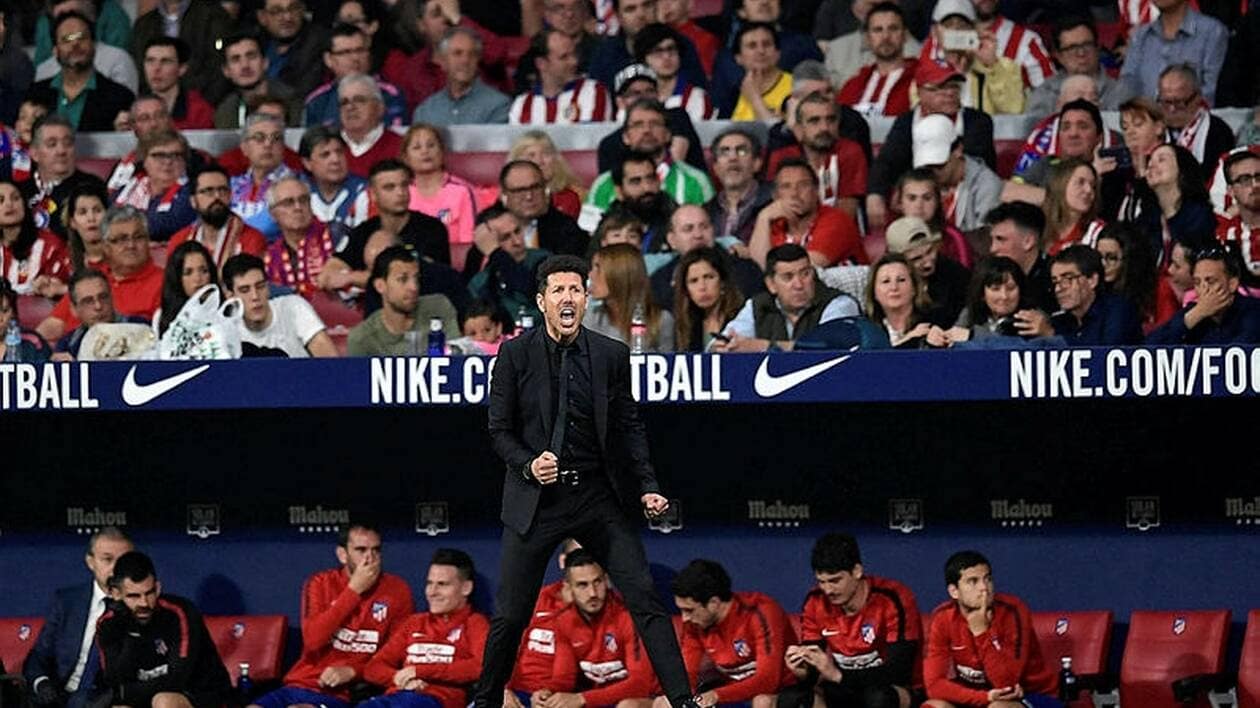
In December 2011, Diego Pablo Simeone, a former Argentine midfielder for the club, was appointed head coach. Nobody imagined that the man nicknamed El Cholo would stay on the bench for more than thirteen years, becoming one of the longest-serving and most influential managers in contemporary European football.
Cholismo has become a full concept of its own. Intense football, compact defense, maximum aggression in pressing, the coach in a suit shouting from the sideline, flags and flares at Vicente Calderón and then at the Metropolitano. Simeone instilled in Atlético a fighting-dog mentality that matches the club’s working-class identity.
Under Simeone, Atlético won La Liga in 2013-2014, ending ten years of Real-Barça duopoly, then La Liga in 2020-2021. Three UEFA Europa League titles as well (including those before his arrival, the club total is three: 2010, 2012, and 2018), three Copa del Rey titles, two UEFA Super Cups, and a Copa del Rey in 2013 won at Santiago Bernabéu, on the field of the big rival.
Three UEFA Champions League finals and three UEFA Europa League titles
The Simeone era also marked a major European return. In 2014, Atlético reached the UEFA Champions League final in Lisbon, against Real Madrid. Trailing 1-0 until the 93rd minute thanks to a goal by Godín, the club lost 4-1 after extra time. Sergio Ramos equalized in the 93rd, and then Real took control in extra time. For the Colchoneros, it is one of the biggest traumas in their history.
Two years later, in 2016, it happened again. Final in San Siro, again against Real. 1-1 after extra time, defeat on penalties. Atlético supporters still carry the memory of these two lost finals today like an open wound. But this consistency at the highest level proves the club has returned for good among the continental elite.
In the Europa League, Atlético has become a specialist in the competition: titles in 2010 (against Fulham), 2012 (against Athletic Bilbao) and 2018 (against Marseille). Three trophies that confirm the club’s ability to win international silverware despite fierce La Liga competition. To learn more about the big white rival, we published a dedicated piece on the complete history of Real Madrid.
From Vicente Calderón to the Metropolitano
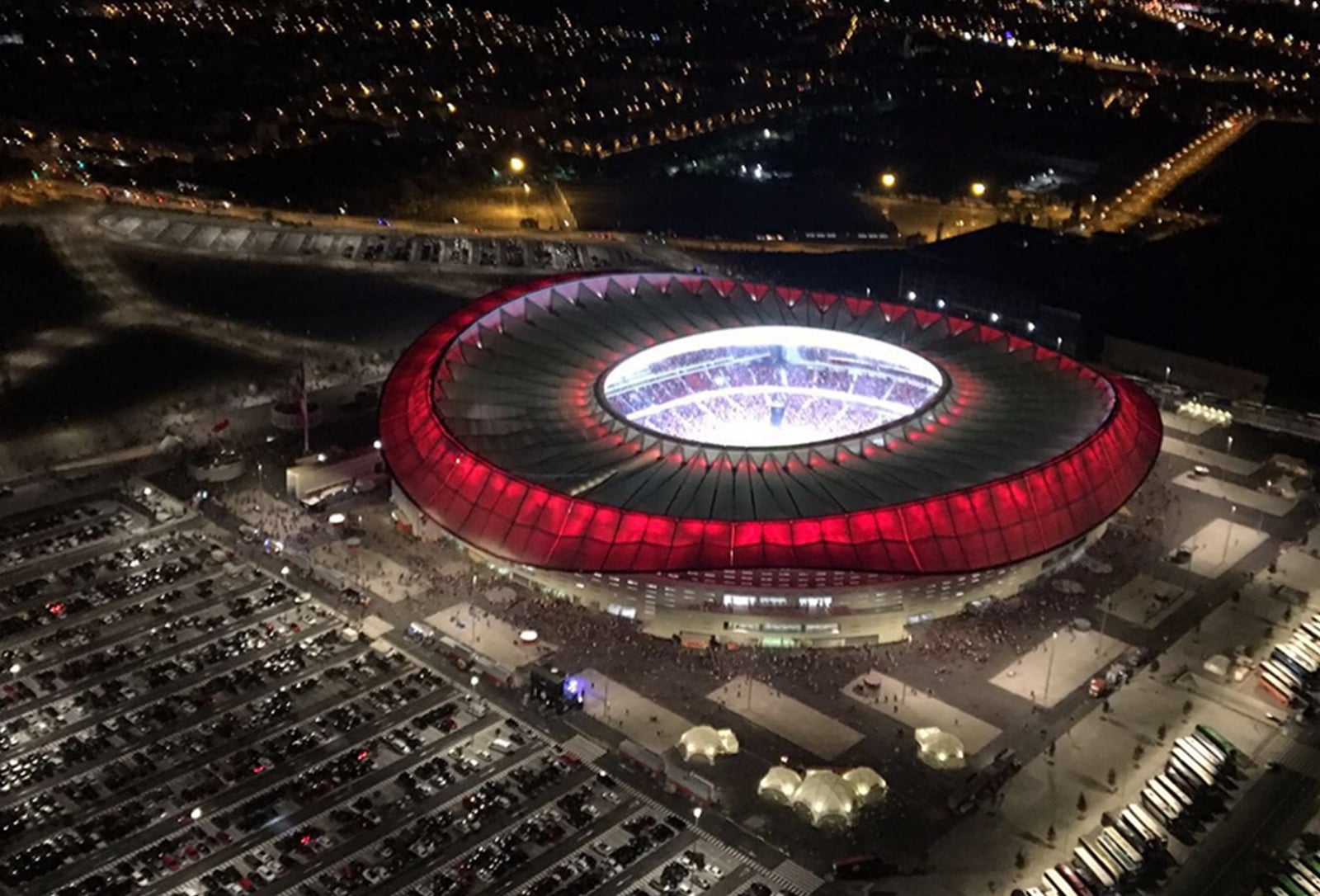
For nearly fifty years, Atlético played at Vicente Calderón stadium, opened in 1966 on the banks of the Manzanares. This 54,000-seat venue, famous for its suspended architecture over a major highway, was the stage for all of the club’s great nights from 1966 to 2017. Calderón was part of the heart of Colchonera identity.
In September 2017, the club moved into a new stadium, the Wanda Metropolitano (renamed Riyadh Air Metropolitano in 2024), with a capacity of 67,829 seats. Located in east Madrid, the ultramodern arena immediately hosted the 2019 UEFA Champions League final, won by Liverpool over Tottenham. The Calderón, meanwhile, was demolished in 2020, making way for a real estate development that partly financed the new stadium.
The move to the Metropolitano marked a new chapter for the club, which is now among the top of Europe’s major stadium infrastructures. The challenge for Diego Simeone and the board is now to turn this modernity into lasting silverware while preserving the popular spirit that has always made Atlético specific. To understand what the other side of the capital represents, our analysis of the Madrid derby details the rivalry with Real since 1929.
What to remember
- Atlético de Madrid was founded on April 26, 1903 by Basque students who came to Madrid to attend the School of Mines.
- The club formally separated from Athletic Bilbao in 1921 and adopted the bear and holm oak on its crest in 1917, a symbol of Madrid.
- Nicknamed Los Colchoneros since the 1920s because of the red-and-white striped mattresses, the club was also called Los Indios for its tradition of recruiting in South America.
- First La Liga title in 1940, La Liga and Copa del Rey double in 1996 under Radomir Antic, relegation to Segunda División in 2000.
- Diego Simeone arrived as coach in December 2011 and established Cholismo, a combative style that became the identity of the modern club.
- Three UEFA Europa League titles (2010, 2012, 2018), two La Liga titles under Simeone (2014, 2021), two UEFA Champions League finals lost to Real Madrid (2014 and 2016).
- Move from Vicente Calderón to the Metropolitano in September 2017, 67,829-seat capacity, and it hosted the 2019 UEFA Champions League final.
Learn more
Atlético history is inseparable from Madrid and La Liga. To explore further, we recommend our pieces on the Real-Atlético Madrid derby, on the history of Real Madrid, which has shared the capital since 1902, and on Athletic Bilbao, from which Atlético is legally linked. To explore La Liga more broadly, our ranking of the best La Liga jerseys features the Colchonera stripes.
Frequently asked questions
When was Atlético de Madrid founded?
Atlético de Madrid was founded on April 26, 1903 by a group of Basque students enrolled at the School of Mines in Madrid. At first, it was a Madrid branch of Athletic Club de Bilbao, before the club was legally emancipated in 1921.
Why is Atlético called the Colchoneros?
The nickname Colchoneros (mattress makers) dates from the 1920s. The fabric used then for making Spanish mattresses was red-and-white striped, exactly like the club’s jerseys. The term was first mocking, but became a source of pride for supporters.
How many La Liga titles has Atlético Madrid won?
Atlético has won 11 La Liga titles. The first is from 1940, and the most recent from the 2020-2021 season under Diego Simeone. The club also won La Liga 2013-2014, putting an end to a ten-year Real Madrid plus FC Barcelona duopoly.
Why has Atlético never won the UEFA Champions League?
The club has played in three finals (1974 vs Bayern Munich, 2014 and 2016 vs Real Madrid) and lost them all. The last two, against the neighboring Madrid club, remain painful moments for Colchoneros. The club has, however, won three UEFA Europa League titles (2010, 2012, 2018).
Where does Atlético Madrid play today?
Since September 2017, Atlético has played at Riyadh Air Metropolitano (formerly Wanda Metropolitano), a 67,829-seat stadium located in east Madrid. The stadium hosted the 2019 UEFA Champions League final. The club left its former Vicente Calderón stadium, which was demolished in 2020.
Show your Colchoneras colors
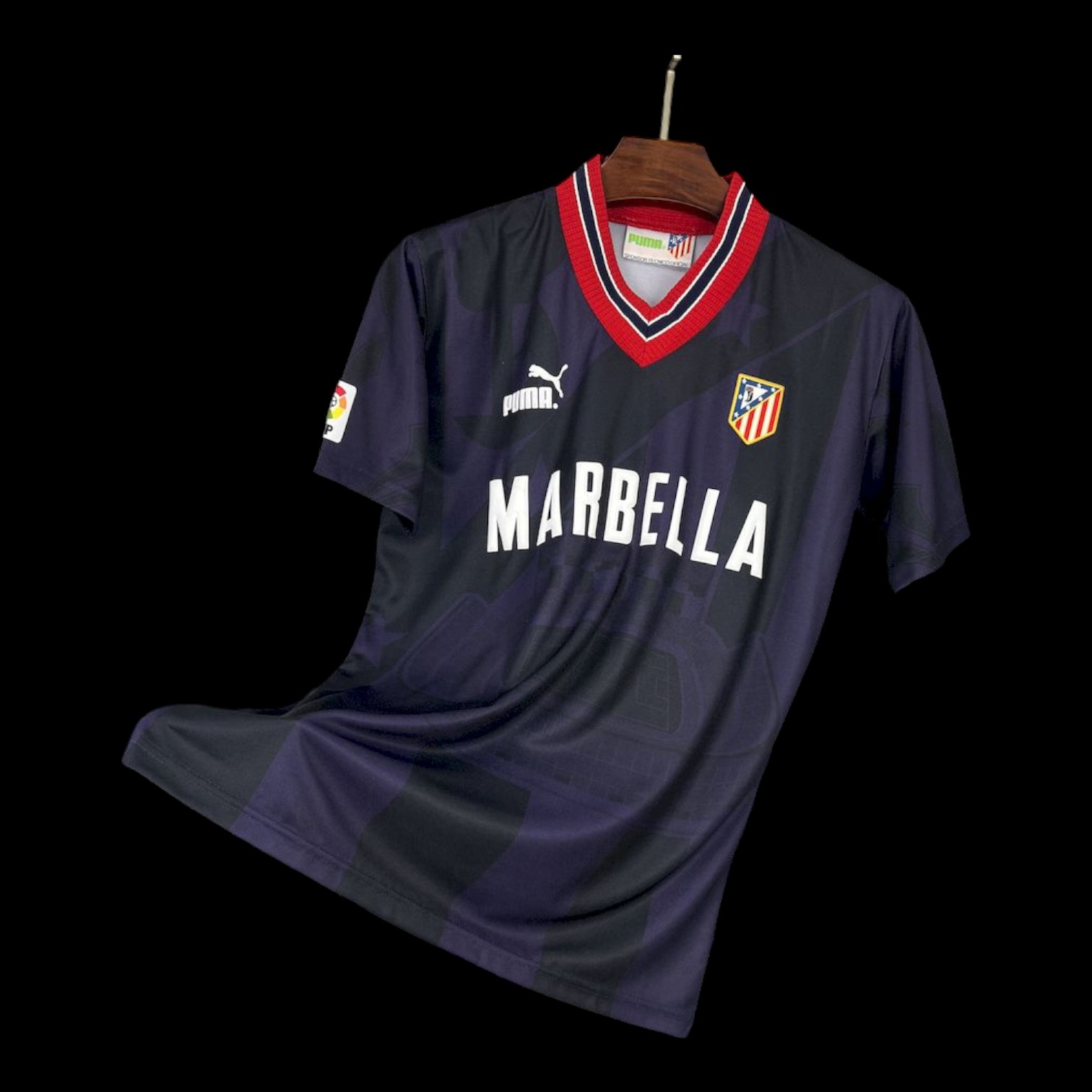
The entire Atlético Madrid collection is available: home red-and-white, away, third, player version, fan version, as well as retro jerseys that recall the club’s greatest seasons.