
October 16, 2004, Camp Nou. FC Barcelona hosted Espanyol for a Barcelona derby. In the 82nd minute, coach Frank Rijkaard brought on a 17-year-old Argentine to replace Deco. That evening, Lionel Messi played his first game with Barça’s first team. No one knew yet that he would stay for 17 seasons, score 672 goals, and write one of the greatest love stories between a player and a club in modern soccer.
The Messi-Barça story goes beyond the statistics. It began in 2000 when the club covered his medical expenses and enrolled him at La Masia. It ended in tears on August 5, 2021, during his forced farewell press conference. This article looks back on those 21 years in Barcelona, from his arrival at age 13 to his departure for PSG.
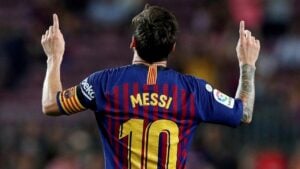
From Rosario to Barcelona: The Contract Document
Lionel Andrés Messi was born on June 24, 1987, in Rosario, Argentina. Coming from a modest family, he began playing soccer at Newell’s Old Boys. At age 11, he was diagnosed with a hormonal deficiency requiring expensive treatment that his family could no longer afford. It was under these circumstances that a scout for FC Barcelona, Carles Rexach, came to watch him play in September 2000.
Rexach was immediately convinced. To ensure he didn’t lose the player, he signed an agreement on the first paper napkin he could find in a Barcelona restaurant on December 14, 2000. The club agreed to cover the young Messi’s medical treatment, on the condition that he join La Masia. The family moved to Barcelona in February 2001.
Lionel Messi joined La Masia in 2000 at the age of 13. There, he lived, studied, and trained with the club’s youth players. For more on Barcelona’s youth development system, see our article on La Masia. He progressed rapidly, skipping levels in the youth ranks and consistently outshining players his own age with his technical skill and tactical intelligence.
His debut with the first team in 2004
On October 16, 2004, Messi came on as a substitute in the 82nd minute of a Barcelona derby against Espanyol. It was his first official appearance for Barça in La Liga. He was 17 years and 113 days old, making him one of the youngest players ever to wear the Blaugrana jersey. The following season, 2005–2006, he signed his first professional contract and began to establish himself in Frank Rijkaard’s rotation.
His first major European performance came on March 7, 2007, during the second leg of the Champions League round of 16 against Chelsea. He scored what many consider to be his first international breakthrough goal. A few weeks earlier, on April 18, 2007, against Getafe in the Copa del Rey, he had scored a 60-meter solo run reminiscent of Maradona’s goal against England in 1986.
During the Ronaldinho era (2003–2008), Messi grew up in the Brazilian’s shadow. He wore the number 30, then the number 19. It was only after Ronaldinho’s departure in the summer of 2008 that he inherited the famous number 10, which he would keep until he left the club. For the context of this transition, see our article on Ronaldinho at Barça.
The Guardiola Era and the False No. 9
Pep Guardiola’s arrival as manager in June 2008 transformed Messi’s career. The new coach, who like him had been trained at La Masia, placed the Argentine at the heart of his system. Above all, he invented a position for him: the false nine, which involves dropping deep between the lines rather than staying up front. This tactical innovation greatly increased the player’s effectiveness, giving him more space and more touches on the ball.
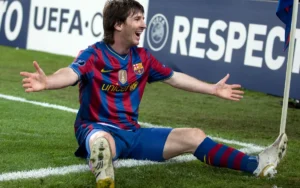
The 2008–2009 season was the season of triumph. Messi scored 38 goals across all competitions, played a key role in the La Liga–Copa del Rey–Champions League treble, and became the most influential player in European soccer. For more on this historic season, see our article on the 2009 treble.
The Guardiola era (2008–2012) was marked by 14 trophies in four years. Messi was the team’s undisputed leader on the field. As for the tactical side of things, our analysis of Pep Guardiola as a coach details how his system shaped a decade of Barcelona’s dominance.
Eight Ballon d'Or awards and world records
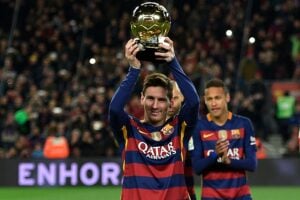
Messi won his first Ballon d’Or in 2009, at the age of 22. He then went on to achieve an unprecedented four-peat in 2010, 2011, and 2012. Four consecutive Ballon d’Or awards—a feat never achieved before or since in the history of the award. He would win a fifth in 2015, following Luis Enrique’s treble, and then three more in 2019, 2021, and 2023, for a record total of eight.
The records keep piling up. Top scorer in a single La Liga season (50 goals in 2011–2012). Top scorer in a single season across all competitions (73 goals in 2011–2012). All-time leading scorer in La Liga history (474 goals). All-time leading scorer in FC Barcelona history (672 goals across all competitions). Player with the most goals scored for a single club in a major European season.
Beyond the statistics, Messi has become the embodiment of a certain vision of soccer: technical, intelligent, and team-oriented. Pep Guardiola once said, “Messi is the only player who runs faster with the ball than without it.” That statement captures the extraordinary relationship between the Argentine and the ball better than any statistic ever could.
The MSN trio with Suárez and Neymar
The summer of 2014 saw the arrival of Luis Suárez from Liverpool. Alongside Messi and Neymar (signed the previous year), he formed the MSN trio, one of the most prolific attacking trios in soccer history. During the 2014–2015 season, the three combined for 122 goals across all competitions, a major contribution to the club’s second continental treble following the one in 2009.
On June 6, 2015, in Berlin, Barça won its fifth Champions League title against Juventus (3–1, with goals from Rakitić, Suárez, and Neymar). Messi was named Man of the Match. The club then entered a period in which it regularly dominated European soccer, until Neymar’s surprise departure for PSG in the summer of 2017. For more on this pivotal period, see our article on the 2017 comeback.
Without Neymar, the system needs to be rethought. Barça remains a strong team but is less dominant in Europe. Messi continues to have exceptional seasons individually, but the team as a whole no longer reaches the heights of the Guardiola or MSN era.
Burofax 2020 and the launch in 2021
The 2018–2019 and 2019–2020 seasons were marked by two humiliating European defeats: a 4–0 loss to Liverpool in the second leg of the 2019 Champions League semifinals, following a 3–0 victory in the first leg, and an 8–2 defeat to Bayern Munich in the 2020 quarterfinals in Lisbon. On August 25, 2020, Messi sent a burofax to the club to invoke a unilateral release clause and request his departure.
The club refused to let him leave, arguing that the clause had expired on June 10. Messi ultimately stayed, but the rift was already set in. A year later, in the summer of 2021, Barça’s financial situation changed everything. La Liga refused to register his new contract due to financial fair play rules. On August 5, 2021, Barça officially announced his departure.
At his farewell press conference on August 8, 2021, Messi was in tears, unable to deliver his speech without pausing. A few days later, he signed with Paris Saint-Germain. A chapter has come to a close, after 17 seasons on the first team and a total of 21 years at the club, dating back to when he was 13 at La Masia.
A Look Back at a Unique Career
The statistics are mind-boggling. 778 official matches, 672 goals, 305 assists. 10 La Liga titles, 7 Copa del Rey titles, 8 Spanish Super Cups, 4 Champions League titles (2006, 2009, 2011, 2015), 3 UEFA Super Cups, 3 Club World Cups, 8 Ballon d’Or awards, 6 European Golden Shoes. No player has amassed such a record with a single club in modern soccer.
Beyond the statistics, Messi has left an indelible mark on an entire generation of fans and players. His playing style—marked by unpredictable moves from left to right, through-balls between the lines, and clinical finishing—has redefined the role of the forward. His relationship with the club, characterized by two decades of loyalty in an era of constant transfers, will remain a textbook example in contemporary soccer.
The abrupt end to his time at Barcelona—due more to financial constraints than to sporting considerations—leaves a bitter taste in the fans’ mouths. But it in no way diminishes the mark the Argentine has left on the club. For a broader look at the post-Messi era, see our profile of Lamine Yamal, one of the new faces in the Blaugrana attack.
Key Takeaways
- Lionel Messi joined La Masia in 2000 at the age of 13, after the club had covered the cost of his hormone treatment.
- He made his first-team debut on October 16, 2004, at the age of 17, in a derby against Espanyol.
- Under Pep Guardiola (2008–2012), he became a false nine and racked up trophies: the 2009 treble and two Champions League titles.
- He has won a total of eight Ballon d'Or awards: 2009, 2010, 2011, 2012, 2015, 2019, 2021, and 2023.
- With the MSN trio (Messi-Suárez-Neymar) starting in 2014, he won a second continental treble in 2015.
- He officially left FC Barcelona on August 5, 2021, to join PSG, after the club was unable to extend his contract.
- Total tally: 672 goals, 10 La Liga titles, 4 Champions League titles—a record never before achieved by a single modern club.
Learn more
The story of Messi and Barça is inextricably linked to the club’s golden age. To learn more, we recommend our articles on La Masia, the club’s youth academy; Pep Guardiola, its brilliant coach; the historic treble of 2009; and the comeback against PSG in 2017.
Frequently Asked Questions
When did Lionel Messi sign with FC Barcelona?
Messi signed his first contract with FC Barcelona on December 14, 2000, at the age of 13, on a paper napkin in a Barcelona restaurant. The club agreed to cover his medical expenses and enroll him in La Masia. He made his first-team debut on October 16, 2004.
How many goals has Messi scored for Barça?
Lionel Messi scored 672 goals for FC Barcelona across all competitions between 2004 and 2021. This is the club’s all-time record, well ahead of César Rodríguez and Luis Suárez in the Blaugrana’s all-time scoring charts.
How many Ballon d'Or awards has Messi won?
Messi has won eight Ballon d'Or awards, an all-time record for the honor: 2009, 2010, 2011, 2012, 2015, 2019, 2021, and 2023. Notably, he is the only player to have won four consecutive awards, from 2009 to 2012.
Why did Messi leave Barça in 2021?
In the summer of 2021, FC Barcelona was unable to extend Messi’s contract due to La Liga’s financial fair play rules. The club officially announced his departure on August 5, 2021. A few days later, he signed with Paris Saint-Germain. The farewell press conference on August 8 was a deeply emotional moment.
How many Champions League titles has Messi won with Barça?
Messi has won four Champions League titles with FC Barcelona: in 2006 against Arsenal, in 2009 against Manchester United, in 2011 against Manchester United, and in 2015 against Juventus. He scored in several of those finals, including the 2009 final in Rome.
Is the Barça jersey catching your eye?
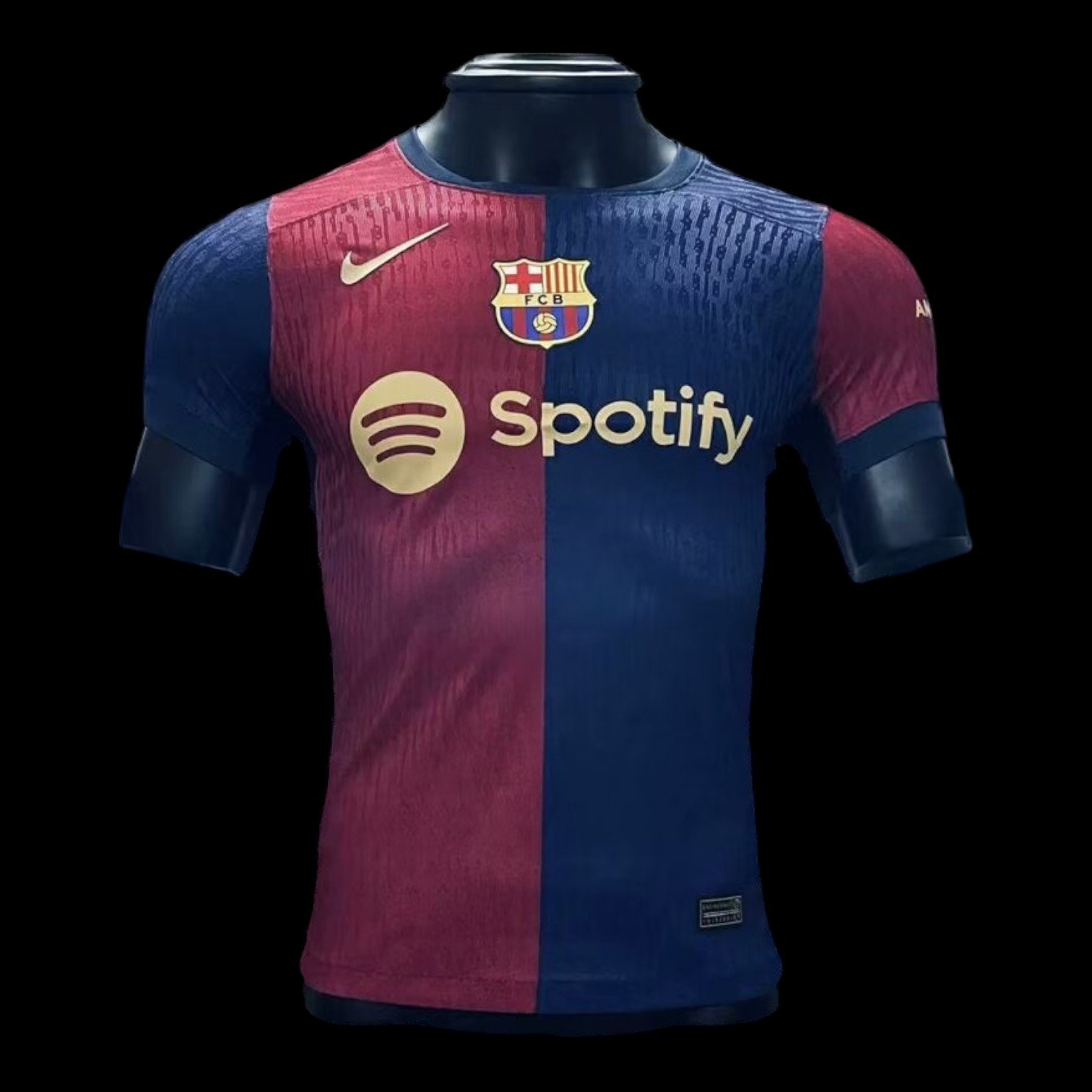
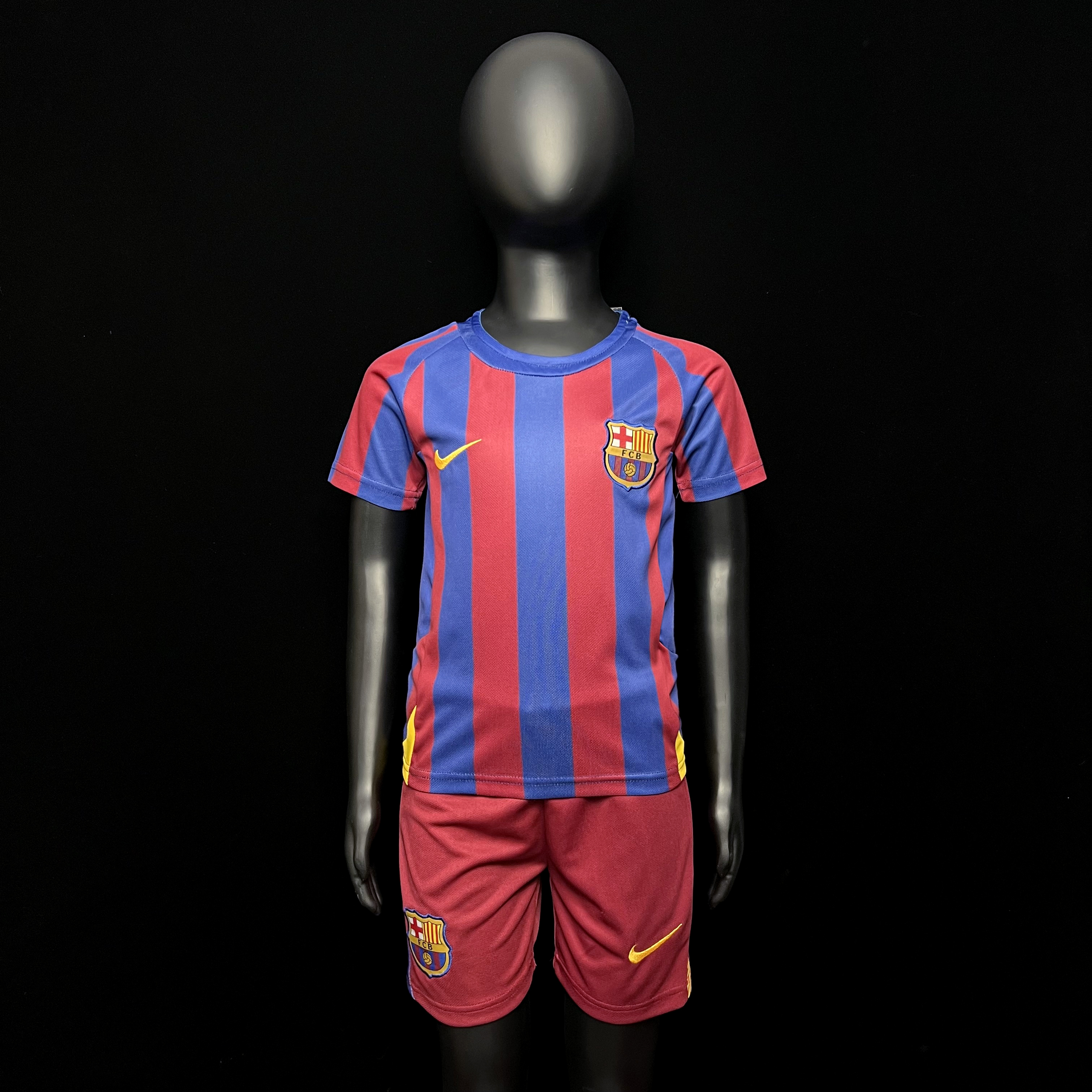
The FC Barcelona collection is available in its entirety on Maxi Kits: home, away, and third jerseys, as well as player and fan versions, and the retro jerseys from Messi’s seasons.