
11 juillet 2010, stade Soccer City de Johannesburg. Iker Casillas, capitaine de l’Espagne, soulève le trophée de la Coupe du monde après une victoire 1-0 contre les Pays-Bas, prolongation décisive d’Andrés Iniesta. À 29 ans, il devient le premier capitaine espagnol champion du monde de l’histoire. Cet article retrace la carrière de Casillas, du gamin de Móstoles entré à La Fábrica à 9 ans au gardien aux trois Ligues des Champions et au triplé international 2008-2010-2012.
La trajectoire de Casillas se résume à une fidélité rare et à un palmarès vertigineux. Seize saisons en équipe première du Real Madrid, 725 matchs officiels, cinq titres de Liga, trois Ligues des Champions, plus une Coupe du monde et deux Euros consécutifs avec la Roja. Un cas unique dans le football espagnol moderne, et l’un des plus grands gardiens de l’histoire de la Liga, tout simplement.
De Móstoles à La Fábrica
Iker Casillas Fernández naît le 20 mai 1981 à Móstoles, en banlieue sud-ouest de Madrid. Fils d’une famille modeste (son père est employé municipal, sa mère coiffeuse), il commence le football très jeune dans les équipes de quartier. À l’âge de neuf ans, en 1990, il intègre les équipes de jeunes du Real Madrid, où ses qualités de gardien sont rapidement remarquées par les recruteurs de La Fábrica.
Pendant toute son adolescence, il gravit les échelons du centre de formation madridista. Cadette, juvénile, équipe C, équipe B (Castilla). Sa progression est régulière, son sérieux salué par tous les éducateurs qui le côtoient. Il développe les qualités qui définiront sa carrière : réflexes courts exceptionnels, sens du placement, lecture du jeu adverse, sang-froid sur les pénaltys et les face-à-face.
Cette formation longue est typique de l’école de La Fábrica, où l’apprentissage du jeu se fait sur des années avant l’accession à l’équipe première. Pour comprendre comment fonctionne ce centre qui a produit tant de joueurs majeurs, notre dossier sur La Fábrica et la formation au Real Madrid retrace toute l’histoire.
Les débuts en équipe première à 18 ans
Le 12 septembre 1999, Iker Casillas entre dans le groupe pro du Real Madrid pour un match de Liga contre l’Athletic Bilbao à San Mamés. Il a 18 ans et trois mois. Sous l’entraîneur John Toshack, il est titularisé en raison de pépins dans la hiérarchie des gardiens, et le Real s’impose 2-1. Quelques mois plus tard, le 24 mai 2000, il dispute la finale de la Ligue des Champions à Saint-Denis contre Valence (3-0), à 19 ans tout juste. Une entrée dans la cour des grands d’une précocité extrême.
Les premières saisons sont contrastées : titulaire un temps, écarté ensuite par le retour en forme de César Sánchez, retourné au banc, avant de regagner sa place. À cette époque, le poste de gardien numéro un n’est pas encore définitivement acquis. Mais Casillas progresse à chaque opportunité, et son potentiel est unanimement reconnu en interne comme à l’extérieur.
L’année 2002 va tout faire basculer.
La finale de Glasgow 2002 et la Neuvième
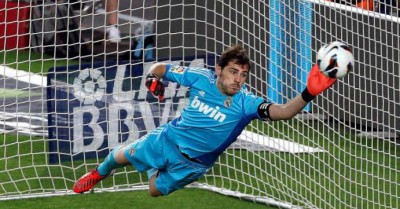
15 mai 2002, finale de la Ligue des Champions à Hampden Park, Glasgow. Real Madrid contre Bayer Leverkusen. César Sánchez est titulaire mais se blesse à la 68e minute. Vicente Del Bosque envoie Casillas, qui n’a pas joué le match. Le jeune gardien va alors enchaîner trois arrêts décisifs en fin de match (notamment sur Lucio et Ulf Kirsten), préservant la victoire 2-1 acquise grâce au but de volée de Zinédine Zidane. Le Real soulève sa neuvième Coupe d’Europe, et Casillas s’impose comme un héros de la finale.
À partir de cette saison 2002-2003, il devient progressivement le numéro un incontestable du Real Madrid. Sa précocité, son calme dans la cage, sa capacité à sortir des arrêts de classe mondiale dans les moments décisifs lui valent rapidement le surnom de San Iker (Saint Iker) auprès des supporters madridistes.
La saison 2002-2003 se conclut sur le titre de Liga, avec Casillas désormais titulaire. Sa fidélité au club et au poste va se consolider sur plus d’une décennie, faisant de lui l’un des gardiens les plus emblématiques de l’histoire de la Liga moderne.
Le palmarès au Real Madrid
En 16 saisons en équipe première, Casillas a accumulé 725 apparitions officielles toutes compétitions confondues sous le maillot du Real Madrid, un total qui le place parmi les joueurs les plus capés de l’histoire du club. Côté trophées : cinq titres de Liga (2001, 2003, 2007, 2008, 2012), trois Ligues des Champions (2000, 2002, 2014), deux Coupes d’Espagne (2011, 2014), plus plusieurs Supercoupes d’Espagne et la Coupe du monde des clubs 2014.
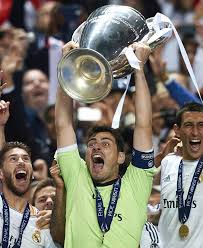
La Décima, dixième Coupe d’Europe du club, est obtenue en 2014 à Lisbonne contre l’Atlético Madrid (4-1 après prolongation). Casillas, qui en est alors à sa quatorzième saison en équipe première, soulève à nouveau le trophée à 33 ans. Une consécration symbolique qui clôt l’attente de douze ans entre la Neuvième de 2002 et la Dixième tant désirée par le club.
En 2010, après le départ de Raúl, il devient officiellement capitaine du Real Madrid. Une fonction qu’il occupera jusqu’à son départ en 2015. Sa relation avec le brassard, le club, les supporters incarne la fidélité madridista d’un joueur formé à La Fábrica et resté plus de vingt ans dans l’institution (formation comprise).
Capitaine de la Roja triple championne
Avec l’équipe d’Espagne, Iker Casillas vit la décennie la plus dorée de l’histoire de la Roja. Champion d’Europe en 2008 en Autriche-Suisse, champion du monde en 2010 en Afrique du Sud, champion d’Europe en 2012 en Pologne-Ukraine. Trois trophées internationaux consécutifs, un exploit jamais réalisé auparavant par une sélection nationale.
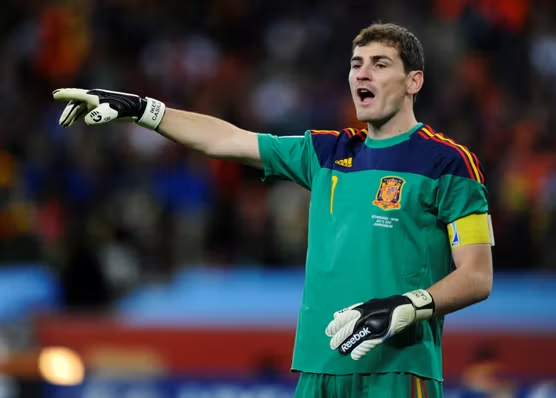
Casillas est capitaine sur les trois compétitions. À la Coupe du monde 2010, il termine la finale contre les Pays-Bas avec un arrêt déterminant face à Arjen Robben en deuxième période, alors que le score est encore vierge. Le but d’Andrés Iniesta en prolongation (116e minute) lui permet d’être le premier capitaine espagnol à soulever le trophée de la Coupe du monde, à Soccer City devant 84 490 spectateurs.
Côté statistique, il termine sa carrière internationale avec 167 sélections en équipe d’Espagne, ce qui constitue l’un des totaux les plus élevés de l’histoire de la Roja. Son palmarès collectif fait de lui l’un des plus grands gardiens des années 2000-2010, à mettre dans la même catégorie que Gianluigi Buffon ou Manuel Neuer pour leur génération respective.
La fin compliquée au Real Madrid
À partir de 2012-2013, la relation entre Iker Casillas et l’entraîneur José Mourinho se détériore publiquement. Le coach portugais relègue son capitaine sur le banc en championnat au profit de Diego López, recruté en janvier 2013. Casillas continue toutefois à disputer la Coupe d’Espagne et la Ligue des Champions, mais le climat dans le vestiaire devient pesant. Une polémique très commentée à Madrid, qui divise socios et observateurs.
Mourinho parti à l’été 2013, Carlo Ancelotti le réintègre comme titulaire dans les compétitions à élimination directe. Casillas fait partie intégrante de l’équipe qui remporte la Décima en 2014, ainsi que la Coupe d’Espagne et la Coupe du monde des clubs la même année. Mais sa place reste fragile, et la concurrence avec Diego López puis Keylor Navas (arrivé en 2014) ne facilite pas les choses.
L’été 2015 marque la séparation. À 34 ans, Casillas quitte le Real Madrid après 25 ans passés au club (formation incluse). Il est libéré par la direction, signe un contrat avec le FC Porto, et fait ses adieux dans une conférence de presse particulièrement émouvante au cours de laquelle il craque face aux journalistes.
Le passage au FC Porto
Casillas s’engage avec le FC Porto en juillet 2015 pour un transfert estimé à 1 million d’euros. Il y reste quatre saisons (2015-2019) et dispute 156 matchs officiels toutes compétitions. Au Portugal, il retrouve une régularité de jeu, soulève une Supercoupe du Portugal en 2018 et reste un titulaire indiscutable dans une Liga NOS dominée par Benfica et Porto.
Son passage au Portugal est apprécié des supporters portistes pour son professionnalisme et sa simplicité d’approche. Il reste également proche de l’équipe d’Espagne, dont il est un cadre historique, sans toutefois retrouver de titularisation après 2014.
Côté équipe nationale, il honore sa dernière sélection en 2016, après l’Euro disputé en France où l’Espagne est éliminée en huitièmes par l’Italie. Une fin internationale plus discrète que ses heures de gloire, mais qui n’efface en rien le bilan exceptionnel de ses années avec la Roja.
L’infarctus de 2019 et la retraite
1er mai 2019. À l’entraînement avec le FC Porto, Iker Casillas est victime d’un infarctus aigu du myocarde. Il est immédiatement évacué vers un hôpital de la ville où il est pris en charge en urgence. Le diagnostic est sévère : il s’agit d’un événement cardiaque majeur, et sa carrière de footballeur professionnel est immédiatement remise en question. À 37 ans, son corps lui envoie un signal qu’il ne peut ignorer.
Pendant plus d’un an, il tente de revenir, espère un retour sur les terrains au moins symbolique, sans pouvoir matériellement reprendre la compétition de haut niveau. Le 4 août 2020, il annonce officiellement sa retraite professionnelle à 39 ans, depuis Porto, avec un message public émouvant adressé à ses supporters et à ses anciens coéquipiers.
Après sa retraite, Casillas reste impliqué dans le football. Il participe à des projets caritatifs, donne des conférences, et reste régulièrement présent au Bernabéu lors des matchs importants du Real Madrid. Sa légende dans le club est définitivement scellée, et il fait partie des figures que les générations de socios continuent de citer en référence quand on parle de gardien madridista.
Ce qu’il faut retenir
- Iker Casillas, né le 20 mai 1981 à Móstoles, est entré à La Fábrica du Real Madrid à neuf ans, en 1990.
- Il fait ses débuts en équipe première le 12 septembre 1999 à 18 ans contre l’Athletic Bilbao.
- Son palmarès au Real : 5 Liga, 3 Ligues des Champions (2000, 2002, 2014), 2 Coupes d’Espagne, 725 matchs officiels en 16 saisons.
- Il devient capitaine du Real Madrid en 2010, après le départ de Raúl.
- Avec l’Espagne, il remporte trois trophées internationaux consécutifs : Euro 2008, Coupe du monde 2010, Euro 2012, comme capitaine de la Roja.
- Il quitte le Real Madrid en 2015 pour le FC Porto, où il dispute 156 matchs en quatre saisons.
- Victime d’un infarctus le 1er mai 2019, il prend officiellement sa retraite professionnelle le 4 août 2020.
Pour aller plus loin
L’histoire de Casillas s’inscrit dans deux décennies fastes du Real Madrid. Pour explorer d’autres facettes, on vous recommande nos dossiers sur Raúl, l’autre capitaine éternel, sur les Galactiques de Florentino Pérez avec lesquels il a partagé le vestiaire, sur La Fábrica qui l’a formé, et sur l’histoire complète du Real Madrid pour resituer son passage dans la grande aventure madridista.
Questions fréquentes
Combien de matchs Iker Casillas a-t-il disputés avec le Real Madrid ?
Iker Casillas a disputé 725 matchs officiels toutes compétitions confondues avec le Real Madrid entre 1999 et 2015, soit 16 saisons en équipe première. Un total qui le place parmi les joueurs les plus capés de l’histoire du club.
Combien de Ligues des Champions Casillas a-t-il gagnées ?
Iker Casillas a remporté trois Ligues des Champions avec le Real Madrid : 2000 contre Valence, 2002 contre le Bayer Leverkusen, et 2014 contre l’Atlético Madrid. La Décima de 2014 a clôturé une attente de douze ans pour le club madrilène.
Quel est le palmarès international d’Iker Casillas ?
Avec l’Espagne, Casillas a remporté trois trophées consécutifs : l’Euro 2008, la Coupe du monde 2010 et l’Euro 2012, en tant que capitaine de la Roja. Il termine sa carrière internationale avec 167 sélections, l’un des totaux les plus élevés de l’histoire espagnole.
Pourquoi Casillas a-t-il quitté le Real Madrid en 2015 ?
Sa relation avec l’entraîneur José Mourinho s’était détériorée à partir de 2012-2013, et la concurrence avec Diego López puis Keylor Navas avait fragilisé sa place de titulaire. Libéré par le club à 34 ans, il a rejoint le FC Porto à l’été 2015.
Pourquoi Iker Casillas a-t-il pris sa retraite ?
Le 1er mai 2019, Casillas a été victime d’un infarctus aigu du myocarde lors d’un entraînement avec le FC Porto. Après plus d’un an de tentatives de retour, il a officiellement annoncé sa retraite professionnelle le 4 août 2020, à 39 ans.
Envie de porter le maillot du Real Madrid ?
Tous les maillots du Real Madrid sont chez nous : domicile, extérieur, third, version joueur, version supporter, sans oublier les maillots rétro qui ont accompagné les grandes saisons de Casillas et de la Décima.