
29 octobre 1994. Au stade La Romareda de Saragosse, un gamin de 17 ans entre en cours de jeu sous le maillot du Real Madrid. Il s’appelle Raúl González Blanco, vient du quartier populaire de San Cristóbal de los Ángeles, et personne ne sait encore qu’il jouera 741 matchs sous ce maillot, en marquera 323 et restera capitaine pendant sept ans. Cet article retrace la carrière de Raúl au Real Madrid, du gamin formé à La Fábrica au capitaine éternel devenu symbole de tout un club.
Raúl n’est pas un joueur comme les autres dans l’histoire madridista. Il n’a pas été acheté à prix d’or, il n’est pas sorti d’un projet de Galactiques, il n’est pas non plus un produit marketing planétaire. Il est arrivé du quartier voisin, a porté le numéro 7 pendant 14 saisons et a tout gagné avec le club de sa ville. Une trajectoire qui en fait, aux yeux des socios, un cas à part.
Du quartier de San Cristóbal à La Fábrica
Raúl González Blanco naît le 27 juin 1977 à Madrid, dans le quartier populaire de San Cristóbal de los Ángeles, au sud de la capitale. Une enfance modeste, partagée entre l’école et le ballon rond joué dans la rue. Comme beaucoup d’enfants de son âge, il commence le football en club très jeune, et son talent est rapidement repéré par les recruteurs.
Premier paradoxe de son histoire : il rejoint d’abord les équipes de jeunes de l’Atlético de Madrid, le rival historique du Real. Il y reste quelques années, jusqu’à ce que le club rojiblanco décide en 1992 de fermer son centre de formation pour des raisons financières. Une décision qui sera regrettée pendant des décennies, puisqu’elle ouvre la porte au Real Madrid. Le voisin merengue saute sur l’occasion et récupère le jeune attaquant.
Raúl intègre ainsi La Fábrica, le centre de formation du Real Madrid. Il y progresse vite : Castilla, équipe réserve, puis appel direct en équipe première. À 17 ans, il joue avec les grands. Ce passage éclair par les catégories de jeunes restera l’une des plus belles réussites du club madrilène en matière de formation. Pour comprendre comment fonctionne ce centre qui produit des joueurs depuis des décennies, notre dossier sur La Fábrica et la formation au Real Madrid retrace toute l’histoire.
Les débuts en pro à 17 ans
Le 29 octobre 1994, l’entraîneur Jorge Valdano décide de faire entrer Raúl en cours de jeu lors d’un match de Liga à Saragosse. Le jeune attaquant a 17 ans et 4 mois, il vient de devenir le plus jeune joueur à porter le maillot du Real Madrid en championnat à cette époque. Une semaine plus tard, le 5 novembre 1994, il marque son premier but officiel à Bernabéu contre l’Atlético, le club qui l’avait laissé partir deux ans plus tôt. Le scénario était parfait pour une légende naissante.
La saison 1994-1995 le voit s’imposer comme une révélation. Aux côtés des cadres comme Iván Zamorano, Fernando Hierro ou Michael Laudrup, il participe à la conquête de la Liga 1995, son premier titre. À 17 ans, il a déjà sa première étoile. Le ton est donné : Raúl ne sera pas un espoir prometteur qui s’éteint, mais bien le futur visage du club.
Sa technique n’est pas spectaculaire au sens brésilien du terme : il n’est ni dribbleur fou ni puissant athlète. Sa force est ailleurs, dans le placement, l’instinct du but, l’intelligence de jeu. Il attaque les espaces avant les autres, finit ses actions du droit comme du gauche, et possède un sens du timing que peu de joueurs développeront aussi jeunes.
Le numéro 7 et l’héritage de Butragueño
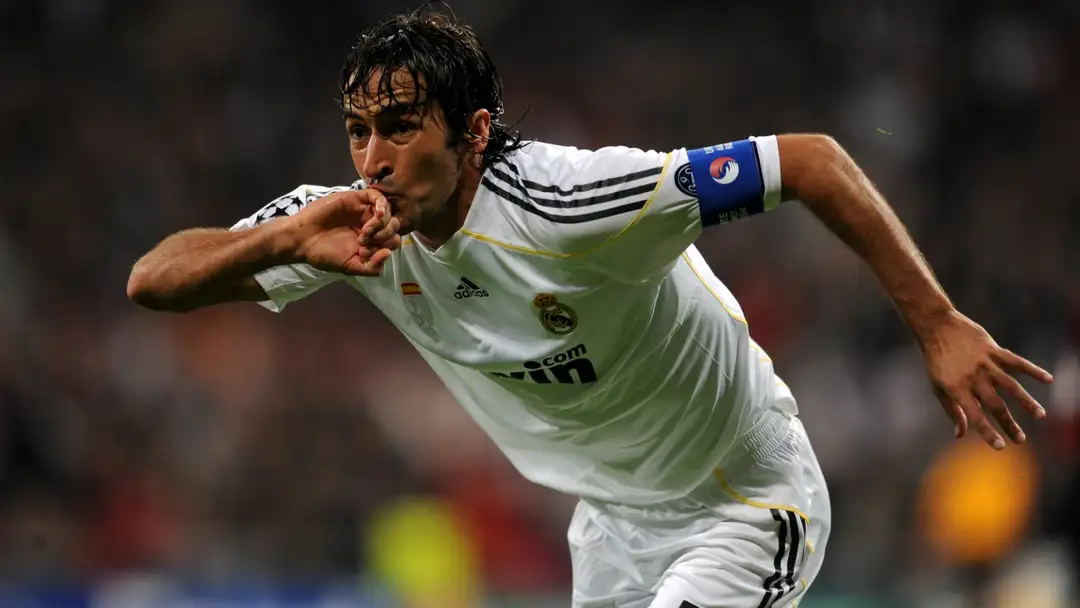
En 1996, à 19 ans, Raúl récupère le numéro 7, hérité d’Emilio Butragueño qui vient de quitter le club pour le Mexique. Ce n’est pas un numéro anodin au Real Madrid : c’est celui des numéros 7 historiques, de Juanito à Butragueño. Le porter implique une forme de responsabilité éditoriale, et Raúl le portera sans interruption jusqu’à son départ en 2010, soit quatorze saisons consécutives sous le 7 madridista.
Le lien avec la Quinta del Buitre est d’autant plus fort que Raúl est arrivé juste après l’âge d’or de cette génération. Il prolonge l’identité madridista d’un attaquant formé au club, fidèle à ses couleurs, capitaine naturel sur le terrain. Pour replacer cet héritage dans son contexte, notre papier sur la Quinta del Buitre raconte toute l’aventure de cette génération dorée des années 1980.
Le numéro 7 du Real Madrid restera ensuite associé à des figures fortes : David Beckham (de 2003 à 2007), puis Cristiano Ronaldo de 2009 à 2018. Mais pour beaucoup de socios, le 7 historique du club moderne reste celui de Raúl. Le maillot floqué Raúl 7 demeure l’un des plus emblématiques produits par les équipementiers du club dans les années 2000.
Le palmarès : six Liga et trois Coupes d’Europe
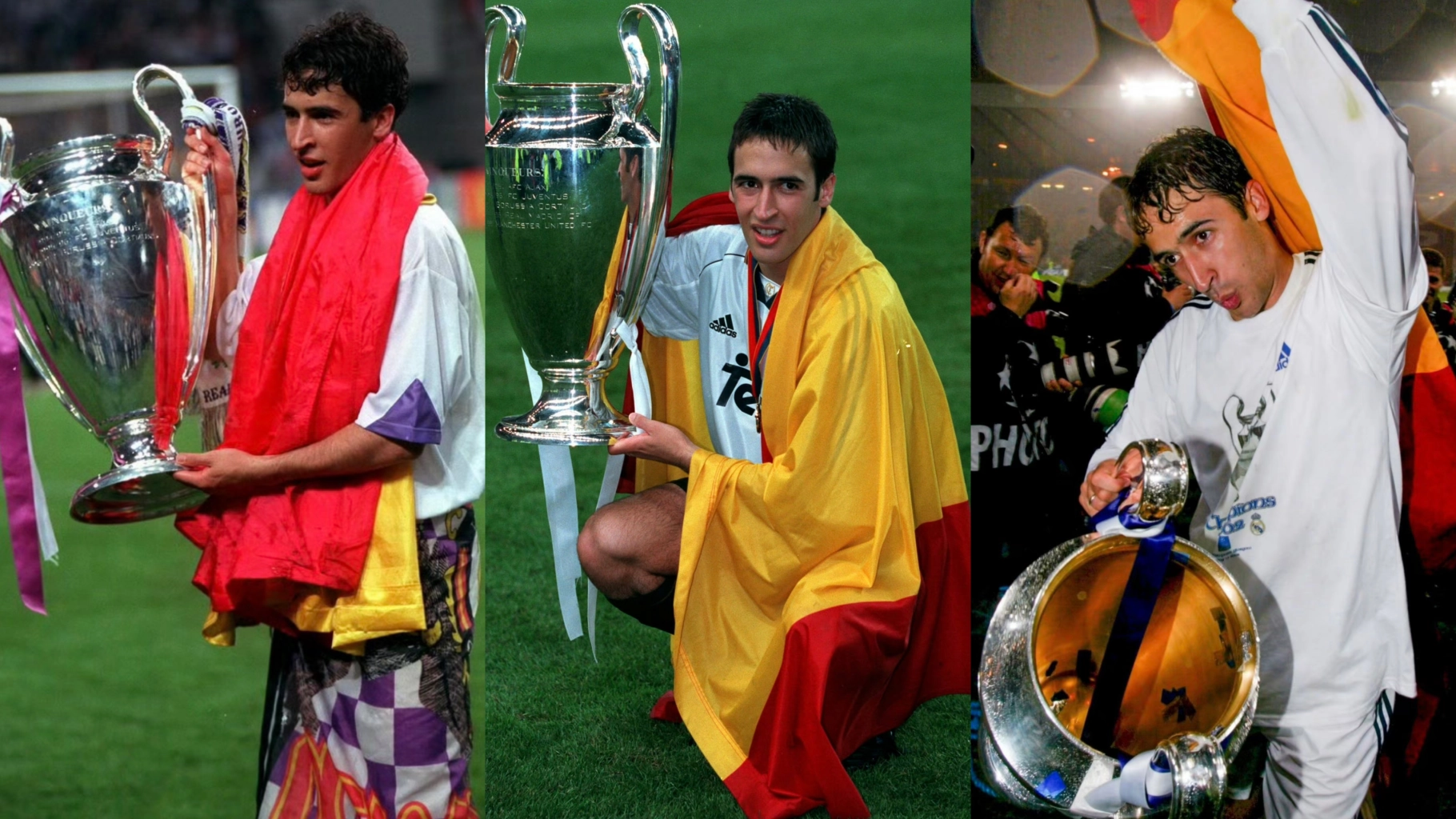
En 16 saisons sous le maillot du Real Madrid, Raúl a tout gagné. Six championnats d’Espagne (1995, 1997, 2001, 2003, 2007, 2008), trois Ligues des Champions (1998, 2000, 2002), deux Coupes intercontinentales (1998, 2002), une Coupe d’Espagne, plusieurs Supercoupes. Un palmarès rare, accumulé sur une période où la concurrence européenne était féroce.
La Ligue des Champions 1998, gagnée à Amsterdam contre la Juventus (1-0), est la première du club depuis 32 ans. Raúl, à 20 ans, fait partie intégrante de cette équipe qui ramène la Coupe d’Europe à Madrid après une longue traversée du désert. Pour comprendre l’attente entre 1966 et cette septième Coupe d’Europe, notre dossier sur les premières Coupes d’Europe du Real remet le tout en perspective.
Statistiquement, son rendement reste impressionnant. Raúl quitte le Real avec 323 buts toutes compétitions confondues, en 741 apparitions sous le maillot blanc. Il sera le meilleur buteur de l’histoire du club jusqu’à ce que Cristiano Ronaldo dépasse cette marque en 2015. Côté sélection espagnole, il termine sa carrière internationale avec 102 sélections et 44 buts, un total qui le place parmi les buteurs historiques de la Roja.
Le capitaine, voix du club et des socios
En 2003, après le départ de Fernando Hierro, Raúl récupère le brassard de capitaine du Real Madrid. Il a 26 ans, il est joueur du club depuis neuf saisons, et il l’incarne désormais aux yeux du grand public. Le capitanat madridista n’est pas un titre purement honorifique : c’est une fonction politique au sein du vestiaire, qui implique de représenter les joueurs auprès de la direction et de porter la voix du club lors des moments importants.
Raúl assume ce rôle pendant sept saisons, jusqu’à son départ en 2010. Il a la particularité de ne jamais avoir été un capitaine bavard ni démonstratif. Pas de discours enflammés, pas de gestes spectaculaires devant les caméras. Sa figure de capitaine repose sur l’exemplarité et la régularité, qualités appréciées par les joueurs et la direction.
Sur le terrain, son attitude reste constante : célébration sobre des buts (le baiser à l’alliance pour sa femme, geste devenu signature), respect des arbitres, jamais d’expulsion pour comportement violent. Une discipline qui fait écho à la culture historique du club, attachée à une certaine forme de tenue dans la rivalité.
Raúl à l’ère des Galactiques
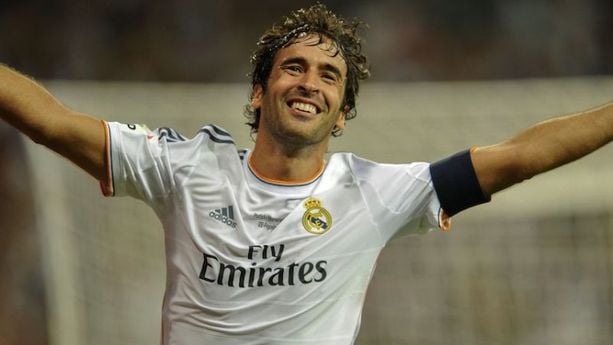
L’arrivée des Galactiques à partir de 2000 (Figo, Zidane, Ronaldo Nazário, Beckham) bouleverse le vestiaire du Real Madrid. Raúl, qui était la star incontestée du club depuis 1996, doit composer avec ces personnalités planétaires arrivées à coups de transferts records. Il garde son brassard, son numéro 7 (jusqu’à l’arrivée de Beckham en 2003 où il bascule sur d’autres numéros pour les compétitions internationales), et reste un titulaire indiscutable en attaque.
Cette période n’est pas la plus dorée de sa carrière en termes statistiques, le système de jeu privilégiant souvent les vedettes étrangères. Mais Raúl maintient son niveau et reste un pilier du vestiaire. Il fait le lien entre l’ancienne génération formée au club et les stars internationales arrivées par les coups de Florentino Pérez. Pour comprendre la stratégie qui a transformé le Real Madrid à cette époque, notre dossier sur les Galactiques du Real Madrid détaille toute la mécanique.
Avec le retour des titres en Liga (2007 et 2008 sous Fabio Capello puis Bernd Schuster), Raúl prouve qu’il sait s’adapter aux différents projets sportifs successifs. Sept entraîneurs en quelques saisons, et lui qui reste, capitaine, numéro 7, buteur. Une stabilité rare dans le football moderne.
Le départ pour Schalke 04 en 2010
L’été 2010 marque la fin d’une époque. À 33 ans, Raúl quitte le Real Madrid après seize saisons en équipe première. Le départ est négocié avec la direction et l’entraîneur de l’époque, José Mourinho, qui souhaite restructurer son attaque autour de Cristiano Ronaldo arrivé l’année précédente. Raúl rejoint Schalke 04 en Bundesliga, librement, et s’engage pour deux saisons.
Son passage en Allemagne (2010-2012) est une réussite sportive. Il marque 40 buts en 98 matchs toutes compétitions, atteint la demi-finale de la Ligue des Champions en 2011 (sortie par Manchester United), et participe à la conquête de la Coupe d’Allemagne 2011 et de la Supercoupe d’Allemagne 2011. Les supporters de Schalke 04 lui réservent un accueil particulièrement chaleureux pour ses adieux.
Il termine sa carrière par deux étapes plus exotiques : Al Sadd au Qatar (2012-2014), où il remporte le championnat qatari, puis le New York Cosmos en NASL américaine (2014-2015), où il finit sur un titre de champion en 2015. À 38 ans, il prend sa retraite définitive, après plus de 20 ans de carrière professionnelle.
L’héritage Raúl au Real Madrid
Plus de quinze ans après son départ, Raúl reste une référence absolue à Madrid. Le club l’a fait revenir comme entraîneur des équipes de jeunes : Cadete B, Juvenil B, puis Castilla (l’équipe réserve) à partir de 2019. En 2025, il est promu sur le banc du Real Oviedo en Liga, marquant le début de sa carrière d’entraîneur professionnel à un poste majeur.
Sur le terrain, son héritage est statistique mais pas seulement. Statistiquement, il reste l’un des trois meilleurs buteurs de l’histoire du club avec Cristiano Ronaldo et Karim Benzema. Symboliquement, il incarne ce que les socios appellent le madridismo : un joueur formé au club, capitaine pendant sept ans, qui a tout gagné sans jamais perdre la mesure ni demander la lune.
Le numéro 7 du Real Madrid n’a plus jamais eu la même signification après son départ. Cristiano Ronaldo l’a porté pendant neuf saisons et a marqué une autre époque, mais le 7 historique du club moderne reste celui de Raúl. Une trace gravée dans la mémoire collective des supporters et dans le palmarès du club.
Ce qu’il faut retenir
- Raúl González Blanco, né le 27 juin 1977 à Madrid, est passé par les jeunes de l’Atlético avant d’intégrer La Fábrica du Real Madrid en 1992.
- Il fait ses débuts en équipe première le 29 octobre 1994 à 17 ans contre Saragosse, sous Jorge Valdano.
- Il porte le numéro 7 du Real Madrid de 1996 à 2010, héritage du grand Emilio Butragueño.
- Son palmarès au Real : 6 Liga, 3 Ligues des Champions (1998, 2000, 2002), 2 Coupes intercontinentales.
- Capitaine du club de 2003 à 2010, il quitte le Real avec 323 buts en 741 apparitions, longtemps record absolu du club.
- Avec la Roja, il totalise 102 sélections et 44 buts, parmi les plus grands buteurs historiques de l’Espagne.
- Après son départ en 2010, il joue à Schalke 04, Al Sadd et New York Cosmos avant de prendre sa retraite en 2015.
Pour aller plus loin
L’histoire de Raúl s’inscrit dans le récit long du Real Madrid. Pour explorer d’autres facettes, on vous recommande nos dossiers sur l’histoire complète du Real Madrid, sur la Quinta del Buitre qui a précédé son arrivée, sur les Galactiques de Florentino Pérez avec lesquels il a partagé le vestiaire, et sur La Fábrica, le centre de formation qui l’a révélé.
Questions fréquentes
Combien de buts Raúl a-t-il marqués au Real Madrid ?
Raúl a inscrit 323 buts en 741 apparitions toutes compétitions confondues sous le maillot du Real Madrid, entre 1994 et 2010. Il a longtemps été le meilleur buteur de l’histoire du club, jusqu’à ce que Cristiano Ronaldo le dépasse en 2015.
Combien de Ligues des Champions Raúl a-t-il gagnées avec le Real ?
Raúl a remporté trois Ligues des Champions avec le Real Madrid : 1998 contre la Juventus à Amsterdam, 2000 contre Valence à Saint-Denis, et 2002 contre le Bayer Leverkusen à Glasgow. La première a mis fin à 32 ans d’attente européenne pour le club.
Pourquoi Raúl a-t-il quitté le Real Madrid en 2010 ?
À 33 ans, son départ a été négocié avec la direction et le nouvel entraîneur José Mourinho, qui souhaitait restructurer son attaque autour de Cristiano Ronaldo. Raúl est parti libre vers Schalke 04 en Bundesliga, où il a joué deux saisons.
Quel numéro Raúl portait-il au Real Madrid ?
Raúl a porté le numéro 7 du Real Madrid de 1996 à 2010, soit quatorze saisons consécutives. Il avait hérité ce numéro d’Emilio Butragueño, parti au Mexique en 1995. Le 7 a ensuite été repris par David Beckham puis Cristiano Ronaldo.
Que fait Raúl aujourd’hui ?
Après sa retraite de joueur en 2015, Raúl est revenu au Real Madrid comme entraîneur des équipes de jeunes, jusqu’à diriger le Castilla (équipe réserve) à partir de 2019. En 2025, il a été nommé entraîneur du Real Oviedo en Liga, première grande étape de sa carrière sur un banc professionnel.
Le maillot du Real Madrid vous fait de l’œil ?
La collection Real Madrid est complète sur notre boutique : maillot domicile, extérieur, third, version joueur, version supporter, et les maillots rétro qui ont accompagné les grandes saisons du club, dont l’ère Raúl numéro 7.