
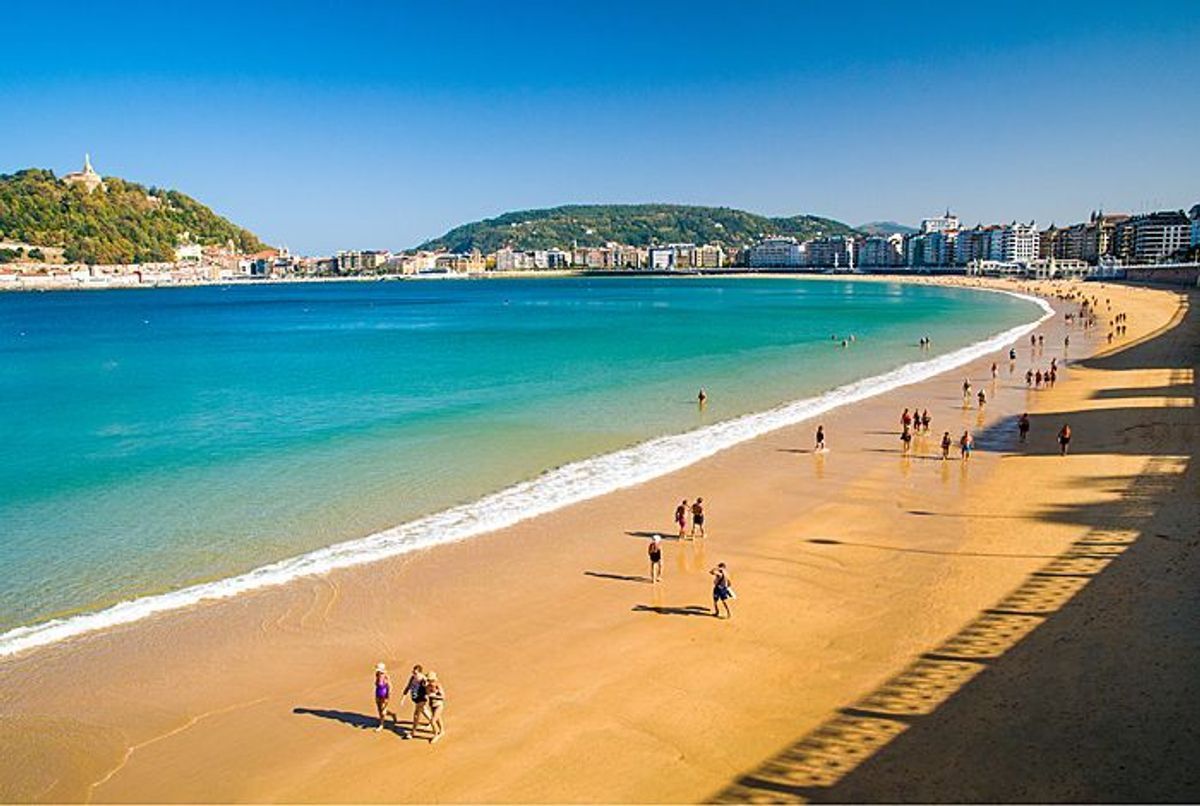
San Sebastián, the seaside capital of the Spanish Basque Country, does not resemble any other city. La Concha Bay, the pintxos in the Parte Vieja district, the understated elegance of its streets: everything breathes a certain way of life. And at the heart of this identity is a football club that has been its sporting expression since 1909, Real Sociedad. Blue and white, Basque through and through, and with a record stronger than many realize.
Twice Spanish champions in 1981 and 1982, winner of the 2020 Copa del Rey in a single final during the pandemic, and a youth-development club that gave us Xabi Alonso, Antoine Griezmann, and Mikel Oyarzabal, Real Sociedad deserves more than a footnote in La Liga history. This article retraces its journey from its founding, through the glorious years under Alberto Ormaechea, to the current renaissance under Imanol Alguacil.
1909: the founding in San Sebastián
Real Sociedad de Fútbol was officially founded on September 7, 1909, in a city where football had already been played for a few years by English and Irish sailors who came to the port of San Sebastián. The sport quickly won over the city’s upper classes, who saw it as a modern and international activity.
The title “Real” was granted in 1910 by King Alfonso XIII, who regularly spent his summers in San Sebastián, where the Spanish royal court had already made itself at home. This royal distinction gave the club immediate institutional legitimacy and marked the start of a rapid rise in Basque and then Spanish football.
From La Liga’s first years, created in 1928-1929, Real Sociedad has been one of the ten founding clubs and established itself as a regular force in the league. The club has largely remained in the top division (with a few short spells in the second division), making it one of the most stable clubs in La Liga over the long term.
The blue and white, txuri-urdin identity
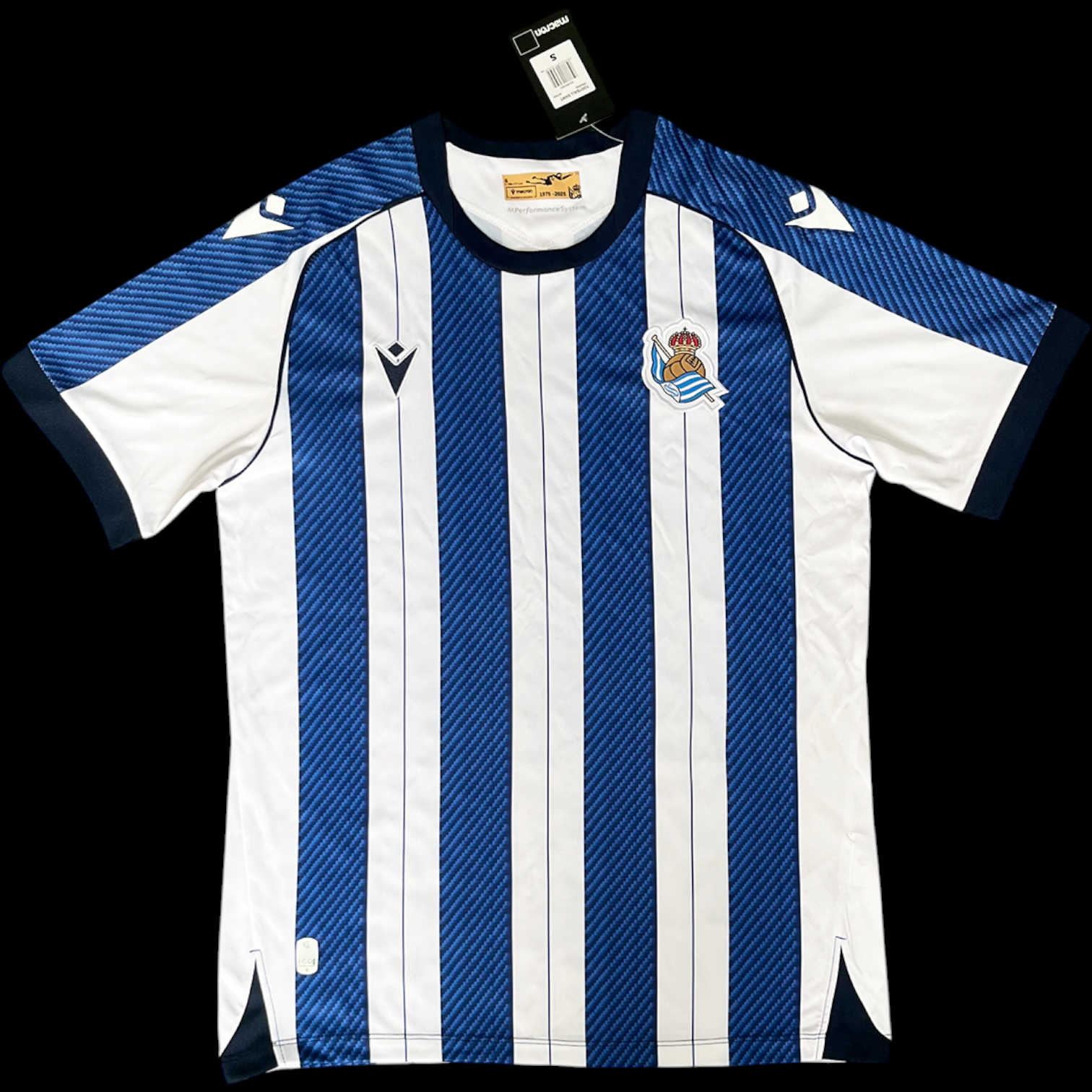
The blue and white colors that are the club’s hallmark were adopted from the founding. In Basque, this is called “txuri-urdin” (white-blue), a nickname used for both the team and its supporters. The home jersey traditionally alternates vertical blue and white stripes, in a style similar to several other European clubs (Argentina, Espanyol Barcelona, etc.).
The club crest incorporates the coat of arms of San Sebastián, with a royal crown recalling the title “Real”. Over the decades, the overall silhouette has changed little, reflecting a strong attachment to its visual heritage. Jerseys change every season like everywhere else, but blue and white remain the unchangeable signature.
The nickname “Erreala” (the Real, in Basque) is used locally, while the Spanish press prefers “los Donostiarras” (the people of Donostia, the Basque name for San Sebastián). All these identity markers reinforce the club’s regional roots, deeply tied to its city and its province (Gipuzkoa).
1981-1982: back-to-back La Liga titles under Ormaechea
The high point of Real Sociedad history remains the 1980-1981 and 1981-1982 seasons, when the club won two consecutive La Liga titles under Alberto Ormaechea. It was a major sporting feat at a time when Real Madrid and FC Barcelona dominated Spanish football. With a squad that was almost exclusively Basque, Real proved you can win against the giants while staying true to an identity.
The title-winning team relied on players such as goalkeeper Luis Arconada, iconic captain and Spanish international who played in the 1984 Euro final, striker Roberto López Ufarte (also an international), Jesús María Satrústegui (who scored 163 goals for the club in total), and midfielder Periko Alonso, father of future Xabi Alonso. All were formed or molded into the Basque model.
These two titles remain the only La Liga titles Real Sociedad has won. But they were enough to place the club in the very small group of teams that have won more than one consecutive Spanish league title. Alongside Real, Barça, Atlético, Athletic and Valencia, this is a marker that has shaped the pride of several generations of Donostia supporters.
Basque cantera until 1989
Like Athletic Bilbao, Real Sociedad long applied a recruitment policy based only on Basque players. This unwritten rule, inherited from the club’s origins, was respected until the late 1980s. For 80 years, only players born or trained in the Basque Country could wear the white-and-blue jersey.
The turning point came in 1989, when the club’s board decided to abandon this policy. The arrival of Irish striker John Aldridge from Liverpool marked the end of an era. This opening sparked intense internal debate among supporters, split between loyalty to Basque tradition and the need to stay competitive in a quickly globalizing game.
Today, Real Sociedad combines international recruitment and local development, with a training center in Zubieta that continues to produce players at La Liga level. The difference with Athletic Bilbao remains fundamental: Donostia now signs foreign players, Bilbao does not. To understand the other Basque club’s philosophy, our article on Athletic Bilbao details the famous cantera rule.
Reale Arena, the renovated Anoeta stadium
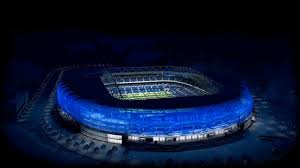
Real Sociedad’s stadium is Anoeta, now called Reale Arena after a naming rights deal in 2019 (Reale is an insurance company). Inaugurated in 1993 to replace the old Atocha stadium, the venue was fully renovated between 2017 and 2019, with the removal of the athletics track that previously pushed the stands away from the field.
Current capacity is about 40,000 seats, with the atmosphere becoming more intense since the renovation, which brought supporters closer to the game. Reale Arena is now among the most modern stadiums in La Liga, while still keeping a human scale that avoids the coldness of large anonymous venues.
The complex also hosts other sports events (rugby with Biarritz Olympique for European Cup matches), and remains a central site for Basque sporting life. Its proximity to La Concha Bay and downtown San Sebastián makes it one of the nicest stadiums to visit in Spain.
From Xabi Alonso to Antoine Griezmann
Zubieta’s cantera is one of Spain’s best youth academies. It has produced several major players over the past decades. Xabi Alonso began his professional career there before leaving for Liverpool in 2004. He is now considered one of the best managers in the world after his time at Bayer Leverkusen.
Antoine Griezmann, partially developed at the club after leaving Mâcon at 13, wore the white-and-blue jersey from 2009 to 2014 before joining Atlético Madrid. It was in San Sebastián that he learned professional football, in a team then coached by Philippe Montanier and later David Moyes. His international career owes a lot to that formative spell.
Other key figures mark recent history: Carlos Vela, Asier Illarramendi, Mikel Merino, Ander Barrenetxea. The club’s ability to produce international players from a limited regional pool remains one of its greatest strengths. It is a reputation that also attracts young talent and scouts from top European clubs.
Imanol Alguacil era and the 2020 Copa del Rey
Imanol Alguacil, a former player and Zubieta graduate, became head coach in December 2018. He imposed an attacking style based on possession, high pressing, and youth development. Under him, Real returned to European places season after season after a long period of decline in the weaker phases of La Liga.
The high point of this era was the 2020 Copa del Rey. The final, played on April 3, 2021 (because of COVID-19 scheduling), pitted two Basque clubs against each other: Real Sociedad and Athletic Bilbao. A one-off match in La Cartuja in Seville without fans, won 1-0 by Real thanks to a penalty from Mikel Oyarzabal. It was the club’s first major trophy in 33 years (1987 Copa del Rey).
Under Imanol, the club also qualified regularly for the Europa League, reaching the round of 16 in 2021 and the quarter-finals in 2024. The 2022-2023 season even saw Real Sociedad finish 4th in La Liga, qualifying for the 2023-2024 UEFA Champions League, its first C1 appearance since 2013-2014. A enviable consistency that cements the club in Spain’s top six.
The Oyarzabal and Kubo new generation
The current face of the club is Mikel Oyarzabal. Trained in Zubieta, captain, international left winger, he scored the goal that crowned Spain at the Euro 2024 final against England (2-1). It is a personal milestone that symbolizes the path of a club that still produces players at the highest international level.
Take Kubo, a Japanese player who arrived in 2022, has become the team’s other star. His technical talent and versatility make him a clear starter. Alongside Oyarzabal, Brais Méndez, Ander Barrenetxea, and Mikel Merino (who moved to Arsenal in 2024), he drives the team’s attacking side as it keeps attracting with its style of play.
The challenge in the coming seasons remains to stabilize this European consistency and, why not, aim for another major trophy. Real Sociedad writes a different script than Real Madrid or Barça, but it writes its own with real flair. To discover other uniquely traced Spanish regional clubs, our article on Celta Vigo tells another story of provincial pride.
What to remember
- Real Sociedad de Fútbol was founded on September 7, 1909, in San Sebastián, the seaside capital of Spain’s Basque Country.
- The title “Real” was granted in 1910 by King Alfonso XIII, who spent his summers in the city.
- The club applied a Basque-only recruitment policy until 1989, which ended with the arrival of Irishman John Aldridge.
- It won consecutive La Liga titles in 1980-1981 and 1981-1982 under Alberto Ormaechea, with a squad that was almost exclusively Basque.
- The 2020 Copa del Rey (final played in April 2021) was won 1-0 against Athletic Bilbao at La Cartuja in Seville, with a Mikel Oyarzabal penalty.
- Reale Arena (formerly Anoeta), renovated between 2017 and 2019, now welcomes around 40,000 spectators.
- The Zubieta cantera has developed Xabi Alonso, Antoine Griezmann, Mikel Oyarzabal, Mikel Merino, Carlos Vela and many others.
Go further
Real Sociedad’s history is inseparable from Basque football. To go deeper, we recommend our articles on Athletic Bilbao and the unique Basque recruiting philosophy, on Celta Vigo, another striking Spanish regional story, and on the best Liga jerseys where the blue-and-white txuri-urdin has a place.
Frequently asked questions
When was Real Sociedad founded?
Real Sociedad de Fútbol was officially founded on September 7, 1909, in San Sebastián. It was awarded the title “Real” in 1910 by King Alfonso XIII, who regularly stayed in the city during the summer. The club is one of the oldest in Spain.
How many La Liga titles has Real Sociedad won?
Real Sociedad has two La Liga titles, won consecutively in 1980-1981 and 1981-1982 under coach Alberto Ormaechea. This was a major achievement, accomplished with a squad that was almost entirely Basque, at a time when Real Madrid and FC Barcelona dominated the league.
Does Real Sociedad recruit only Basque players?
No, it hasn’t since 1989. For 80 years, the club followed a Basque-only policy, which was abandoned with the arrival of Irishman John Aldridge in 1989. Today, Real combines international recruitment and local development through the Zubieta academy. Athletic Bilbao, by contrast, remains committed to the rule of only Basque players.
Which big players have played for Real Sociedad?
The club has developed Xabi Alonso (left for Liverpool in 2004), Antoine Griezmann (partly trained at the club before joining Atlético in 2014), Mikel Oyarzabal (current captain and scorer of Spain’s 2024 European Championship title against England), Mikel Merino, Carlos Vela, Asier Illarramendi. Zubieta’s cantera remains one of the best in Spain.
Where does Real Sociedad play?
Real Sociedad plays at Reale Arena stadium (formerly Anoeta), located in San Sebastián. Inaugurated in 1993, the stadium was renovated between 2017 and 2019 to remove the running track and bring the stands closer to the pitch. Its current capacity is about 40,000 seats.
The txuri-urdin collection is waiting for you
All Real Sociedad jerseys are in the shop: home blue-and-white striped, away, third, player version, supporter version, and retro jerseys that recall the Liga titles of 1981 and 1982.