
On January 10, 1909, in Milan, two teams faced each other for the first time in an official match. On one side was the Milan Foot-Ball and Cricket Club, founded ten years earlier by Englishman Herbert Kilpin. On the other was Football Club Internazionale Milano, founded only ten months earlier by 44 dissidents from the first club. Milan won 3-2. No one knew that day that this match would become one of the most passionate rivalries in world football: the Derby della Madonnina.
More than 115 years later, over 240 official confrontations have opposed the two Milanese clubs. This article retraces the history of the Milan derby, its socio-economic roots, its mythic European Cup moments, and the uniqueness of a rivalry where both rival clubs have shared the same stadium, San Siro, since 1947.
Why is it called the Derby della Madonnina?
The derby gets its name from the golden statue of the Virgin that crowns the top of Milan’s cathedral, the Duomo. This 4-meter-tall Madonnina, erected in 1774, is one of the city’s most recognizable symbols. The idea of naming the derby this way emerged in the 1950s: the Virgin overlooks both clubs, like a patron figure that rises above the rivalry.
The other name used, simpler, is Derby di Milano. But Derby della Madonnina remains the official term and the one used by Italian and international media. This religious and architectural reference roots the derby in the city’s own identity, beyond sporting loyalties.
The uniqueness of this derby also comes from geography: no river or administrative boundary separates the supporters of the two sides. Milan is a dense city, where families and colleagues often share the same district but opposite loyalties. The rivalry is therefore lived every day, with no spatial divide making it more legible.
1908, the split that created the rivalry
The origin of the derby goes back to March 9, 1908. That day, 44 members of Milan Foot-Ball and Cricket Club, founded in 1899, left the club after a disagreement over recruiting foreign players. Milan, which had become mostly Italian in its recruitment, refused to open its squad further. The dissidents, who wanted a club open to the world, founded Football Club Internazionale Milano the same day, a name that was itself a manifesto.
This split, initially almost ideological, would durably shape the identities of both clubs. Milan claims local roots and loyalty to the founders. Inter affirms cosmopolitan openness and rejection of identity retreat. On the field, these differences translated into opposite recruitment choices during the first decades.
The first official derby took place on January 10, 1909 in Prima Categoria, and Milan won 3-2. Since then, the two clubs have faced each other at least twice per season in the league, plus matches in the Coppa Italia, European Cup, and friendlies. The total today exceeds 240 official confrontations, with a slight statistical advantage for Inter (91 wins versus 84 for Milan, and 71 draws).
Bauscia versus casciavid, the social divide
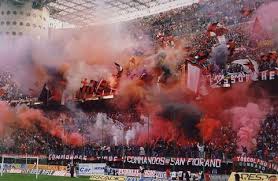
Throughout the 20th century, the Milan derby was understood through a socio-economic lens. Inter was seen as the club of Milanese high society, nicknamed bauscia (a dialect term meaning “show-offs” or “braggarts”). AC Milan was associated with the working class, nicknamed casciavid (“screwdriver,” a reference to workers and artisans).
This social divide was sustained by concrete factors. Inter, founded by intellectuals and industrialists eager to open up to the world, historically attracted Milan’s wealthier classes from downtown. Milan, more deeply rooted in the popular fabric, recruited more from industrial workers on the outskirts, especially from the northern districts. These representations shaped supporter identity for decades.
Today, those divides have largely faded. Supporter sociology has mixed, as have geographic origins. The rivalry remains fierce but is no longer primarily driven by class opposition. Both clubs now have supporters from all backgrounds, in Milan as well as in the rest of Italy and the world.
San Siro, the shared stadium since 1947
One of the most striking characteristics of the Milan derby is that both clubs have shared the same stadium since 1947. Built in 1926 at the initiative of Milan president Piero Pirelli, San Siro Stadium was used exclusively by AC Milan in its early years. Inter, which played at Arena Civica in the center of Milan, moved to San Siro in 1947 in a cost-sharing move.
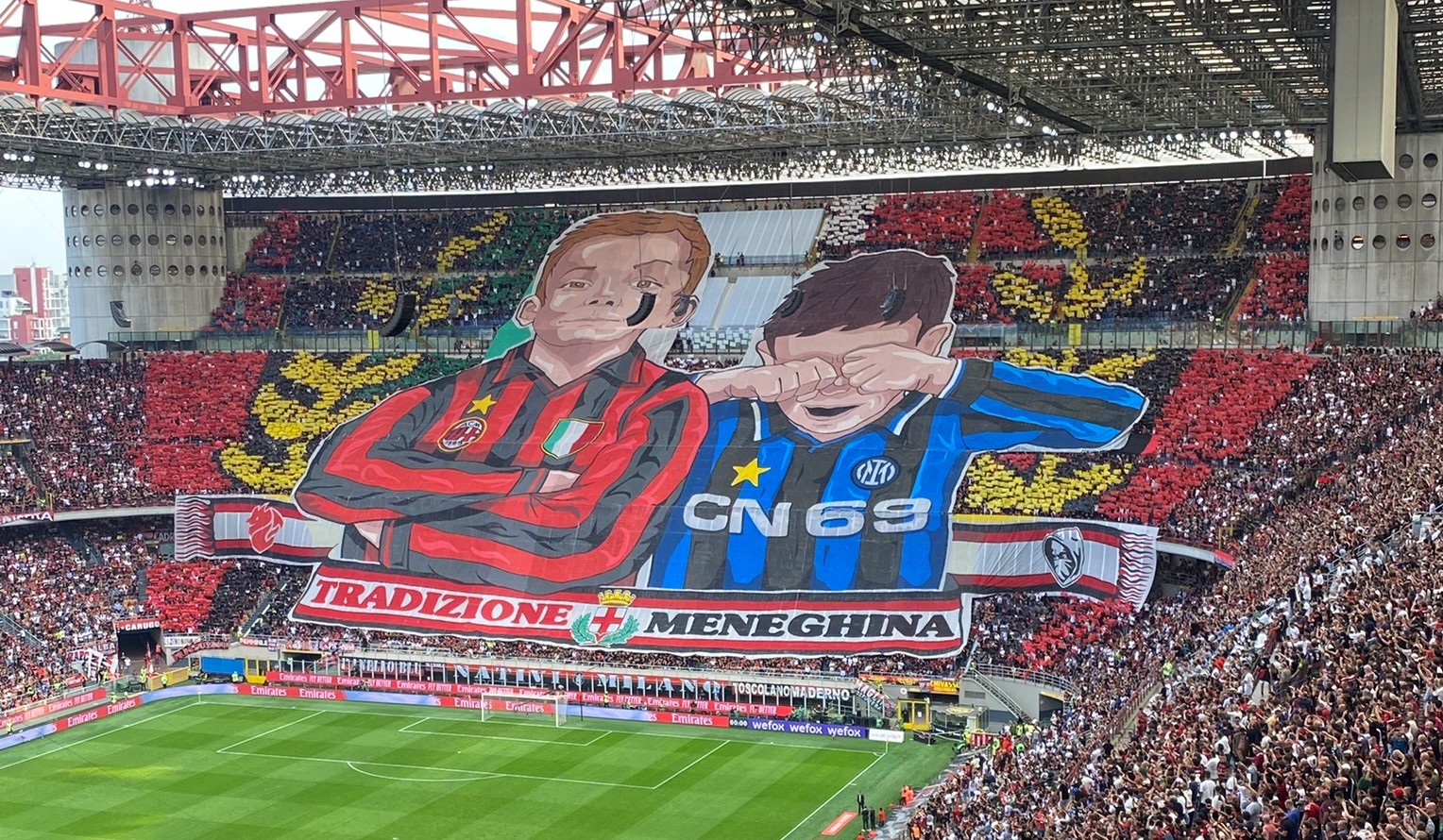
The stadium was officially renamed Giuseppe Meazza in 1980, two years after the death of the legendary striker who had played for both clubs (mainly for Inter). Meazza’s double affiliation, a historical exception, illustrates the uniqueness of a rivalry where some names can transcend club lines. The stadium today has 75,817 seats in limited configuration and 80,018 at maximum.
The idea of replacing San Siro with two separate stadiums or one new shared stadium has been debated for years. Multiple scenarios have been considered (demolition, renovation, building elsewhere) without one consensus emerging. For supporters, San Siro remains the sacred place of Milan calcio, even if its maintenance and modernization pose growing challenges.
2003, historic Champions League semifinal
The Milan derby has always been a national event, but it took on a European dimension in 2003 with the first Champions League semifinal between the two clubs. The iconic two-legged tie saw AC Milan qualify for the final thanks to the away-goals rule after two draws (0-0 then 1-1).
The decisive goal, scored by Andriy Shevchenko in the second leg, sent Milan to the Old Trafford final, which it later won against Juventus. For Inter, elimination was painful, especially since it happened at San Siro, at home for the Nerazzurri that night. This 2003 semifinal was a turning point: for the first time, the derby was broadcast to hundreds of millions of viewers worldwide, and both clubs moved beyond their purely Italian frame.
The year 2003 also illustrates the tactical uniqueness of the derby: despite the stakes, the teams did not become a goal-fest. Ancelotti’s Milan and Héctor Cúper’s Inter neutralized each other in a chess-like duel where each mistake could cost qualification. A semifinal that will remain in the memory of both sides.
2005, the quarter-final interrupted by flares
Two years later, in April 2005, the two clubs met again in European competition, this time in the quarter-final. The first leg saw Milan win 2-0 at San Siro. The return leg, also played at San Siro (both clubs being at home in rotation), became heated. Around the 73rd minute, with Milan leading 1-0, Inter supporters threw flares onto the pitch, one of which hit Milan goalkeeper Dida.
The referee stopped the match, waited for calm, but more devices kept coming. He ultimately decided to end the match permanently. UEFA, after review, awarded a 3-0 win to AC Milan on paper and handed heavy sanctions to Inter (partial closed-doors match, fine). Milan qualified for the semifinal, where it eliminated PSV before losing the famous Istanbul final to Liverpool.
This episode remains one of the most painful moments in recent Inter history, both for the sporting result and for the image left by some supporters. It helped lead to stricter measures against pyrotechnic devices in Italian and European stadiums.
2023, Inter takes its revenge in the semifinal
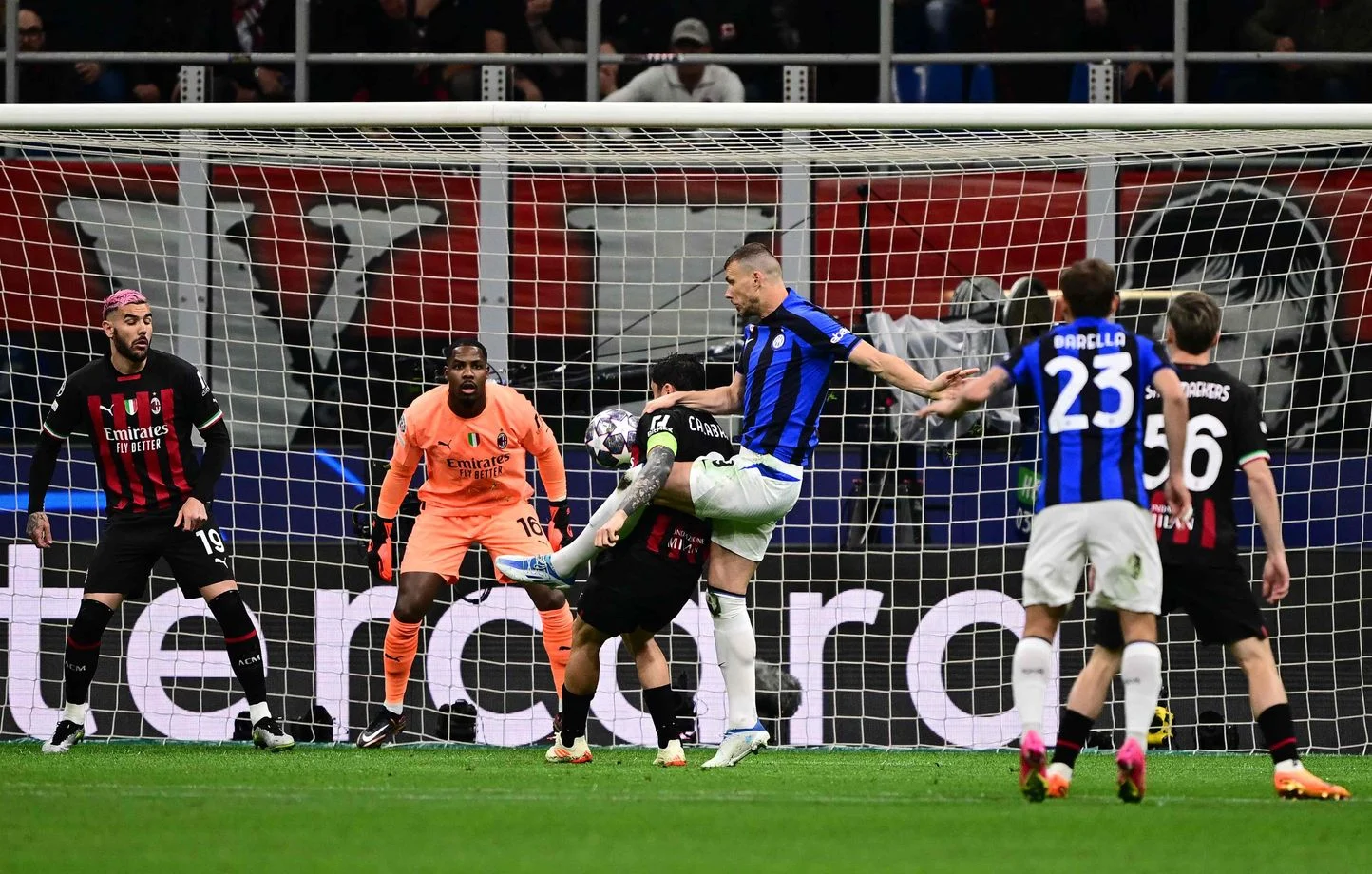
Twenty years after 2003, the derby returned in the Champions League semifinal. In May 2023, Inter and Milan met again for a place in the final. This time, Inter took control. It won 2-0 in the first leg (a brace from Edin Džeko and Henrikh Mkhitaryan), then 1-0 in the second leg thanks to Lautaro Martínez.
Simone Inzaghi’s Inter reached its first Champions League final since the 2010 treble. It lost that final 1-0 to Manchester City in Istanbul, on a Rodri goal, but the return to the top of Europe was sealed. For Milan, the elimination in the semifinal closed a European cycle opened under Pioli with the 2022 Scudetto.
This 2023 semifinal confirms the derby’s international dimension: today AC Milan vs Inter is watched around the world, among benchmark rivalries such as El Clásico (Real-Barça), Superclásico (Boca-River), and the Istanbul derby (Galatasaray-Fenerbahçe).
Players who crossed the border
In derby history, some players have had the rare privilege (or boldness) of playing for both clubs. The list includes major names: Giuseppe Meazza, who spent most of his career at Inter before a short final spell at Milan. More recently, Brazilian Ronaldo, who moved from Inter to Milan in 2007. Andrea Pirlo, raised at AC Milan after leaving Inter (where he was seen as promising but not retained).
Clarence Seedorf, Christian Vieri, Hernán Crespo, and Zlatan Ibrahimović have also played on both sides of the Naviglio. The most controversial case remains that of Hakan Çalhanoğlu, who left Milan for Inter in 2021 at the end of his contract, sparking anger among Rossoneri supporters. His provocative celebration after scoring against his former club has become a recurring topic of the derby.
For more on the two protagonists, we published a feature on AC Milan history and its Sacchi-Berlusconi era, as well as on Inter Milan and the Grande Inter. For the next chapter of calcio, our 125-year piece on Juventus revisits the major shared rival of both Milanese clubs.
What to remember
- The Derby della Madonnina is named after the golden statue of the Virgin that crowns the top of Milan’s cathedral.
- The derby’s origin dates back to the March 9, 1908 split, when 44 AC Milan dissidents founded Inter Milan.
- The first official derby took place on January 10, 1909, with Milan winning 3-2.
- Over 240 official confrontations have taken place, with a slight edge for Inter (91 wins vs 84 for Milan).
- Both clubs have shared San Siro since 1947, officially renamed Giuseppe Meazza in 1980.
- 2003 Champions League semifinal: Milan qualified thanks to the away-goals rule (1-1).
- 2005 quarter-final: match interrupted by flares and 3-0 awarded on paper to Milan.
- 2023 semifinal: Inter won 3-0 on aggregate and reached the final, which it lost to City.
Go further
To explore both protagonists of the derby in detail, read our features on AC Milan history and Inter Milan history. Our Juventus feature revisits the major shared rival, and our top 10 greatest Serie A jerseys traces the iconic pieces of Italian football.
Frequently asked questions
Why is the Milan derby called the Derby della Madonnina?
The name refers to the golden statue of the Virgin (the Madonnina) that crowns the top of Milan’s cathedral, the Duomo. This naming, which appeared in the 1950s, ties the derby to the identity of the city, beyond sporting loyalties.
What is the origin of the Milan-Inter rivalry?
The rivalry began on March 9, 1908, when 44 members of AC Milan left the club after disagreeing over the recruitment of foreign players. They founded Football Club Internazionale Milano that same day, and its very name asserts cosmopolitan openness in contrast to the parent club’s inward turn.
Why do both clubs share San Siro?
San Siro was built in 1926 at AC Milan’s initiative. Inter, which played at Arena Civica in central Milan, moved to San Siro in 1947 to share costs. Since then, the two clubs share the stadium, which has 75,817 seats and was renamed Giuseppe Meazza in 1980.
What is the overall Milan derby record?
In more than 240 official confrontations since 1909, Inter has 91 wins, 71 draws, and AC Milan has 84 wins. The largest win remains Inter’s 6-0 victory over Milan on May 11, 2001, and the highest-scoring match is Inter 6-5 Milan on November 6, 1949 (11 goals).
Which players have played for both clubs?
Several major players have crossed the divide between the two sides: Giuseppe Meazza, Ronaldo (the Brazilian), Andrea Pirlo, Clarence Seedorf, Christian Vieri, Hernán Crespo, Zlatan Ibrahimović. The most controversial case remains Hakan Çalhanoğlu, who left Milan for Inter in 2021 on a free transfer.
Show your Milan colors
Whether you are a Rossonero or a Nerazzurro, the store offers jerseys from both Milan clubs: home, away, third, player version, fan version, and retro jerseys that recall the major editions of the Derby della Madonnina.