
On May 26, 1993, at Munich’s Olympiastadion, Basile Boli rose higher than the Milan defense and sent an unstoppable header past Sebastiano Rossi. Olympique de Marseille led 1-0 against defending champion AC Milan. At the end of the match, the Vieux-Port erupted, smoke bombs filled the Champs-Élysées, and French soccer finally claimed its first European Cup title.
OM has built this moment over nearly a century. From the multi-sport club founded in 1899 by René Dufaure de Montmirail to Bernard Tapie’s megalomaniacal ambitions, through the golden age of the 1970s, the Marseille institution has carved out a unique path in the landscape of French soccer. Here is the story of OM, in all its glory and its dark moments.
1899: The Founding and Marseille’s Roots
Olympique de Marseille was founded on August 31, 1899, under the leadership of René Dufaure de Montmirail. From the very beginning, it was not just a soccer club but a multi-sport organization that also included rugby, track and field, and fencing. In fact, it was the rugby division that coined the motto still in use today, “Droit Au But” (Straight to the Goal), which the entire club has adopted over time.
The name chosen pays homage to the ancient city. Marseille was founded by the Phocaeans around 600 BCE, and the term “Olympique” refers to the ancient Olympic Games. This claimed connection also explains the nickname “Les Phocéens,” which the club still bears today. The white colors with sky-blue trim echo those of the city’s flag.
The club’s early years were spent far from the Vélodrome. OM first played at the Stade de l’Huveaune, in the 10th arrondissement, from 1904 to 1937. The club rose through the regional and then national ranks as soccer became more organized in France, and participated in the first professional league season in 1932–1933.
The first titles and the move to the Vélodrome
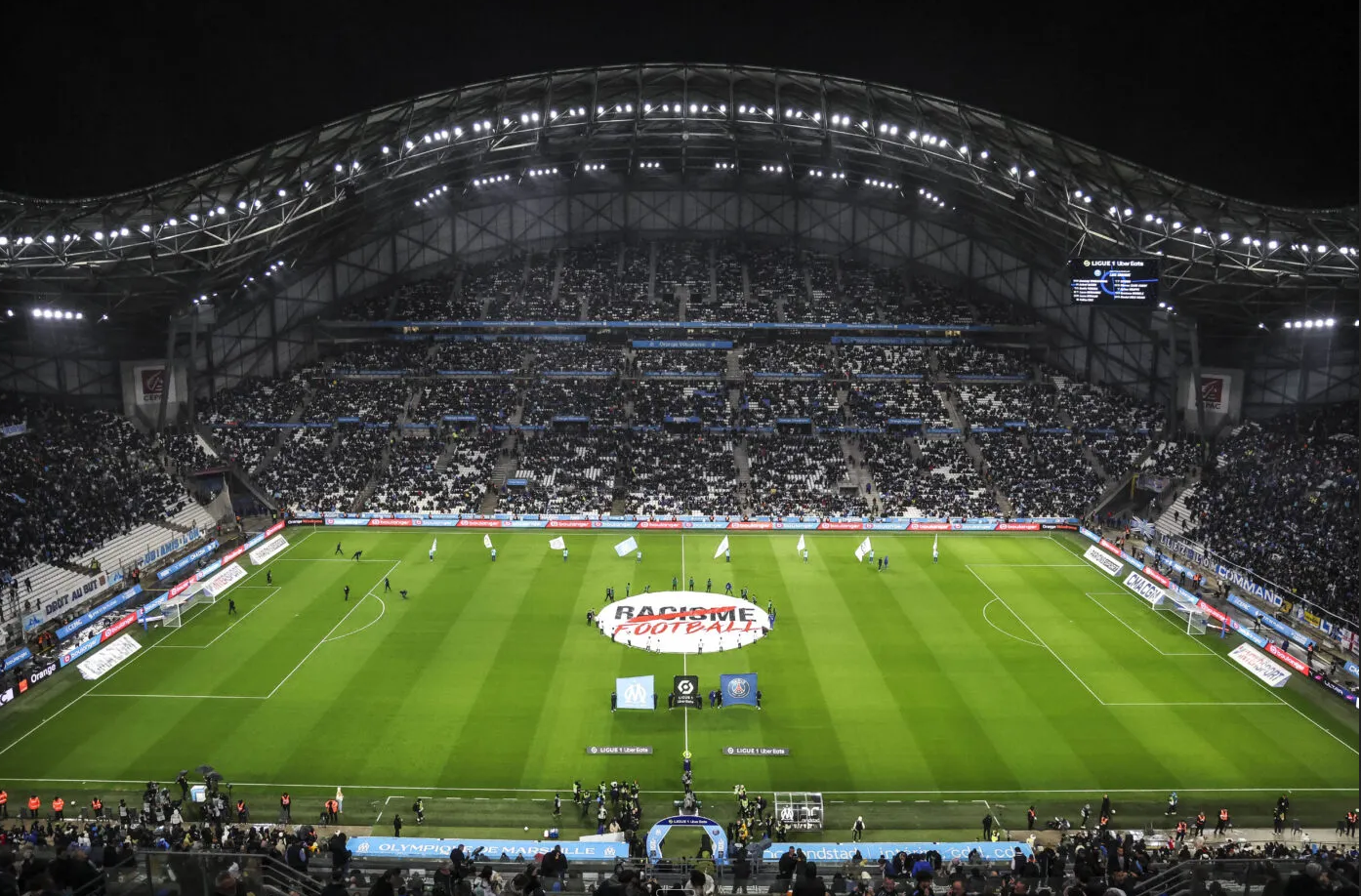
The club’s first national title came in 1937: OM won its first French league title. That same year, the club moved to the Stade Vélodrome, built to host the 1938 World Cup held in France. The stadium, located in the 8th arrondissement, would go on to become one of the most iconic stadiums in Europe.
OM went on to win several French Cups, particularly in the 1920s and 1930s, and added two more French league titles in 1948 and 1971. In between, the club went through quieter periods, marked by the war and then by the city’s sporting and economic reconstruction. The Vélodrome, however, remained packed: Marseille had grown attached to its club as if it were an emblem.
The 1970s: The Golden Age of Skoblar and Magnusson
The 1970s marked the beginning of a golden era. Under the presidency of Marcel Leclerc, OM won the French league title in 1971 and 1972, then added the Coupe de France in 1972 (a league-and-cup double) and 1976. Yugoslav striker Josip Skoblar finished as Europe’s top scorer in 1971 with 44 league goals, a record that still stands in Ligue 1.
Alongside him, Swedish forward Roger Magnusson shone on the right wing. The Skoblar-Magnusson duo remains one of the most prolific attacking partnerships in the club’s history. The Stade Vélodrome witnessed some memorable European nights during that time, even though OM did not reach the major continental finals until the following decade.
The late 1970s and early 1980s were a more difficult period. The club faced financial difficulties and was even briefly relegated to the second division in 1980, before bouncing back and stabilizing its roster. This turbulent period paved the way for the arrival of a new president, who would transform OM into a winning machine on the European stage.
The arrival of Bernard Tapie in 1986
In April 1986, Bernard Tapie became president of Olympique de Marseille. The Marseille-based businessman, then a member of parliament and a media personality, arrived with a clear ambition: to make the club a powerhouse in France and Europe. He invested heavily, signed international stars, and implemented a long-term plan that was unprecedented in French soccer.
The first major transfers set the tone. Karl-Heinz Förster, Alain Giresse, and especially Jean-Pierre Papin, who became one of the world’s top scorers while wearing the Olympique jersey. Next came Chris Waddle (1989), Abedi Pelé (1987), Carlos Mozer, Basile Boli (1990), Marcel Desailly, Rudi Völler (1992), Alen Bokšić (1992), and Didier Deschamps (1989). OM gradually assembled one of the best teams on the continent.
Tapie is also changing the way the club is perceived. With an aggressive communication strategy, unapologetic marketing, and openly stated European ambitions, Marseille is no longer content to be just a major French club—it is aiming for the top in Europe. The Vélodrome has become one of the most impressive stadiums on the continent, with a crowd capable of turning around even the most hopelessly lost matches.
Four consecutive titles (1989–1992)
Between 1989 and 1992, Olympique de Marseille won four consecutive French league titles. No French club had achieved such a streak since Saint-Étienne in the 1970s. These titles were accompanied by regular appearances in the European Cup, the predecessor of today’s Champions League.
The great missed opportunity took place in Bari, Italy, on May 29, 1991. Olympique de Marseille faced Red Star Belgrade in the European Cup final. After a frustrating 0-0 draw, Marseille lost in a penalty shootout. The disappointment was immense: the club had come so close to the Holy Grail that it seemed unwilling to wait any longer.
Tapie wouldn't let the idea go. He strengthened the team in the summer of 1992 with the arrival of Rudi Völler and the return of Abedi Pelé. The 1992–1993 season would be the club's crowning achievement, but it would also leave a lasting mark on the club due to the legal fallout.
Munich 1993: The Champions League
On May 26, 1993, Olympique de Marseille played in the final of the first edition of the new Champions League at Munich’s Olympiastadion, in front of 64,400 spectators. Their opponents were Fabio Capello’s AC Milan, the defending champions, featuring Marco van Basten, Frank Rijkaard, Demetrio Albertini, and Roberto Donadoni. Swiss referee Kurt Röthlisberger kicked off the match.
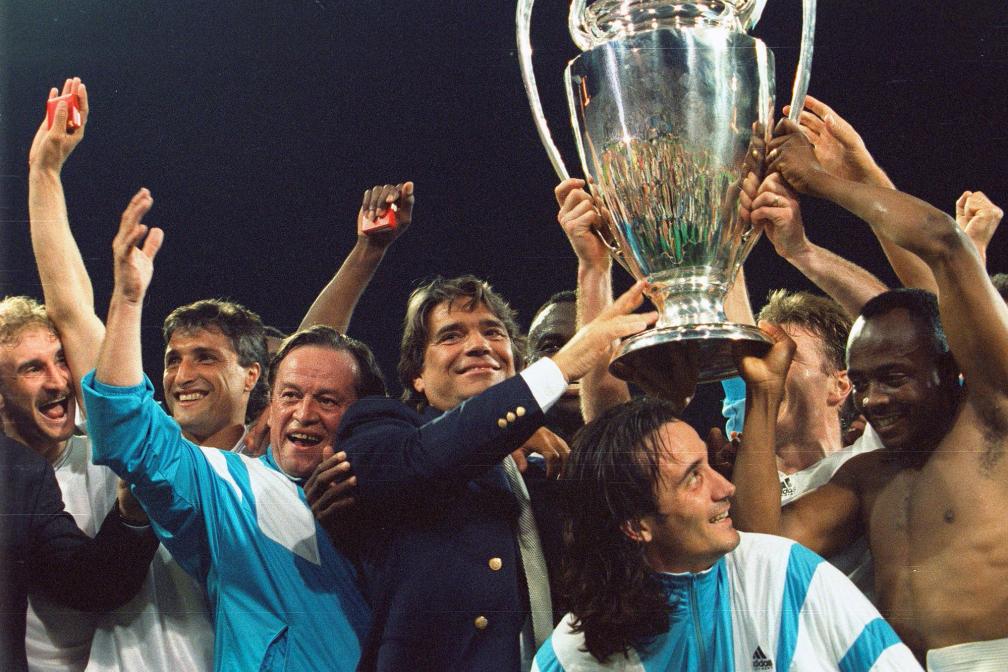
In the 43rd minute, Abedi Pelé took a corner kick from the left. Basile Boli rose above the Milan defense and sent a powerful header into the back of the net. 1-0. Marseille leads at halftime and holds on to its lead until the final whistle, led by captain Didier Deschamps and coach Raymond Goethals. For the first time in history, a French club wins the European Champions Cup.
The return to Marseille turned into a grand finale. Hundreds of thousands of fans flooded the Canebière and the Old Port. The club turned what had previously been nothing more than a fantasy in French soccer into reality. For a detailed look at that night, check out our feature on the 1993 Munich final.
The VA-OM Case and the Demotion
The triumph was quickly marred by a scandal that broke a few days after the final. On May 20, 1993, six days before the match in Munich, OM had faced Valenciennes in league play. Several Valenciennes players, including Jacques Glassmann, reported attempts at bribery aimed at persuading them to take it easy. The investigation revealed the involvement of Jean-Pierre Bernès, OM’s general manager, and player Jean-Jacques Eydelie.
The sanctions were imposed in 1994. The French Football Federation stripped Olympique de Marseille of its 1992–1993 league title and administratively relegated the club to the second division. UEFA, however, never revoked the European Cup title: Olympique de Marseille remains the official winner of the 1992–1993 Champions League.
The trial took place in March 1995 at the Valenciennes Criminal Court. Bernard Tapie was sentenced to two years in prison, one of which was to be served. Jean-Pierre Bernès received a two-year suspended sentence. The club’s reputation was permanently tarnished, and this generation’s European campaign came to an abrupt end: OM would not play in the Champions League again until 1999.
The Modern Era and the McCourt Takeover
After several years of rebuilding, OM won another French league title in 2010 under Didier Deschamps, who had by then become the team’s coach. It was the club’s ninth national title, and its first since the 1992–1993 championship was revoked. Three consecutive League Cups between 2010 and 2012 rounded out this era, featuring players such as Mathieu Valbuena, André-Pierre Gignac, and Steve Mandanda.
In October 2016, American businessman Frank McCourt acquired 95% of the club. He succeeded Margarita Louis-Dreyfus, who had owned OM since the death of Robert Louis-Dreyfus in 2009. McCourt promised massive investments and a new era. The Vélodrome, renovated for Euro 2016 with a full roof, reached its current capacity of 67,394 seats.
On the field, OM reached the Europa League final in May 2018 in Lyon, where they lost to Atlético Madrid (0–3). In the 2019–2020 season, the club finished second in Ligue 1 under André Villas-Boas, behind PSG. Since then, the club has alternated between intense European campaigns and rebuilding phases, without having yet regained the French league title.
Key Takeaways
- Olympique de Marseille was founded on August 31, 1899, by René Dufaure de Montmirail as a multi-sport club.
- The motto “Straight to the Point” comes from the club’s rugby team.
- OM has won 9 French league titles and 10 French Cups.
- The Tapie era (1986–1994) was marked by four consecutive Ligue 1 titles between 1989 and 1992.
- On May 26, 1993, in Munich, Olympique de Marseille defeated AC Milan 1-0 (goal by Basile Boli) in the Champions League final.
- To this day, the club remains the only French club to have won the European Cup / Champions League.
- The VA-OM scandal cost the club its 1992–1993 league title and led to its administrative relegation in 1994, though it did not affect its European title.
- Frank McCourt has owned the club since October 2016. The Stade Vélodrome now has a capacity of 67,394.
Learn more
To explore other aspects of Olympique’s history, read our in-depth look at the night of Munich in 1993, our retrospective on the evolution of OM’s white and blue jersey, and our feature on the OM-PSG Derby. To learn more about the club’s historic southern rival, our feature on AS Saint-Étienne traces the history of Les Verts back to the 1970s.
Frequently Asked Questions
When was Olympique de Marseille founded?
OM was founded on August 31, 1899, by René Dufaure de Montmirail. Originally, it was a multi-sport club that also played rugby, practiced track and field, and competed in fencing, before becoming the soccer club you know today.
How many titles has OM won?
Olympique de Marseille has won 9 French league titles, 10 French Cups, 3 League Cups, and 1 Champions League title (in 1993). The 1992–1993 league title was stripped by the French Football Federation following the VA-OM scandal.
Which European final did Olympique de Marseille win?
Olympique de Marseille won the Champions League on May 26, 1993, at the Olympiastadion in Munich, defeating AC Milan 1-0. The goal was scored in the 43rd minute by Basile Boli off a corner kick by Abedi Pelé. The club remains the only French club to have won the trophy.
Where does the slogan “Straight to the Point” come from?
The motto originated with the OM rugby team in the late 19th century. It was gradually adopted by the entire club and still appears on the jersey and crest. It encapsulates the attacking spirit that the Olympians have historically championed.
Who is the current owner of OM?
American businessman Frank McCourt has owned Olympique de Marseille since October 2016, holding approximately 95% of the club’s shares. He took over from the Louis-Dreyfus family, which had controlled the club since 1996.
Want to add an OM jersey to your collection?
All Olympique de Marseille jerseys are available in our store: home, away, third, player editions, fan editions, as well as retro jerseys that marked the club’s greatest seasons.