
Un maillot blanc à liseré bleu ciel. Cinq mots qui résument plus de 125 ans d’identité visuelle de l’Olympique de Marseille. Depuis la fondation du club en 1899, la base du maillot olympien n’a presque jamais bougé : un fond blanc inspiré du drapeau de la ville, agrémenté de touches de bleu ciel qui le rendent immédiatement reconnaissable dans n’importe quel stade d’Europe.
Mais derrière cette continuité graphique, l’histoire du maillot de l’OM raconte aussi celle d’un club qui a accompagné l’évolution du football moderne. Équipementiers qui changent, sponsors qui s’affichent en grand, versions third de plus en plus audacieuses, retour des maillots rétro auprès des fans : voici comment le blanc et bleu de la Canebière a traversé les époques.
L’origine des couleurs blanc et bleu
Quand l’Olympique de Marseille naît le 31 août 1899, la nouvelle société omnisports ne se contente pas d’inventer un nom évoquant les Jeux antiques et les origines phocéennes de la ville. Elle choisit aussi un code couleur qui reprend directement le drapeau municipal : un fond blanc et une croix bleu ciel. La symbolique est immédiate, le maillot devient une extension visuelle de la cité.
Pendant des décennies, le maillot domicile de l’OM reste essentiellement blanc, avec un liseré bleu plus ou moins prononcé selon les époques. Cette sobriété a une vertu : elle traverse les modes sans paraître datée. Les anciennes photos en noir et blanc des années 1930 et 1940 montrent déjà cette épure, qu’on retrouve à peu près à l’identique sur les maillots actuels.
Le bleu ciel n’est pas une couleur secondaire au sens strict. C’est une couleur d’accent, présente sur le col, les manches, parfois en bandes verticales, parfois en filets discrets. C’est cette tension entre un fond clair et des touches de bleu qui fait la signature du maillot olympien.
L’écusson et la devise “Droit Au But”
Sur la poitrine du maillot trône l’écusson, immédiatement reconnaissable. Le logo a évolué plusieurs fois, mais l’élément central est resté : la devise “Droit Au But”, héritée de la section rugby du club, qui résume l’esprit offensif revendiqué par l’OM depuis ses premières années. Les initiales “OM” entrelacées dans certaines versions, l’étoile au-dessus depuis 1993, complètent l’identité visuelle.
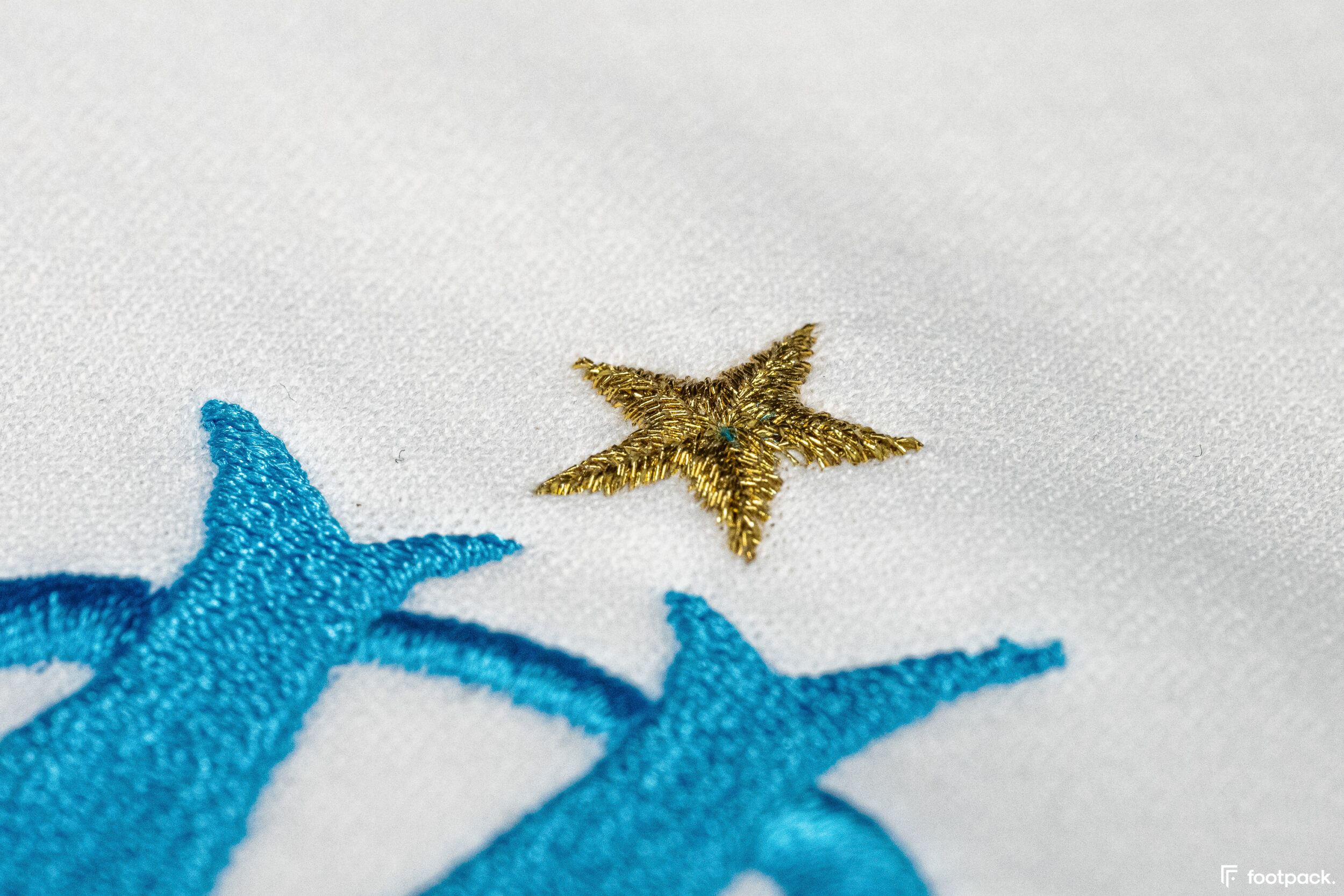
L’étoile, justement, est arrivée après le sacre européen. Les clubs français ne sont pas autorisés à porter d’étoile pour les titres nationaux, mais l’OM a choisi d’arborer la sienne en référence au trophée de la Ligue des Champions remporté à Munich. Une étoile unique dans l’histoire du football français, que le maillot affiche fièrement sur le côté droit du logo.
Les équipementiers successifs
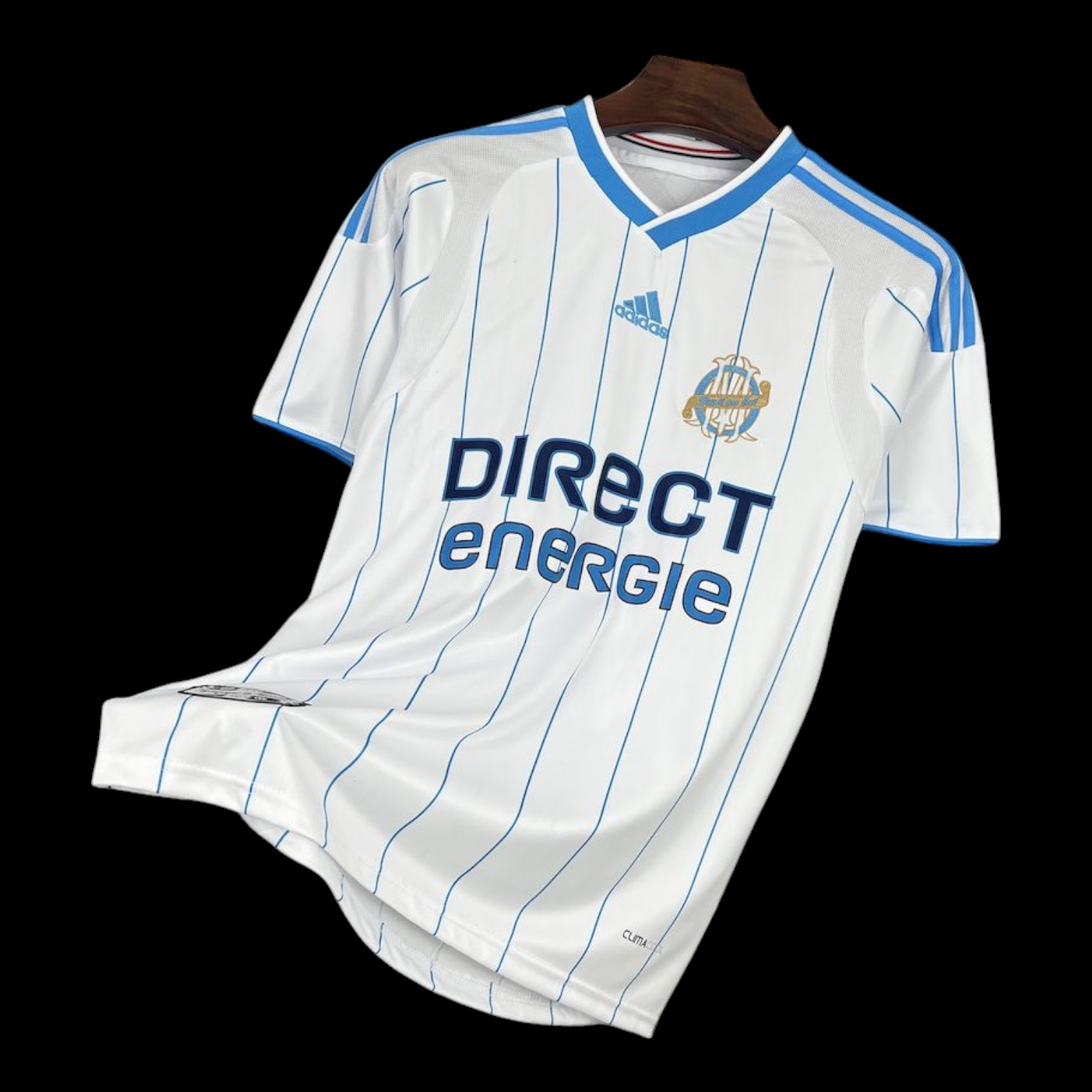
L’OM a connu plusieurs équipementiers majeurs au fil des décennies. Le Coq Sportif a habillé le club au tournant des années 1970, puis Adidas a pris le relais sur la majeure partie de l’ère Tapie et au-delà, signant en particulier le maillot historique du sacre européen de 1993. Reebok et Mizuno ont également équipé le club brièvement au milieu des années 1990, avant le retour d’Adidas sur la longue durée.
Chaque équipementier a apporté sa griffe : trois bandes Adidas sur les manches, ergonomie des matières, coupes plus ou moins ajustées, traitements anti-transpirants. Mais tous se sont pliés à la même règle : ne pas trahir la base blanche et bleu ciel. Les fans de l’OM sont parmi les plus attachés à l’identité graphique de leur club et ne pardonnent pas les expérimentations trop éloignées de la tradition.
Le maillot de 1993 : l’icône absolue
Si un maillot de l’OM devait incarner toute l’histoire du club, ce serait celui de la saison 1992-1993. C’est ce kit Adidas, blanc avec liseré bleu marine, qui a été porté par Basile Boli, Didier Deschamps, Marcel Desailly, Rudi Völler, Abedi Pelé et leurs coéquipiers le soir du 26 mai 1993 à l’Olympiastadion de Munich. Le tee-shirt Panasonic frappé en sponsor maillot, la coupe ample des années 1990, les détails brodés : tout évoque cette nuit qui a fait basculer le football français.
Ce maillot est aujourd’hui l’un des plus recherchés du marché des vêtements de football vintage. Les exemplaires d’époque s’échangent à des prix élevés sur le marché de la seconde main, et les rééditions officielles ou inspirées trouvent toujours preneur. Pour comprendre pourquoi, il faut revenir à la nuit elle-même : notre décryptage de la finale OM-Milan raconte le contexte qui a transformé ce textile en relique.
Les sponsors qui ont marqué le maillot
Le sponsoring maillot a fait son apparition dans le football français à partir de la fin des années 1970. À l’OM, plusieurs marques se sont succédé sur la poitrine des joueurs au fil des décennies. Panasonic accompagne le club au moment du quadruplé et du sacre européen, à la fin des années 1980 et au début des années 1990. Eurest, Parmalat puis Ericsson prennent le relais dans les années qui suivent.
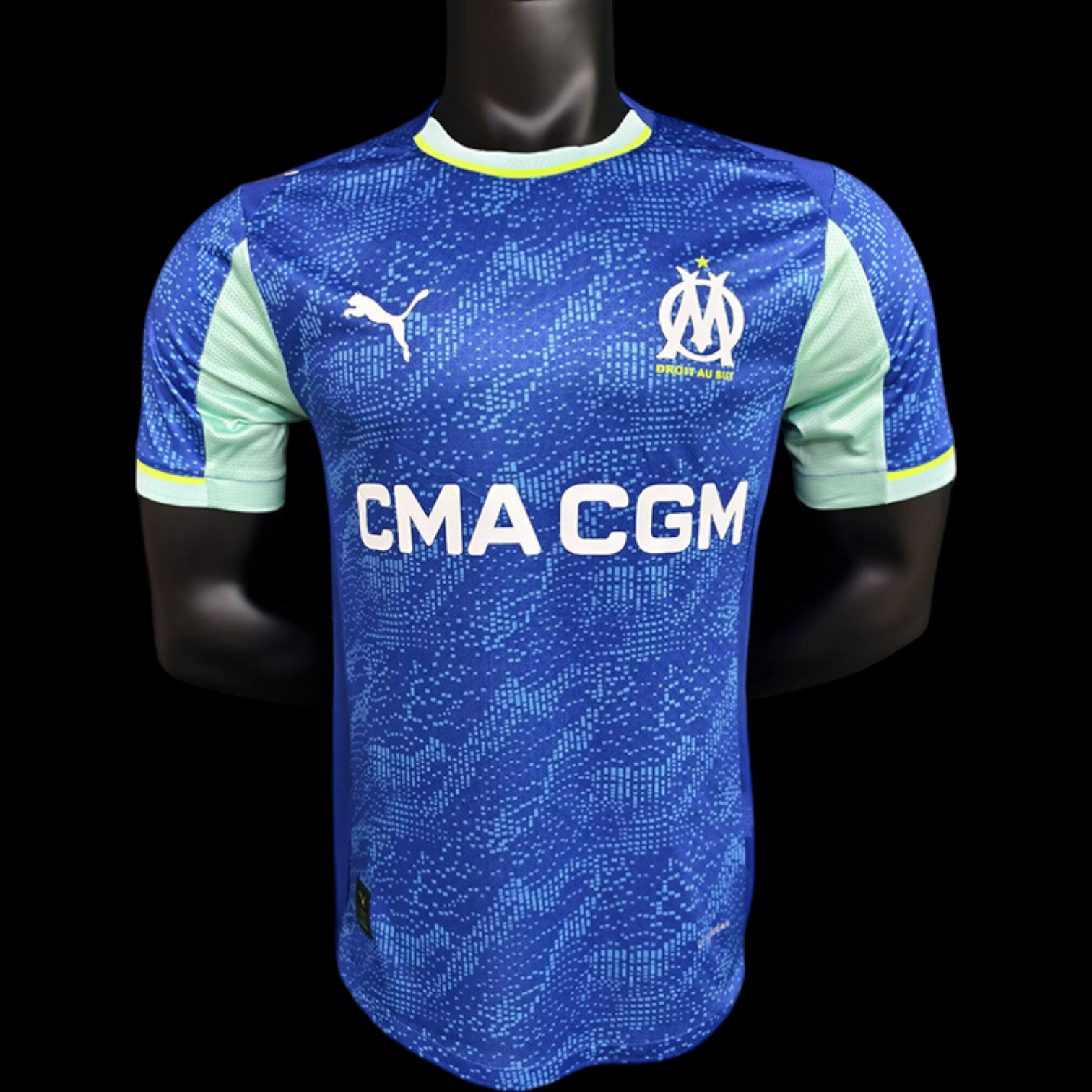
À partir des années 2000, les contrats se multiplient et se renouvellent plus vite : Neuf Telecom, Direct Énergie, BetClic, Intersport, Orange. Plus récemment, Uber Eats puis CMA CGM, l’armateur emblématique de Marseille, ont occupé l’avant du maillot. Le retour de CMA CGM au premier plan en 2023 a été particulièrement salué par les supporters, attachés à voir une entreprise marseillaise associée à leur club.
Maillots extérieur et third : l’audace assumée
Si le maillot domicile reste l’icône intouchable, l’OM s’est progressivement autorisé plus de liberté sur les kits extérieur et third. Bleu marine profond, noir, gris anthracite, jaune fluo, beige clair, motifs inspirés du Vieux-Port ou des calanques : les déclinaisons ont été nombreuses ces dernières années, avec parfois des partis pris graphiques très tranchés.
Cette audace assumée répond à la fois à une logique de marketing (multiplier les pièces collectionnables) et à une réalité du football moderne : les clubs portent désormais trois maillots distincts par saison, voire quatre quand on ajoute les éditions spéciales. Pour un fan, c’est aussi l’occasion de varier les pièces dans son armoire sans renier la base blanche et bleue.
L’ère Puma depuis 2018
Depuis la saison 2018-2019, c’est Puma qui équipe l’Olympique de Marseille. La marque allemande a succédé à Adidas, après un long partenariat. Les maillots Puma ont apporté un design plus contemporain, des matières plus techniques, une coupe ajustée typique de l’équipementier de Herzogenaurach. Le bleu ciel a été retravaillé dans des nuances légèrement différentes selon les saisons, parfois plus marine, parfois plus turquoise.
Puma a aussi multiplié les éditions spéciales et les collaborations. Maillots third aux esthétiques affirmées, capsules en édition limitée, séries autour des années cultes du club : la marque a compris que l’OM était autant un objet textile qu’un club de football, et elle a joué la carte du collector autant que celle du sportswear.
Les maillots rétro : la mémoire qui se porte
Le marché des maillots rétro a explosé ces dernières années, et l’OM est l’un des clubs les plus prisés. Les fans cherchent à porter le kit du sacre européen 1993, ceux du quadruplé 1989-1992, parfois même les versions plus anciennes des années 1970, à l’époque de Skoblar et Magnusson. Ces pièces racontent une époque, un joueur, un souvenir précis.
L’intérêt pour ces maillots s’est largement généralisé. Les fans plus jeunes, qui n’ont pas connu Munich 1993, s’approprient ces vêtements comme des objets culturels, au même titre qu’un vinyle ou qu’un tee-shirt vintage. Pour les plus anciens, c’est un moyen de raviver des souvenirs précis : la finale de Bari, le but de Boli, les soirées européennes au Vélodrome.
Ce qu’il faut retenir
- Le maillot domicile de l’OM est blanc à liseré bleu ciel depuis la fondation du club en 1899, en référence au drapeau de Marseille.
- L’écusson porte la devise “Droit Au But”, héritée de la section rugby de la société omnisports.
- Une étoile unique sur le maillot rappelle le sacre en Ligue des Champions de 1993, seul titre européen majeur d’un club français.
- Plusieurs équipementiers ont habillé le club, notamment Le Coq Sportif, Adidas (sur la majeure partie de l’ère Tapie et bien au-delà), Reebok, Mizuno, puis Puma depuis 2018.
- Le maillot Adidas de la saison 1992-1993, avec sponsor Panasonic, reste l’icône absolue du club.
- Le sponsor maillot actuel est CMA CGM, l’armateur basé à Marseille.
- Les maillots rétro de l’OM (1993, 1989-1992, années 1970) sont parmi les plus recherchés sur le marché du vêtement de football vintage.
Pour aller plus loin
Pour replacer le maillot dans son contexte sportif, lisez notre histoire complète de l’OM et notre décryptage de la finale de Munich 1993. Côté rivalités, notre dossier sur le Classique OM-PSG raconte la concurrence directe entre les deux maillots les plus suivis du championnat.
Questions fréquentes
Pourquoi le maillot de l’OM est-il blanc et bleu ?
Les couleurs reprennent celles du drapeau municipal de Marseille : un fond blanc et une croix bleu ciel. Le club a adopté cette identité dès sa fondation en 1899 et n’a jamais véritablement abandonné cette base graphique sur le maillot domicile.
Pourquoi y a-t-il une étoile sur le maillot de l’OM ?
L’étoile fait référence à la victoire en Ligue des Champions du 26 mai 1993, à l’Olympiastadion de Munich, face à l’AC Milan. C’est à ce jour le seul titre européen majeur d’un club français, et l’OM est le seul club du championnat à arborer cette étoile.
Quel équipementier fournit actuellement les maillots de l’OM ?
L’OM est équipé par Puma depuis la saison 2018-2019. La marque allemande a succédé à Adidas, qui avait habillé le club sur la majeure partie de la période Tapie et au-delà, dont la saison du sacre européen 1992-1993.
Quel est le maillot le plus iconique de l’histoire de l’OM ?
Sans hésitation, le maillot domicile de la saison 1992-1993, fourni par Adidas et floqué Panasonic. C’est celui que portait Basile Boli quand il a marqué de la tête face à l’AC Milan en finale de la Ligue des Champions à Munich.
Que signifie la devise “Droit Au But” sur l’écusson ?
La devise est héritée de la section rugby de la société omnisports créée en 1899. Elle traduit l’esprit offensif revendiqué historiquement par le club et figure en bonne place sur l’écusson cousu sur la poitrine de tous les maillots olympiens.
Le maillot de l’OM, on l’a en boutique
Maillots domicile, extérieur, third, version joueur, version supporter, mais aussi maillots rétro qui ramènent au quadruplé et au sacre européen : la collection complète de l’Olympique de Marseille est sur notre boutique.