
In Hamburg, in the harbor district of St Pauli, a football club unlike any other has brought together a community of dockworkers, students, artists, activists, and squatters for more than a century. FC St Pauli does not play to win trophies (it has almost none); it plays to embody a political and social vision of sport. A left-wing, anti-fascist, anti-racist, and anti-homophobia club that has turned its outsider status into global cultural strength.
St Pauli history is that of a sports institution that became a movement. From the windy Millerntor Stadium in the north to the black flags with skulls sold worldwide, and from its return to the Bundesliga in 2024 after thirteen years in the second division, the club has built a unique identity in European football. This article retraces the stages of a truly singular trajectory.
1910: The birth of a neighborhood club
FC St Pauli was officially founded in 1910 as the football section of the multisport club Hamburg-St. Pauli Turnverein 1862. The football section became independent on May 15, 1910. In the early decades, the club developed in the shadow of its larger neighbor Hamburger SV, the historical powerhouse of Hamburg football. St Pauli remained a popular neighborhood club, frequented by harbor workers, sailors, and residents of Reeperbahn.
The St Pauli district, located on the banks of the Elbe, has always had a singular identity in Hamburg. It is a harbor district, working-class, left-leaning, marked by the presence of the famous Reeperbahn (Hamburg’s nightlife avenue) and alternative communities. By geographic inheritance, the club naturally carries this DNA.
Between the world wars, and later under National Socialism, St Pauli remained a minor club without any major sporting profile. Football was not its priority, and club life often mixed with the neighborhood’s cultural and political activities.
Millerntor Stadium, the cradle of identity
The club has played at Millerntor Stadium since 1963, between the famous Reeperbahn and Heiligengeistfeld, a large esplanade that hosts the Hamburger Dom funfair several times a year. The current stadium, renovated in phases between 2007 and 2015, holds about 29,500 spectators. Its modest size reflects the nature of the club: not an industrial venue for major TV events, but a community gathering place.
The atmosphere at Millerntor is unique in Europe. No oversized VIP stand, no aggressive marketing, no commercial music during team entrances. Instead, political chants, solidarity banners, and sometimes moments of silence for social causes (refugees, evictions, victims of police violence). The club’s internal organization actively involves supporters in key decisions.
The stadium is also known for its affordable prices, which preserve real social diversity in the stands. It is a deliberate policy by the club, resisting economic pressure by rejecting all-money models that elsewhere turn stadiums into two-speed spaces.
Reeperbahn, a unique cultural anchor
You cannot understand St Pauli without talking about Reeperbahn, the legendary Hamburg nightlife avenue. This historic artery, where bars, concert halls, nightclubs, and venues linked to the sex industry mix, has always been a unique cultural melting pot. The Beatles made their professional debut here in 1960 in clubs like the Indra or the Star-Club. The district still hosts a very active alternative music scene today.
The club’s popular image is rooted in this atmosphere: embraced cultural marginality, rejection of bourgeois respectability, and solidarity with outsiders. When supporters come to the stadium, they often pass through Reeperbahn, and the club’s visual identity (brown, tan, and black colors) also reflects this nocturnal world.
The geographic anchoring has a direct political effect. Starting in the 1980s, when St Pauli underwent a wave of gentrification and urban struggles (squats, housing movements), the sports club gradually became a gathering point for Hamburg’s left-wing activists, anarchists, and anti-fascists.
The 1980s: the political shift
The turning point came in the mid-1980s. In a context of rising far-right hooliganism in several German stadiums, St Pauli supporters took a clear opposite stance. The Südkurve (south stand) became a hub of Hamburg’s punk and alternative culture. The club was one of the first in Germany to officially ban nationalist or racist displays in its stadium as early as 1991.
This identity is then written into the club statutes. Today, they explicitly state the rejection of racism, sexism, homophobia, nationalism, and all forms of discrimination. These are the core values the club highlights in every communication, sometimes ahead of sporting results.
Several concrete initiatives reflect this philosophy: refusing certain sponsors considered incompatible with club values, organizing charity matches for LGBTQ+ or anti-far-right associations, and running specific programs to integrate refugees. The club runs largely thanks to its 30,000 members, who genuinely hold the keys to governance.
The rise of the skull and crossed bones
St Pauli’s famous logo, a skull on crossed bones (the Totenkopf), is not an official club creation but a grassroots reappropriation. In the late 1980s, a local musician and artist known as Doc Mabuse carried a pirate flag in the stands. The symbol, simple and powerful, was quickly adopted by supporters.
In 1989, screen-printer illustrator Steph Braun created a stylized version of the design, combining the skull with the club name. Its pirate, libertarian, anti-authoritarian symbolism fit perfectly with the identity the club wanted to embody. The logo gained worldwide recognition throughout the 1990s and was officially adopted by the club as a trademark in 1999.
Today, the skull has become one of the most sold emblems in world football. Official shops around the globe, partnerships with music and fashion brands, and appearances in films and TV series. The club embraces this marketing side while keeping control over usage, systematically rejecting spin-offs it sees as contrary to its values.
Anti-fascism, anti-racism, and left identity
St Pauli’s political commitment is not a marketing claim but an operational reality. In 2009, the club rejected a lucrative sponsorship deal from an apparel brand seen as too closely tied to far-right movements. In 2014, it backed a campaign against a defender suspected of homophobic rhetoric. In 2020, it launched an official support program for Syrian refugees.
This stance has given it substantial international visibility. Distant supporters adopt St Pauli as a second club due to shared values: organized fan groups in Brooklyn, Buenos Aires, Tokyo, and Paris. The brand is now present far beyond the narrow sporting context.
This identity also creates friction. Other clubs, especially those whose supporters hold opposing positions, have increasingly tense matchups. But St Pauli embraces this polarization, viewing it as the logical consequence of strong convictions. For the club, it is better to be challenged for its principles than popular through neutrality.
The derby against Hamburger SV
St Pauli’s historic rival is Hamburg’s other major club: Hamburger SV. The derby between them, nicknamed the Stadtderby, is one of the most politically charged in Germany. Hamburger SV, a former European heavyweight (German champion in 1979, 1982, 1983 and European Cup winner in 1983), traditionally represents the more bourgeois and institutional face of Hanseatic football.
St Pauli, meanwhile, plays the role of the rebellious smaller brother. The two clubs meet relatively rarely in league play because they rarely share the same division at the same time. But when the matchup happens, the stakes go far beyond sport. On November 1, 2024, during St Pauli’s first Bundesliga season in thirteen years, the derby at Volksparkstadion grabbed all media attention in the country.
The rivalry also goes beyond the clubs. Hamburger SV is based on the west side of town, in a more affluent district. St Pauli is rooted in the heart of Reeperbahn, in a historic working-class area. Two worlds, two social realities, crossing through football.
The sporting adventure: between Bundesliga and 3rd division
Sportingly, St Pauli has always been a yo-yo club. First promotion to the Bundesliga in 1977, first relegation in 1978. Several promotions and relegations in the 1980s and 1990s. The 2001-2002 season remains notorious: the club had only just come up to the Bundesliga, but financial struggles threatened its survival even at professional level. The club was saved at the last minute by a collective mobilization of its supporters and partner associations.
The period between 2003 and 2010 was marked by seasons in Germany’s third division. The club returned to the second division in 2007, then to the Bundesliga in 2010-2011 (a season that ended in immediate relegation). Over thirteen seasons, from 2011 to 2024, St Pauli played in the Zweite Bundesliga (second division), often mid-table, sometimes close to another relegation, sometimes close to promotion.
The stable element, despite sporting fluctuations, was attendance. Millerntor is consistently full, even in the second division, with an average of 29,500 spectators (full capacity). This economic consistency, supported by global merchandising, allows the club to survive comfortably even without major sporting results.
The return to the Bundesliga in 2024
The 2023-2024 season marks a turning point. Under Fabian Hürzeler, a 31-year-old coach who took charge in December 2022, St Pauli won the second-division championship decisively. Promotion to the Bundesliga was made official on May 12, 2024. Thirteen years after its last season in the top tier, the club returned to the highest level of German football.
Hürzeler left the club the following summer to join Brighton in the Premier League. His successor, Alexander Blessin, inherited a team modest on paper but powered by unmatched fan passion. The 2024-2025 season proved harder, with a constant battle for survival. But the main objective is to stay in the Bundesliga for the long term.
Beyond sporting results, St Pauli’s return to the top division has brought new visibility to the alternative model. In an increasingly financialized European football environment, the existence of an openly political club, run democratically and proud of its marginality, plays a valuable symbolic balancing role. For another perspective on a different Bundesliga model, we also wrote a piece on RB Leipzig and the 50+1 debate.
What to remember
- FC St Pauli was founded in 1910 as the football section of multisport club Hamburg-St. Pauli Turnverein 1862.
- The club is rooted in Hamburg’s harbor and alternative St Pauli district, near Reeperbahn.
- Millerntor-Stadion, renovated from 2007 to 2015, holds about 29,500 spectators.
- The club officially banned racist, nationalist, and homophobic demonstrations in its venue as early as 1991.
- The skull and crossed bones logo (Totenkopf) was adopted from a flag brought into the stands by a supporter in the 1980s.
- The club represents a visibly left-wing political identity in world football (anti-fascist, anti-racist, pro-LGBTQ+).
- St Pauli returned to the Bundesliga in 2024 after thirteen seasons in the second division, under Fabian Hürzeler.
Further reading
To understand the context that makes St Pauli so unique, we have published several profiles of other Bundesliga clubs. Our article on RB Leipzig draws the portrait of a perfect opposite, a disputed company-style club. Our portrait of Borussia Dortmund tells another popular model, one more focused on sporting success. And to discover the colors and designs that shaped the Bundesliga, our top picks of the best Bundesliga jerseys include the iconic St Pauli editions for sure.
Frequently asked questions
When was FC St Pauli founded?
The FC St Pauli football section became independent on May 15, 1910, in Hamburg, as a section of an older multisport club (Hamburg-St. Pauli Turnverein 1862). The club later gradually structured itself as an independent entity over the course of the 20th century.
Why is the St Pauli logo a skull with crossed bones?
The logo comes from a pirate flag brought into the Millerntor stands by a supporter in the 1980s. Adopted gradually by fans and formalized in 1989 by illustrator Steph Braun, the skull became the club’s official emblem in 1999. It symbolizes the libertarian and anti-authoritarian spirit claimed by the club community.
What is FC St Pauli’s political position?
The club officially states an anti-fascist, anti-racist, and anti-homophobic position, written into its statutes since the early 1990s. It was one of the first German clubs to ban any nationalist or racist demonstration in its stadium, as early as 1991.
What is the capacity of Millerntor Stadium?
Millerntor Stadium, located between Reeperbahn and Heiligengeistfeld in Hamburg, can hold about 29,500 spectators after renovations carried out between 2007 and 2015. The stadium is almost always full, even when the club plays in the second division.
When did St Pauli return to the Bundesliga?
FC St Pauli officially returned to the Bundesliga on May 12, 2024, after winning the second-division title under Fabian Hürzeler. It was their return to top-flight football after thirteen years in the Zweite Bundesliga.
All FC St Pauli jerseys are available here
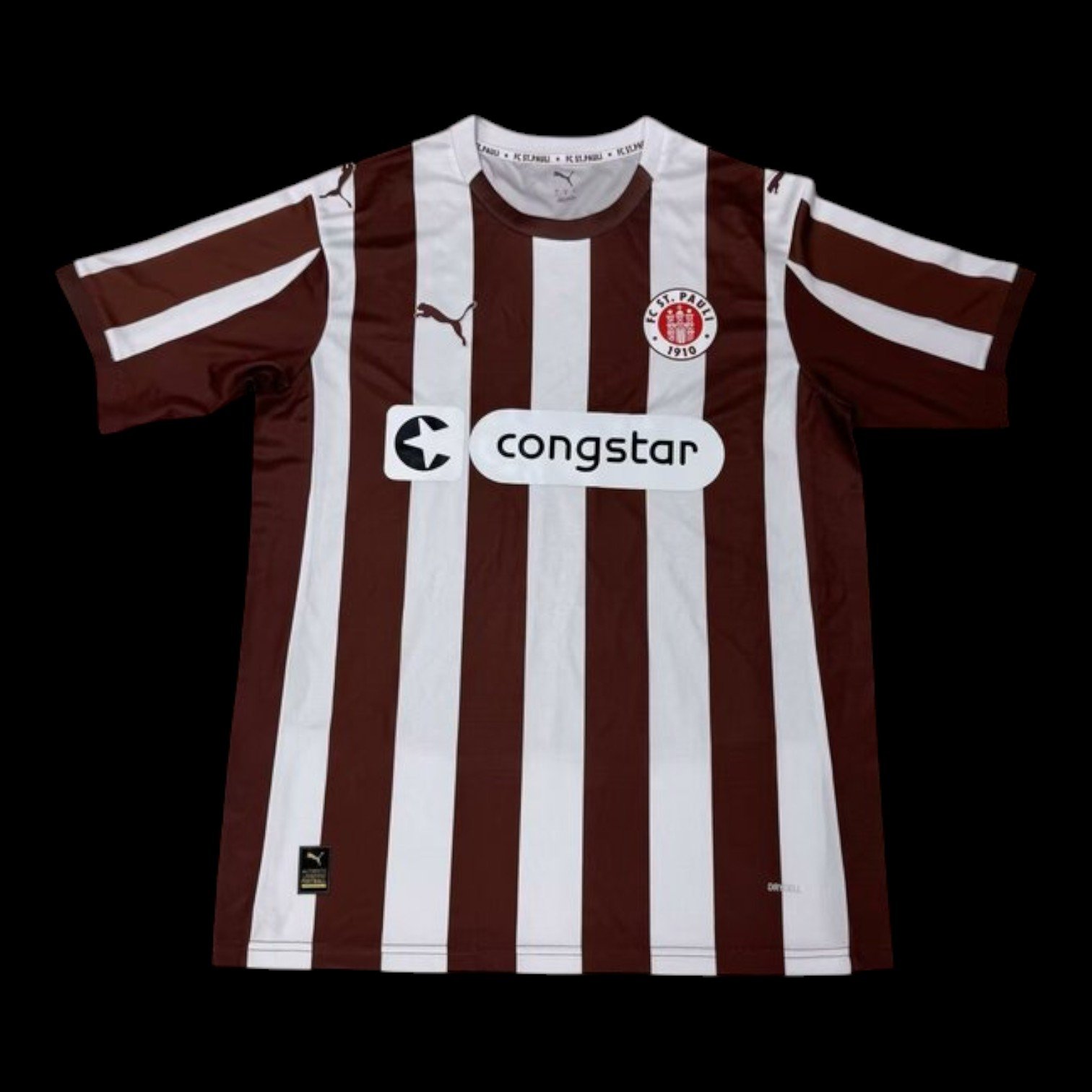
The St Pauli collection is available: a distinctive brown and white home jersey, away jersey, third, player version, supporter version, not to mention retro jerseys and limited editions that have defined the culture of the club and its neighborhood.