
‘Manque pierda’: ‘Even if it had to lose’. This almost unique slogan in world football sums up the identity of Real Betis Balompié by itself. Following the verdiblancos is not about backing victories every Sunday, but about supporting a club no matter what, in both its glory days and its dry spells. A loyalty in Seville passed down from generation to generation for more than a century.
Often in the shadow of neighboring FC Sevilla, Betis nevertheless has its own trophy count and history. Spanish champion in 1935, winner of three King’s Cups (1977, 2005, 2022), a 60,720-seat club at Benito Villamarín, it represents Andalusian popular culture against the wealthier club from the Nervión district. This article traces the major milestones of its history, from the founding merger of 1914 to the 2022 Kings Cup victory.
1907-1914: the founding and the historic merger
Real Betis Balompié history begins with the founding, on September 12, 1907, of Sevilla Balompié, a club created by students from the Polytechnic of Seville after breaking away from FC Sevilla, which already existed. In parallel, in 1909 another group founded Betis Football Club. The two entities merged in 1914 to create the club as we know it today, under the name Betis Balompié.
The word \’Balompié\’ needs an explanation. It is the literal Spanish translation of the English word \’football\’ (balom meaning ball, pié meaning foot). Several Spanish clubs of the era tried to promote this word to replace football vocabulary in Spanish, but only Betis kept it until today. It is a linguistic quirk that sets the club apart within La Liga.
The prefix \’Real\’ was granted in 1914, shortly after the merger, during the reign of Alfonso XIII. This royal distinction, common at the time in Spanish football (Real Madrid, Real Sociedad, etc.), reflects a link to national institutions that contrasts with the popular image Betis has built over the decades.
The origin of Betis’s green and white
The green and white colors, the club’s signature look, were adopted in the early years. Legend has it they were chosen in reference to the Andalusia flag, which is also green and white. Another, less certain version attributes the inspiration to Celtic Glasgow, but this link is not confirmed by the club’s historical sources.
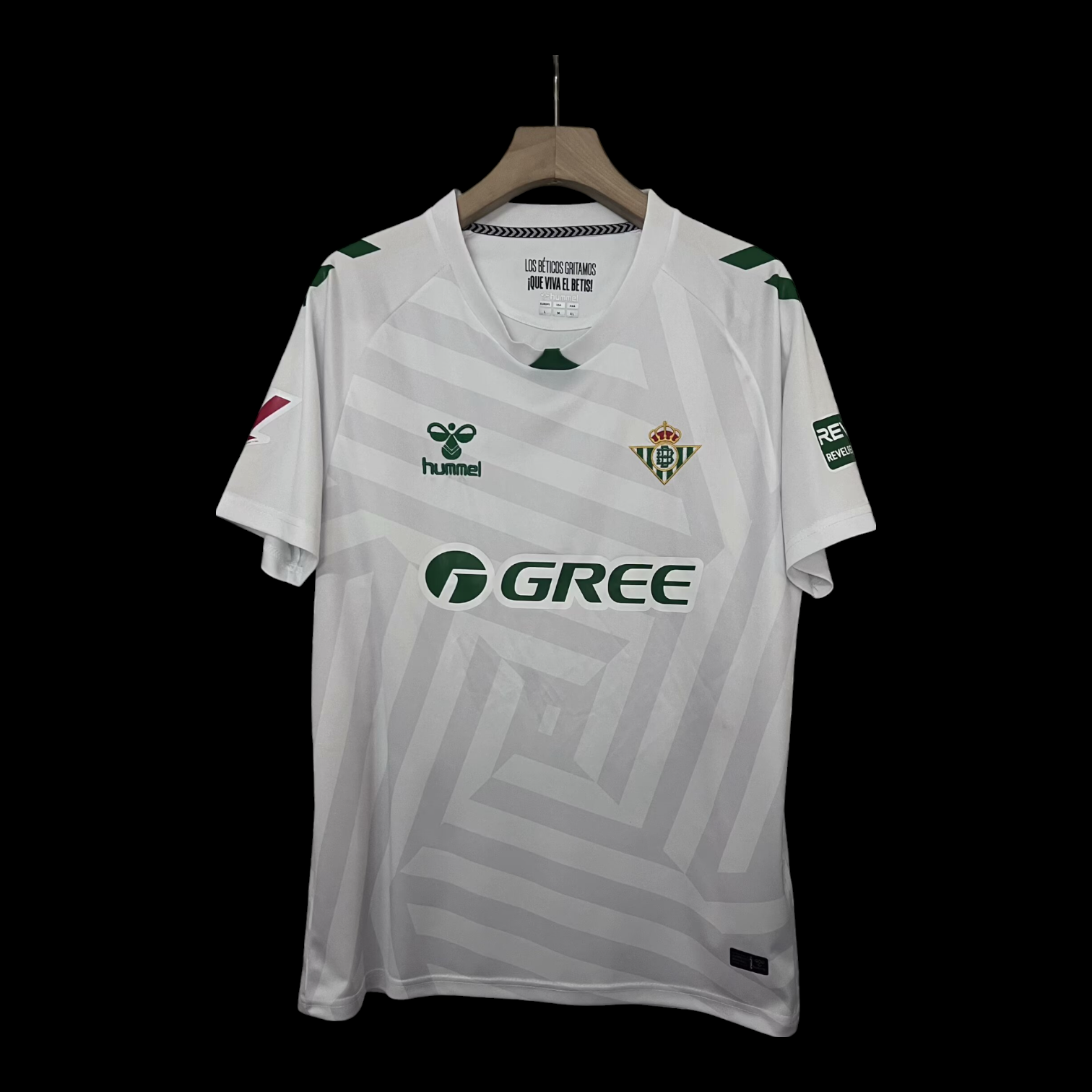
Betis’s jersey, with green-and-white vertical stripes, has become one of the most recognizable in La Liga. It has accompanied all generations of players and supporters. The nickname \’verdiblancos\’ (the green and whites) became natural and remains the most common unofficial term for the team and its fans.
The crest, meanwhile, includes the coat of arms of the city of Seville and has changed very little over the decades. The club plays mostly in this striped home jersey, keeping a visual continuity that sets it apart in a modern football world where visual changes are frequent.
1935: the unexpected La Liga title
The 1934-1935 season remains a magical chapter in the club’s history. Under Irish coach Patrick O\’Connell and with a squad led by Simón Lecue and Manuel Aedo, Betis won its only Spanish league title in club history. A huge performance that briefly put the club among the giants at a time when La Liga was only seven seasons old.
This breakthrough came just before the Spanish Civil War (1936-1939), which deeply destabilized the club. The post-war period saw Betis drop into lower divisions, even reaching third division in the early 1960s. The trajectory is typical of a club with limited resources and fluctuating sporting ambitions.
The club climbed back up and returned to La Liga on a regular basis starting in the 1970s. But the 1935 title remains, to this day, Betis’s only league title in Spanish championship history. Supporters still celebrate it as an untouchable landmark, a marker of a period when anything seemed possible.
Benito Villamarín Stadium, home of the verdiblancos
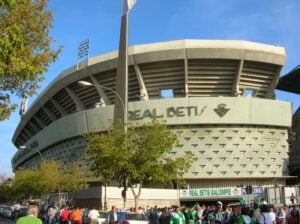
Betis’s stadium is Benito Villamarín, located in the Heliópolis district. Inaugurated in 1929 as Estadio de la Exposición, it was renamed Estadio Heliópolis in 1939, then Benito Villamarín in 1961, in tribute to a former club president who died two years earlier. Its current capacity is about 60,720 seats after several extensions.
From 1997 to 2010, the ground was called Estadio Manuel Ruiz de Lopera, after its then-president (controversial for his management methods). But the return to the historic name Benito Villamarín in 2010 was strongly backed by supporters, who are attached to that collective memory. Today the stadium remains one of the largest in Spain and one of the most intense atmospheres.
The Heliópolis district in south Seville has a working-class and popular character, which fits perfectly with Betis identity. It is one of the factors that distinguishes the club from its Sevillian rival, based in the more affluent neighborhood of Nervión. This social geography is a key marker of the Seville derby, which we explained in our article on the Betis-Sevilla FC rivalry.
The three Kings Cups: 1977, 2005, 2022
Betis’s honors are mostly three Kings Cups, won over long gaps and in very different circumstances. The first came in 1977, against Athletic Bilbao, after an epic final won on penalties (2-2, 8-7 pens). It was the first major joy for the club since the 1935 title, 42 years earlier.
The second Kings Cup came in 2005, against Osasuna (2-1), thanks mainly to a goal from Dani and another from Oliveira. That victory qualified Betis for the UEFA Champions League, where it reached the group stage the next season. It was a golden era led by players such as Joaquín, Denilson, Marcos Assunção and the Brazilian Capi.
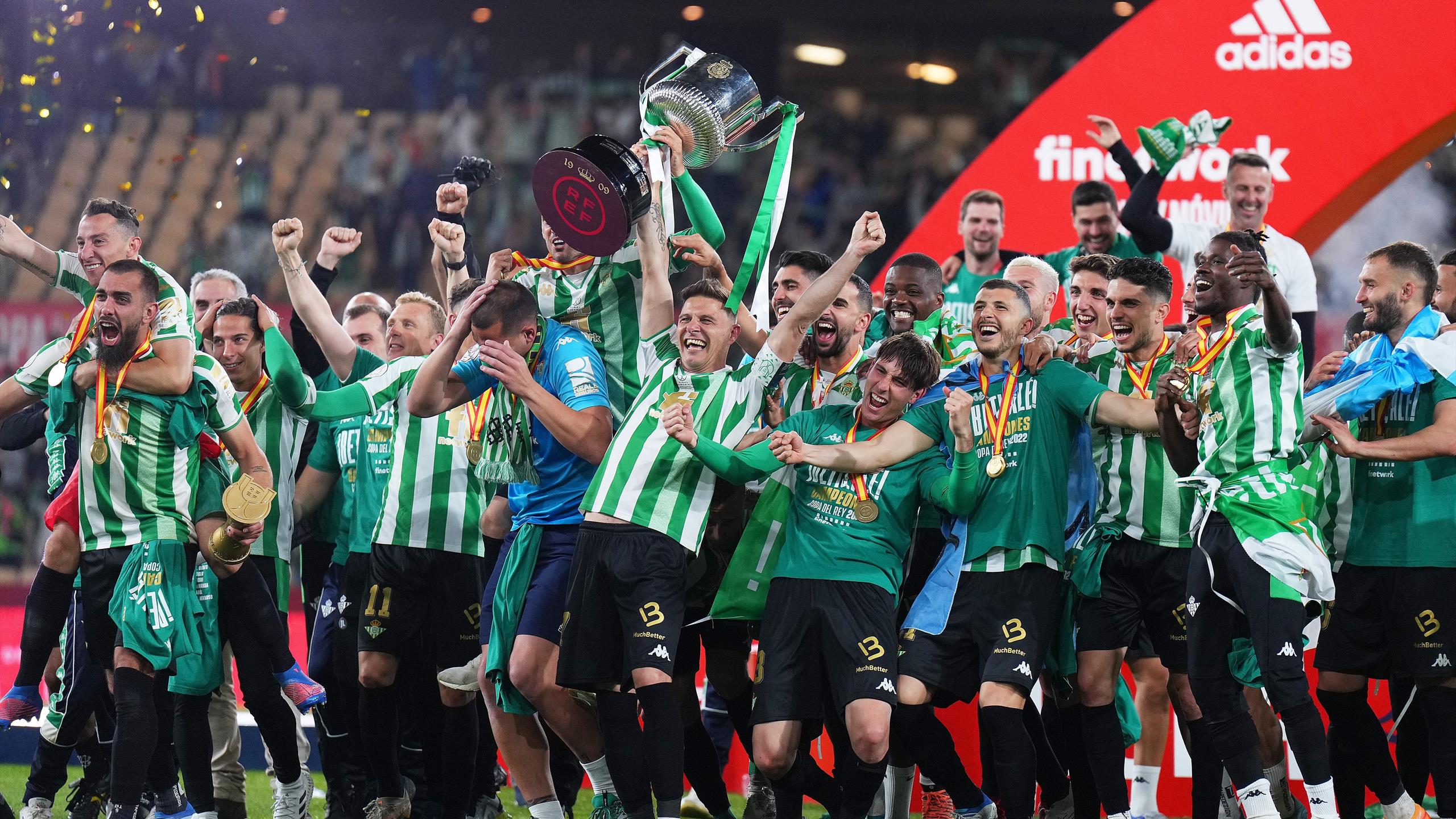
The third Kings Cup arrived in 2022, against Valencia (1-1, 5-4 pens) at La Cartuja in Seville. This victory ended another long wait and delivered huge joy to supporters, who gathered in large numbers in the Andalusian capital to celebrate the trophy. It was the triumph of the Manuel Pellegrini generation, which restarted the club after several difficult seasons.
Joaquín, the eternal captain
You can\’t talk about modern Betis without mentioning Joaquín Sánchez Rodríguez, known as Joaquín. A winger developed at the club’s cantera, he made his professional debut with Betis in 2000, moved to Valencia in 2006, then Málaga, then Fiorentina, before returning home in 2015. He retired in 2023 at 41, after a season in which he was still captain.
Joaquín holds the record for most matches played in a Betis jersey, with roughly 510 appearances across all competitions. Beyond numbers, he represents a certain idea of the club: loyalty, joy of life, humor (his interview moments are still iconic in Spain), and total commitment every match. He wore the captain\’s armband in his last seasons and lifted the Kings Cup in 2022.
Other historical figures punctuate the club\’s story: Rafael Gordillo, Spanish international midfielder who played for Betis in the 1980s; Hipólito Rincón, also an attacker from the 1980s; and more recently, Sergio Canales, Nabil Fekir and William Carvalho. Betis has often been a home for technical, creative players, matching the style of football the club plays.
The Pellegrini era, stability regained
Manuel Pellegrini\’s arrival in the summer of 2020 marked a turning point in recent club history. The Chilean coach, formerly of Real Madrid and Manchester City, brought tactical stability and an organizational discipline the team had lost. Under his leadership, the club regained European places season after season.
The 2022 Kings Cup victory is the culmination of that work. With Nabil Fekir as the technical leader, Sergio Canales as midfield controller, and Borja Iglesias as the goalscorer, Betis has played attractive football that appeals to Andalusian fans. The club has regularly played in the Europa League and the Conference League for four years.
The challenge for coming seasons is to turn this consistency into more titles, without losing the popular identity that defines Betis. To understand the major rivalry with its neighbor, our article dedicated to the Seville derby details the whole history of this unique Spanish rivalry.
\’Manque pierda\’: the motto that says it all
\’Viva el Betis manque pierda\’: \’Long live Betis, even if it has to lose\’. This is the unofficial motto of Betis supporters, and it says a lot about the club\’s culture. Supporting Betis is not about results; it is about identity, deep attachment, family tradition, and irrational passion.
This mindset explains the strong attendance at Benito Villamarín, which is regularly among the highest average attendance numbers in La Liga, despite sometimes difficult sporting seasons. Betis supporters come to the stadium for loyalty, not calculation. And that passion makes the club a cultural institution as much as a sporting one in Andalusia.
Betis may not have the trophy cabinet of Spanish giants, but it has a recognized soul. And it is probably this soul that makes it one of the most loved and respected clubs beyond its own borders. To discover another world within La Liga, our article on FC Valencia and its Murciélagos takes readers to Spain\’s Mediterranean coast.
What to remember
- Real Betis Balompié was born in 1914 from the merger of Sevilla Balompié (1907) and Betis Football Club (1909).
- The word \’Balompié\’ is the literal Spanish translation of \’football\’, a unique linguistic feature kept only by Betis today.
- The club won only one La Liga title, in 1935, under Irish coach Patrick O\’Connell.
- Three King\u2019s Cups in its honors: 1977 vs Athletic Bilbao, 2005 vs Osasuna, and 2022 vs Valencia.
- Benito Villamarín Stadium in the popular Heliópolis district holds around 60,720 spectators.
- Joaquín, a club legend, played about 510 matches in a verdiblanco jersey and lifted the King\u2019s Cup in 2022 as captain.
- The unofficial motto \’Viva el Betis manque pierda\’ summarizes Betis supporters\’ unwavering loyalty culture.
Further reading
Betis history is inseparable from Seville and Andalusia. To go deeper, we recommend our pieces on the Seville derby Betis-Sevilla FC, on the history of Valencia CF, which shares with Betis the same Mediterranean La Liga identity, and on the best La Liga jerseys where the verdiblanco green and white has a place.
Frequently asked questions
When was Real Betis Balompié founded?
The club as we know it today was born in 1914, from the merger between Sevilla Balompié (founded in 1907) and Betis Football Club (founded in 1909). The \’Real\’ title was granted soon after by King Alfonso XIII.
Why is the club called Betis Balompié?
\’Balompié\’ is the literal Spanish translation of the English word \’football\’ (balom = ball, pié = foot). Several Spanish clubs tried to impose this language adaptation at the beginning of the 20th century, but only Real Betis has kept it in its official name to this day.
How many La Liga titles has Betis won?
Real Betis has won one La Liga title, in the 1934-1935 season, under Irish coach Patrick O\’Connell. This is still the club\’s only top-flight national title. Betis also has three King\u2019s Cups (1977, 2005, 2022).
What does \’Manque pierda\’ mean?
\’Manque pierda\’ is an Andalusian expression meaning \’even if the club were to lose\’. The unofficial motto \’Viva el Betis manque pierda\’ expresses unconditional supporter loyalty to the club, regardless of sporting results. It has become a strong identity marker of Betis culture.
Where does Real Betis play?
Real Betis plays at Benito Villamarín Stadium, located in the popular Heliópolis district in southern Seville. Inaugurated under a different name in 1929, it was renamed Benito Villamarín in 1961 in honor of a former president. Its current capacity is about 60,720 seats.
The verdiblanco jersey catches your eye?
The full Real Betis collection is in the shop: home green-and-white striped jersey, away, third, player version, fan version, plus retro jerseys that recall the club\’s greatest moments.