
In 1943, Santiago Bernabéu took over as president of a club on the brink of bankruptcy. The Spanish Civil War had just ravaged Madrid, the Chamartín Stadium lay in ruins, and Real Madrid had won only one European Cup (which, incidentally, did not yet exist). Thirty-five years later, upon his death in 1978, the club would boast six Champions League titles, a 75,000-seat stadium named after him, and a status as a global benchmark.
How did a single man manage to transform a struggling club into a global powerhouse? The answer lies in three words: vision, boldness, and perseverance. This article traces the story of Santiago Bernabéu, a player who became president and built both a stadium and a strategy that continue to define Real Madrid today.
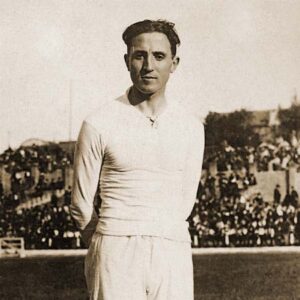
Bernabéu as a player: 18 years in the white jersey
Before becoming the driving force behind Real Madrid, Santiago Bernabéu Yeste was a player for the club. Born on June 8, 1895, in Almansa, he joined Madrid Football Club in 1909 at the age of 14. He remained there as a player until 1927—a total of 18 seasons—with a relatively modest record of achievements (the club had not yet dominated Spanish soccer) but with absolute loyalty to the white jersey.
As captain for several seasons, he developed a passion that would stay with him for life. At the same time, he studied law, became a lawyer, and then returned to the club as sporting director in the 1930s. This dual background in law and sports would prove decisive when he became president.
His intimate knowledge of the club, the players, the members, and the Madridista spirit is unmatched. When he became president in 1943, he already knew every aspect of the organization inside out. He was not a bureaucrat parachuted in from the outside, but a man of the club, schooled both on the field and in the offices.
The 1943 Election: Taking the Reins of a Club in Ruins
Spain was emerging from three years of civil war (1936–1939). Real Madrid had been left in ruins. The Chamartín Stadium had been partially bombed. The archives were partially destroyed. Several players had died or gone into exile. The club had accumulated debts and lost some of its members. When Bernabéu ran for president in 1943, no one was eager to take the position.
He was elected at the age of 47 with little opposition. His first task was both financial and moral: to rebuild the club, restore hope among the fans, and regain control of an institution that was barely surviving. He had neither the regime’s money nor government support. He would have to figure it all out on his own, starting from almost nothing.
The Bernabéu approach became clear right away: quick decisions, a long-term vision, and a rejection of short-term thinking. Rather than patching up the gaps, he decided to invest heavily in the future, even if it meant taking risks that many considered reckless.
The daring gamble of the new stadium in 1947
His first major decision was also the most controversial. Instead of renovating the old, bomb-damaged Chamartín Stadium, Bernabéu decided to build a new stadium. Not a modest stadium: a colossal 75,000-seat venue, the largest in Spain and one of the largest in Europe. The project, launched in 1944, seemed excessive for a country emerging from civil war and for a club with fragile finances.
To finance this extravagant project, Bernabéu devised an innovative scheme. He issued bonds to the club’s members, who lent their money in exchange for the promise of getting their investment back plus modest interest. It was the precursor to crowdfunding, sixty years before the Internet. Thousands of Madrid fans answered the call, won over by their president’s vision.
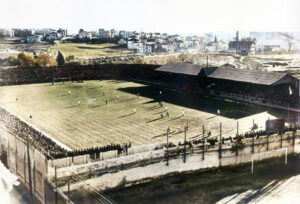
The Nuevo Estadio Chamartín opened its doors on December 14, 1947, with an initial capacity of 75,145. It was a national event: all of Spain realized that Real Madrid was now thinking big. The stadium was renamed the Estadio Santiago Bernabéu in 1955, while its builder was still alive—an extremely rare honor in the world of soccer.
Di Stéfano: The stroke of genius that changed everything
1953: Bernabéu pulled off the transfer that would define his era. He signed Alfredo Di Stéfano, an Argentine forward from Millonarios de Bogotá, under extraordinary circumstances. FC Barcelona had a prior agreement with the player, but a legal mess involving the Spanish Football Federation allowed Real Madrid to snatch him up. The Catalans would talk about it for decades.
Di Stéfano was a complete player. He wasn’t just a goal-scorer; he was a total player ahead of his time, capable of defending, creating chances, scoring, and orchestrating the game from anywhere on the field. In eleven seasons wearing the white jersey, he scored 308 goals in 396 matches and led Real Madrid to a level of dominance never seen before.
This transfer epitomizes the Bernabéu strategy: to sign the best player in the world, regardless of nationality, cost, or obstacles. It was a revolutionary approach at the time, when most European clubs limited themselves to signing local or regional players.
The Bernabéu Strategy: Bringing in the World's Best
After Di Stéfano, the president continued to make big moves. Raymond Kopa arrived in 1956 (Ballon d’Or winner in 1958), Ferenc Puskás in 1958, José Santamaría from Uruguay, and Francisco Gento emerged as the world’s best left winger. Bernabéu thus built an international team composed of the greatest talents available, at a time when the globalization of soccer did not yet exist.
His financial approach is equally innovative. Rather than viewing costly transfers as a burden, Bernabéu sees them as investments. Star players attract fans, who fill the stadium, generating revenue that funds the next transfer. It’s a virtuous cycle now known as the “Real Madrid model,” which dozens of clubs have tried to emulate—though not always successfully.
The president also fostered loyalty among his players. Di Stéfano stayed with the club for eleven years. Gento played 18 seasons with Real Madrid and won six European Cups, an all-time record for a player. This stability in the core lineup, combined with the steady arrival of new stars, created a virtually unbeatable team for a decade.
Five consecutive European Cups (1956–1960)
The culmination of the Bernabéu strategy was this streak of five consecutive European Cups between 1956 and 1960. No club has ever matched this feat. Real Madrid won the very first edition of the competition in 1956, in Paris, against Stade de Reims (4-3). They then went on to win in Florence in 1957, Brussels in 1958, Stuttgart in 1959, and finally in Glasgow in 1960.
The 1960 final—a 7–3 victory over Eintracht Frankfurt at Hampden Park in front of 127,000 spectators—is still considered by many to be the greatest match in the history of soccer. Di Stéfano scored a hat trick, and Puskás scored four goals. Real Madrid proved to the world that it was the premier club in Europe.
Bernabéu attends all these finals, dressed in a dark suit with a cigar hanging from the corner of his mouth. For him, these victories are not an end in themselves, but the validation of an entire vision: to prove that a club can, through strategy and boldness, dominate European soccer for the long term.
Bernabéu and Francoism: an ambiguous relationship
It is impossible to discuss Bernabéu without mentioning his relationship with Franco’s regime, which ruled Spain from 1939 to 1975. The president of Real Madrid maintained cordial ties with the regime, which earned the club the enduring label of “the regime’s club.” The reality is more nuanced. Other Spanish clubs (FC Barcelona, Athletic Bilbao) also accommodated the regime to varying degrees. And Bernabéu himself was not a political activist but a pragmatic businessman.
It is nevertheless clear that close ties to those in power have facilitated certain processes: building permits for the stadium, approvals for international transfers, and access to bank financing. These ties remain a historical fact that it would be dishonest to deny, even if they do not fully explain the Bernabéu’s success.
The president survived politically through several regimes—a republic, a dictatorship, and the democratic transition that began upon his death—without ever facing any serious challenges. This is undoubtedly a testament to his ability to position himself, above all, as a member of the establishment, transcending political labels.
The Bernabéu Legacy: 50 Years After His Death
Santiago Bernabéu died on July 2, 1978, at the age of 83, after 35 years as president without interruption. He left behind a club at the pinnacle of world soccer, a stadium bearing his name, and a management style that continues to inspire subsequent presidents. Florentino Pérez, the current president, openly draws on Bernabéu’s legacy in his strategy for signing the Galácticos.
Fifty years after his death, Real Madrid has won 15 Champions League titles, an unmatched international record. The Bernabéu Stadium has just undergone a €1.8 billion renovation, featuring a retractable roof and a retractable playing field. The club continues to attract today’s biggest stars (Mbappé, Bellingham, Vinícius). In short, the Bernabéu formula still works, more than 80 years after it was first implemented.
To understand how this legacy has continued under Florentino Pérez, we’ve written an article dedicated to Florentino Pérez and the Galácticos project. And to put Bernabéu in the context of the club’s long history, our article on Real Madrid’s 120th anniversary traces the club’s origins back to 1902.
Key Takeaways
- Santiago Bernabéu Yeste (1895–1978) played for Real Madrid for 18 years before serving as the club’s president from 1943 until his death.
- His first major decision: to build the Nuevo Estadio Chamartín in 1947, financed by bonds purchased by the club members.
- The stadium was renamed Estadio Santiago Bernabéu in 1955, while he was still alive—a very rare honor.
- His international recruitment strategy (Di Stéfano in 1953, Puskás in 1958, Kopa in 1956) was revolutionary for its time.
- Under his presidency, Real Madrid won five consecutive European Cups between 1956 and 1960, a feat that has never been matched.
- Bernabéu died in 1978 after 35 years as president without interruption, the longest tenure in the club’s history.
- His management style continues to inspire subsequent presidents, particularly Florentino Pérez with his "Galácticos" project.
Learn more
The history of the Bernabéu is inextricably linked to that of modern-day Real Madrid. To explore other aspects, we recommend our articles on the complete history of Real Madrid, on Di Stéfano and the most controversial transfer of the 20th century, and on the first six European Cups that cemented the club’s legacy. For the next chapter in the club’s architectural journey, our feature on the Bernabéu Stadium details the €1.8 billion modern renovation.
Frequently Asked Questions
Who was Santiago Bernabéu?
Santiago Bernabéu Yeste (1895–1978) was a player and later president of Real Madrid. He played for the club from 1909 to 1927 and served as president from 1943 until his death in 1978—a 35-year uninterrupted tenure, the longest in the club’s history.
In what year did Bernabéu become president of Real Madrid?
Santiago Bernabéu was elected president of Real Madrid in 1943, at the age of 47. At the time, the club was reeling from the Spanish Civil War, and no one was eager to take on the role. He remained president until his death on July 2, 1978.
Why is the stadium called Santiago Bernabéu?
The stadium was renamed Estadio Santiago Bernabéu in 1955, while its builder was still alive, in recognition of his pivotal role in the construction of the new stadium, which opened in 1947. This is an extremely rare honor in world soccer.
What were Bernabéu's major achievements as president?
Three major achievements: the construction of the new 75,000-seat Chamartín Stadium in 1947, the signing of Alfredo Di Stéfano in 1953, and the winning of five consecutive European Cups between 1956 and 1960—a feat never matched in the history of soccer.
What is Santiago Bernabéu's legacy today?
His strategy of recruiting the best international players and his virtuous cycle management model (stars + revenue + new transfers) continue to inspire Real Madrid’s current presidents, particularly Florentino Pérez and his “Galácticos” project. The stadium, renovated at a cost of 1.8 billion euros, still bears his name.
Carry on the Bernabéu legacy
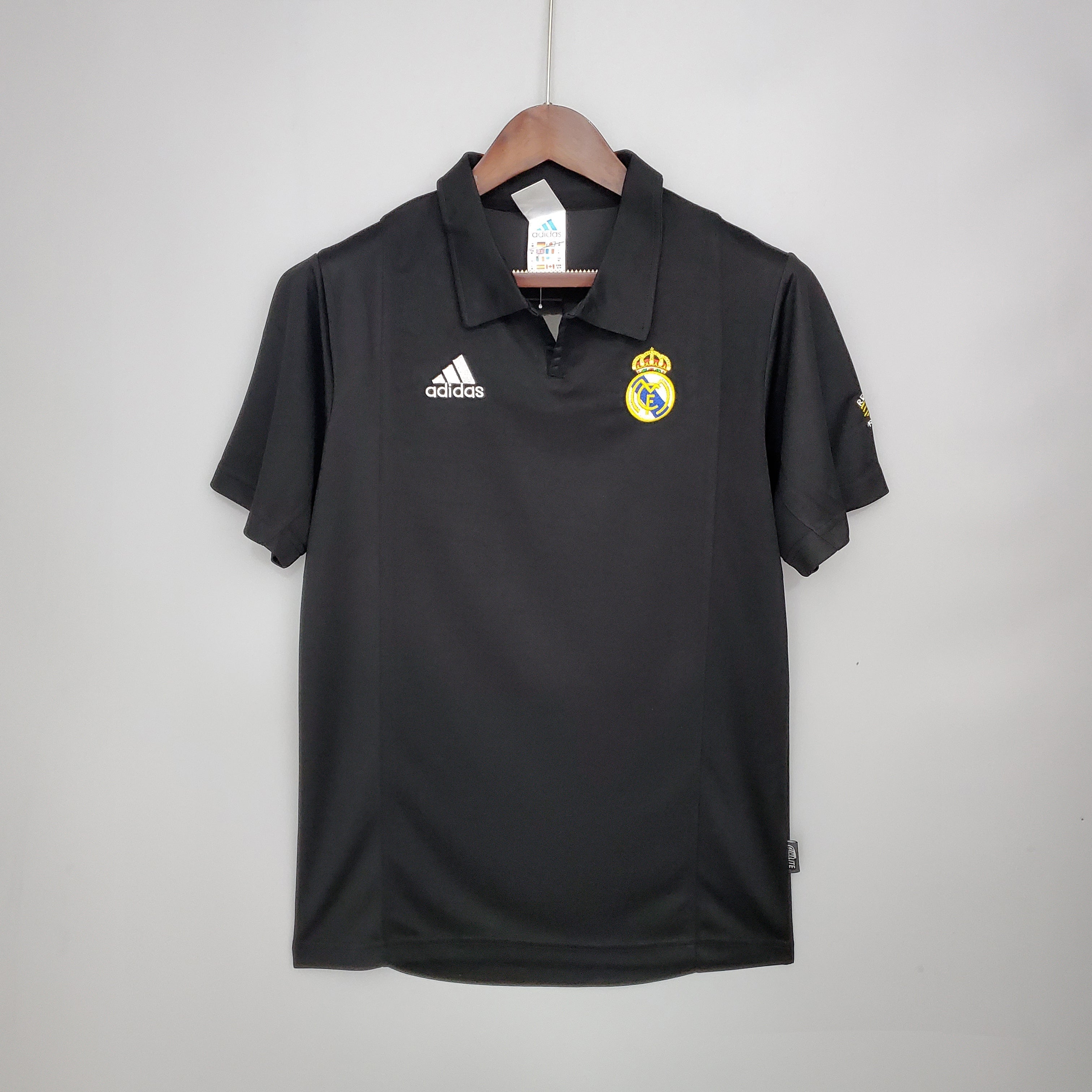
All Real Madrid jerseys are available in our store: home, away, third, player edition, fan edition, as well as the retro jerseys from the club’s greatest seasons.