
11 juillet 2010, stade de Soccer City, Johannesburg. Finale de la Coupe du Monde face aux Pays-Bas. 116e minute de jeu, prolongation. Xavi récupère le ballon dans le rond central, glisse une passe pour Iniesta qui se trouve dans la surface adverse. Frappe du droit, ouverture parfaite, but. L’Espagne devient championne du monde pour la première fois de son histoire. À l’origine de l’action, deux joueurs formés à La Masia, qui se connaissent depuis l’adolescence : Xavi Hernández et Andrés Iniesta.
Le duo Xavi-Iniesta a régné sur le milieu de terrain mondial pendant plus d’une décennie. Quatre Ligues des Champions ensemble au FC Barcelone, deux Euros et une Coupe du Monde avec l’Espagne, plusieurs Liga, des centaines de matchs côte à côte. Cet article retrace leur parcours commun, leur complémentarité tactique, et l’héritage qu’ils laissent au football.
Xavi : Terrassa, La Masia, métronome
Xavier Hernández Creus naît le 25 janvier 1980 à Terrassa, dans la banlieue nord de Barcelone. Il rejoint La Masia à 11 ans, en 1991. Sa progression dans les catégories jeunes du FC Barcelone est rapide. Il fait ses débuts en équipe première en août 1998, à 18 ans, lors de la Supercoupe d’Espagne face à Majorque. Son poste : milieu de terrain organisateur, capable de garder le ballon, d’orienter le jeu, de toujours donner des solutions à ses partenaires.
Sa carrière au Barça s’étend de 1998 à 2015, soit 17 saisons consécutives. Il dispute 767 matchs officiels, record du club à son départ (battu seulement par Messi en 2021). Pendant toutes ces années, il est l’un des cadres incontournables du milieu de terrain, présent sous tous les entraîneurs successifs : van Gaal, Antic, Rijkaard, Guardiola, Vilanova, Martino, Luis Enrique.
Il quitte le Barça à l’été 2015 pour rejoindre Al Sadd, au Qatar, où il termine sa carrière de joueur en 2019. Il revient ensuite comme entraîneur à Barcelone, de novembre 2021 à mai 2024, remportant la Liga 2022-2023 et la Supercoupe d’Espagne 2023. Pour le contexte sportif et son retour, voir notre article sur l’histoire du FC Barcelone.
Iniesta : Fuentealbilla, La Masia, illusionniste
Andrés Iniesta Luján naît le 11 mai 1984 à Fuentealbilla, petit village de Castille-La Manche d’environ 1 800 habitants. Il rejoint La Masia à 12 ans, en 1996, après avoir été repéré lors d’un tournoi de jeunes à Albacete. Sa progression est fulgurante. Il fait ses débuts en équipe première le 29 octobre 2002, à 18 ans, lors d’un match de Ligue des Champions face au Club Bruges (victoire 1-0).
Sa carrière au Barça s’étend de 2002 à 2018, soit 16 saisons consécutives. Il dispute 674 matchs officiels et inscrit 57 buts. Son poste évolue avec le temps : il commence comme milieu relayeur capable de monter jusqu’à la surface, puis devient un véritable numéro 10 sous Guardiola. Son jeu se caractérise par la technique en mouvement, la conduite de balle entre les défenseurs, et un sens du dernier geste rare à ce niveau.
Il quitte le club à l’été 2018, après une cérémonie d’adieu très émouvante au Camp Nou. Il rejoint le Vissel Kobe au Japon, puis l’Emirates Club aux Émirats arabes unis. Sa carrière de joueur se prolonge jusqu’en 2024, et il garde un statut d’icône absolue au Barça malgré son éloignement géographique.
Une complémentarité tactique exceptionnelle
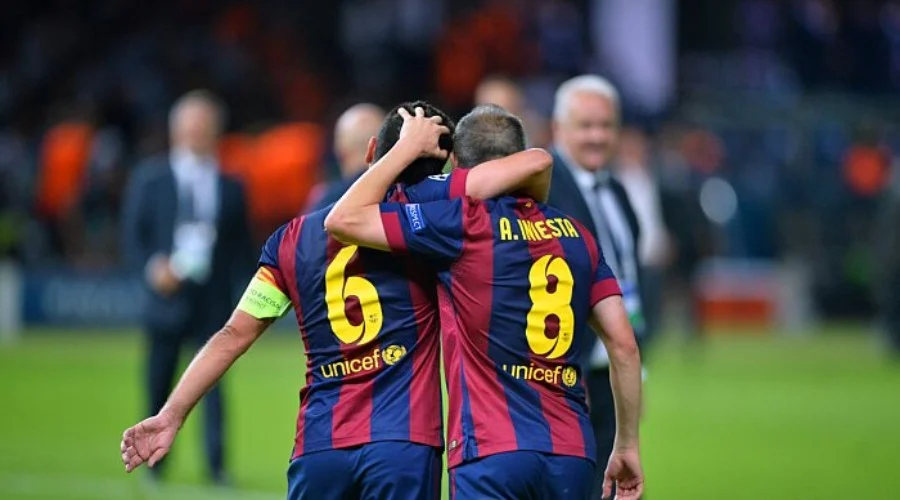
Ce qui rend le duo unique, c’est sa complémentarité quasi-parfaite. Xavi est le métronome, celui qui distribue le ballon, qui garde la circulation, qui donne le rythme. Iniesta est le joueur qui rompt les lignes, qui dribble, qui crée le déséquilibre dans le dernier tiers du terrain. Ensemble, ils forment un milieu de terrain capable à la fois de conserver le ballon et de progresser vers le but adverse.
Leur connivence est née à La Masia, où ils se sont entraînés ensemble dans les catégories jeunes pendant plusieurs années. Cette intimité footballistique, construite sur le temps long, leur permet de jouer sans se regarder, de deviner les courses, d’anticiper les passes. Aucun autre duo de milieu de terrain dans le football moderne n’a atteint ce niveau de symbiose sur autant d’années.
Avec Sergio Busquets, autre produit de La Masia recruté en équipe première en 2008, ils forment le trio milieu de terrain le plus emblématique du Barça moderne. Pour la philosophie qui sous-tend ce milieu, voir notre article sur La Masia et notre portrait de Johan Cruyff, qui a posé les bases de cette manière de jouer.
Le tiki-taka de Guardiola : ils en sont les artisans
L’arrivée de Pep Guardiola sur le banc en juin 2008 fait éclater le duo au plus haut niveau. Le nouvel entraîneur place Xavi et Iniesta au cœur d’un système basé sur la possession permanente du ballon, la circulation rapide, le pressing immédiat à la perte. Le tiki-taka tient son nom de cette mécanique de passes courtes incessantes.
Sous Guardiola (2008-2012), le Barça remporte 14 trophées dont trois Liga consécutives, deux Ligues des Champions (2009, 2011), deux Supercoupes d’Europe et deux Mondiaux des clubs. Xavi et Iniesta sont titulaires sur la quasi-totalité des grands matchs. Pour le détail de cette période faste, voir notre papier sur Pep Guardiola entraîneur.
Le triplé Liga-Coupe-Ligue des Champions de 2009 reste le sommet absolu. La finale du 27 mai 2009 à Rome face à Manchester United (2-0) est largement contrôlée par le duo. Pour ce match historique, voir notre article dédié au triplé de 2009.
Chelsea 2009 : le but d’Iniesta dans le temps additionnel
Le 6 mai 2009, demi-finale retour de Ligue des Champions à Stamford Bridge. Le Barça est mené 1-0, éliminé virtuellement, après un but de Michael Essien en première mi-temps. Chelsea défend, le Barça pousse, l’arbitrage est contesté. À la 93e minute, ultime occasion. Messi décale Iniesta à l’entrée de la surface. Frappe enroulée du droit, lucarne. 1-1, le Barça se qualifie au goal average.
Ce but reste l’un des plus emblématiques de la carrière d’Iniesta et de toute l’épopée européenne du Barça moderne. Il symbolise la capacité du duo à apparaître dans les moments décisifs, à transformer une situation perdue en victoire collective. Sans ce but, pas de finale à Rome, pas de premier triplé.
L’image d’Iniesta arrachant son maillot face au public de Stamford Bridge fait le tour du monde. Le silence qui descend sur le stade londonien dit tout du choc tactique : Chelsea pensait avoir gagné, le duo Xavi-Iniesta a renversé l’issue à la dernière minute par un coup de génie collectif.
L’Espagne tricolore 2008-2010-2012
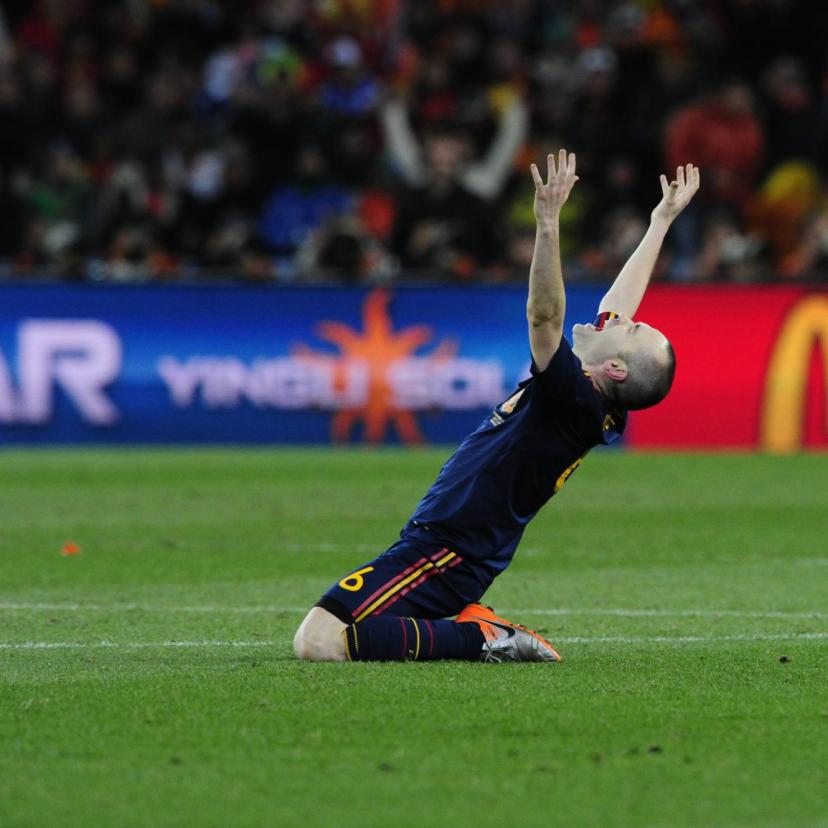
Au-delà du Barça, le duo a aussi régné sur la sélection espagnole. Champions d’Europe en 2008 (Autriche-Suisse), champions du monde en 2010 (Afrique du Sud), champions d’Europe en 2012 (Pologne-Ukraine). C’est la première et seule fois dans l’histoire qu’une sélection nationale enchaîne ces trois trophées consécutifs.
Le but de la finale du Mondial 2010 face aux Pays-Bas, inscrit par Iniesta à la 116e minute après une passe de Xavi, restera comme le moment le plus emblématique du règne espagnol. Iniesta soulève son maillot pour révéler un message dédié à Dani Jarque, ancien capitaine de l’Espanyol décédé en 2009. Ce geste fait le tour du monde et complète une scène déjà anthologique.
Xavi est désigné homme du match en finale de l’Euro 2008, et il termine cette année-là sur le podium du Ballon d’Or. Iniesta, lui, finira sur le podium en 2010 et 2012. À deux, ils symbolisent la décennie dorée du football espagnol, à laquelle ils ont apporté la rigueur tactique du Barça.
Bilan d’un duo unique
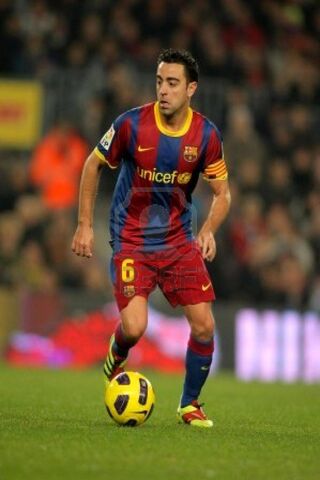
Les chiffres communs donnent le vertige. Plus de 600 matchs disputés ensemble en équipe nationale et au Barça réunis. 8 Liga remportées par Xavi, 9 par Iniesta. 4 Ligues des Champions chacun, dont les éditions 2006, 2009, 2011 et 2015 disputées tous les deux. Plus la triplette Espagne 2008-2010-2012 qui les a installés au sommet absolu du football mondial.
Au-delà des trophées, c’est leur influence sur le jeu qui restera. Le tiki-taka, la possession comme arme défensive et offensive, la valorisation des petits joueurs techniques, le pressing immédiat : autant de principes que le duo a popularisés et que des dizaines de clubs essaient encore de copier. Pour la suite, voir notre article sur Messi, troisième joueur central de cette génération dorée.
Aujourd’hui retraités du football joué (Iniesta a mis fin à sa carrière en 2024), tous deux s’orientent vers d’autres rôles. Xavi a entamé une carrière d’entraîneur, passée par Al Sadd puis Barcelone. Iniesta gère plusieurs investissements et reste impliqué dans la formation des jeunes. Leur héritage sportif, lui, est gravé pour longtemps dans la mémoire du football mondial.
Ce qu’il faut retenir
- Xavi (né en 1980) et Iniesta (né en 1984) sont tous deux formés à La Masia, intégrée à 11 et 12 ans respectivement.
- Xavi joue au Barça de 1998 à 2015, dispute 767 matchs et remporte 8 Liga et 4 Ligues des Champions.
- Iniesta joue au Barça de 2002 à 2018, dispute 674 matchs et remporte 9 Liga et 4 Ligues des Champions.
- Le tiki-taka de Pep Guardiola (2008-2012) repose largement sur leur complémentarité au milieu de terrain.
- Le but d’Iniesta à Stamford Bridge en mai 2009 sauve le Barça et permet la finale victorieuse de Rome.
- Avec l’Espagne, ils remportent l’Euro 2008, la Coupe du Monde 2010 et l’Euro 2012, série jamais réalisée auparavant.
- Le but d’Iniesta en finale 2010 face aux Pays-Bas, sur passe de Xavi, est l’un des moments fondateurs du football espagnol moderne.
Pour aller plus loin
Le duo Xavi-Iniesta est inséparable de toute l’époque dorée. Pour creuser, on vous recommande nos papiers sur La Masia, leur école commune, sur Pep Guardiola et le tiki-taka, sur le triplé historique de 2009, et sur Messi, leur partenaire de toujours.
Questions fréquentes
Combien de temps Xavi et Iniesta ont-ils joué ensemble au Barça ?
Xavi joue au Barça de 1998 à 2015 (17 saisons), Iniesta de 2002 à 2018 (16 saisons). Leur période commune en équipe première s’étend de 2002 à 2015, soit 13 saisons consécutives, ce qui en fait l’un des duos de milieu de terrain les plus durables de l’histoire du football.
Combien de Ligues des Champions ont-ils gagnées ensemble ?
Xavi et Iniesta ont remporté 4 Ligues des Champions ensemble avec le FC Barcelone : 2006 face à Arsenal, 2009 face à Manchester United, 2011 face à Manchester United, et 2015 face à la Juventus. Iniesta en remportera une cinquième sans Xavi, qui avait quitté le club en 2015.
Quel est le but le plus célèbre d’Iniesta ?
Le but le plus célèbre d’Iniesta est sans doute celui de la finale de la Coupe du Monde 2010, à la 116e minute face aux Pays-Bas, sur une passe de Xavi. Il offre à l’Espagne son premier titre mondial. Il faut aussi citer son but à Stamford Bridge en mai 2009, qui sauve le Barça en demi-finale de Ligue des Champions.
Pourquoi appelle-t-on Xavi le métronome ?
Xavi est appelé métronome en référence à son rôle d’orchestrateur du milieu de terrain. Il garde le ballon, distribue les passes, donne le rythme à toute l’équipe, sans jamais perdre la balle. Sa précision technique et sa lecture du jeu ont structuré le tiki-taka du Barça et de l’Espagne pendant plus d’une décennie.
Le duo Xavi-Iniesta a-t-il gagné la Coupe du Monde ?
Oui, Xavi et Iniesta ont remporté la Coupe du Monde 2010 en Afrique du Sud avec l’Espagne, qui battait les Pays-Bas en finale 1-0 grâce au but d’Iniesta sur une passe de Xavi à la 116e minute. C’est le premier et seul titre mondial de la sélection espagnole.
La collection Barcelone vous attend
Tous les maillots du FC Barcelone sont en boutique : domicile, extérieur, third, version joueur, version supporter, et les maillots rétro qui rendent hommage aux saisons triomphales Xavi-Iniesta.