
May 1951, Stade du Ray. OGC Nice had just won its first French league title, outclassing the top teams of the era. Three years later, the club did it again. Then again in 1956, and once more in 1959. Four titles won in eight seasons, in a French soccer scene then dominated by Reims and Saint-Étienne. The Gym, as it was already known, established itself at the top and never really looked back, even when the seasons became more challenging.
A century after the multisport club was founded in 1904, the history of OGC Nice tells the story of a unique club from the South, deeply rooted in its city, with a strong red-and-black identity, and one that has weathered every era of French soccer. This article traces these key milestones, from the club’s first titles to its acquisition by INEOS, including the construction of the Allianz Riviera.
1904: The Beginnings of a Century-Old Club
OGC Nice traces its roots back to a multi-sport club founded in 1904, the Gymnaste Club de Nice. At that time, organized sports were gaining popularity in major French cities, and the French Riviera was no exception to this trend. The soccer division was established a few years later, in 1908, and today’s professional club is a direct descendant of that division.
The name Olympique Gymnaste Club Nice emerged later, following the merger of several local organizations. The club adopted red and black as its colors in 1919, and they have remained unchanged ever since. This consistency in color contributes to the club’s visual identity, making it instantly recognizable on both French and European fields.
Before World War II, Nice was one of the league’s solid clubs, though it never quite made a run at the title. It was the postwar era that changed everything, with an exceptional generation of players propelling the Gym to the top of French soccer.
The Golden Age of the 1950s: Four Titles in Eight Years
It’s a rare feat: four French league titles in eight seasons—in 1951, 1952, 1956, and 1959. During that period, OGC Nice dominated French soccer with a consistency that few clubs have matched since. Les Aiglons relied on a solid core, well-chosen recruits, and a passionate fan base that filled the Stade du Ray for every big match.
Joaquín Valle, a forward who arrived from Spain, became the iconic goal-scorer of that generation, netting 339 goals for the club between 1937 and 1948—a record that has never been broken. Pancho Gonzalez, another prolific forward, was a key figure in that golden era. And Just Fontaine, the future World Cup scoring record-holder, would spend time in Nice before moving on to Reims.
The 1956 title remains particularly memorable. That year, Nice crushed Reims, which had been dominating French soccer at the time, and symbolically brought an end to the Reims dynasty. The 1958–59 season, which culminated in the club’s fourth title, capped off an exceptional run. In addition to these league titles, the club won three French Cups: in 1952, 1954, and 1997. This consistency ranks Nice among the twelve most successful clubs in the history of French soccer.
Le Ray Stadium, the Gym’s historic home
For 86 years, from 1927 to 2013, the club played at the Stade du Ray, in the northern district of Nice. It was there that the Aiglons wrote some of their greatest chapters, from their four league titles to their European nights. Le Ray, with its intimate layout and stands hugging the field, offered a unique atmosphere, one particularly feared by visiting teams during big matches.
The stadium had its limitations: limited capacity, increasing dilapidation, and increasingly stringent UEFA standards. The club and the city had long sought a modernization solution, but could not always reach an agreement. Plans for a new stadium finally gained momentum in the early 2010s, in anticipation of the 2016 European Championship, which was to be hosted in France.
The Ray Stadium hosted its last official match in 2013, bringing to a close eight decades of history. Many Nice fans still speak of it with emotion, as if it were a family heirloom. The transition to a modern stadium was not without a touch of nostalgia.
Why the Aiglons, and why red and black?
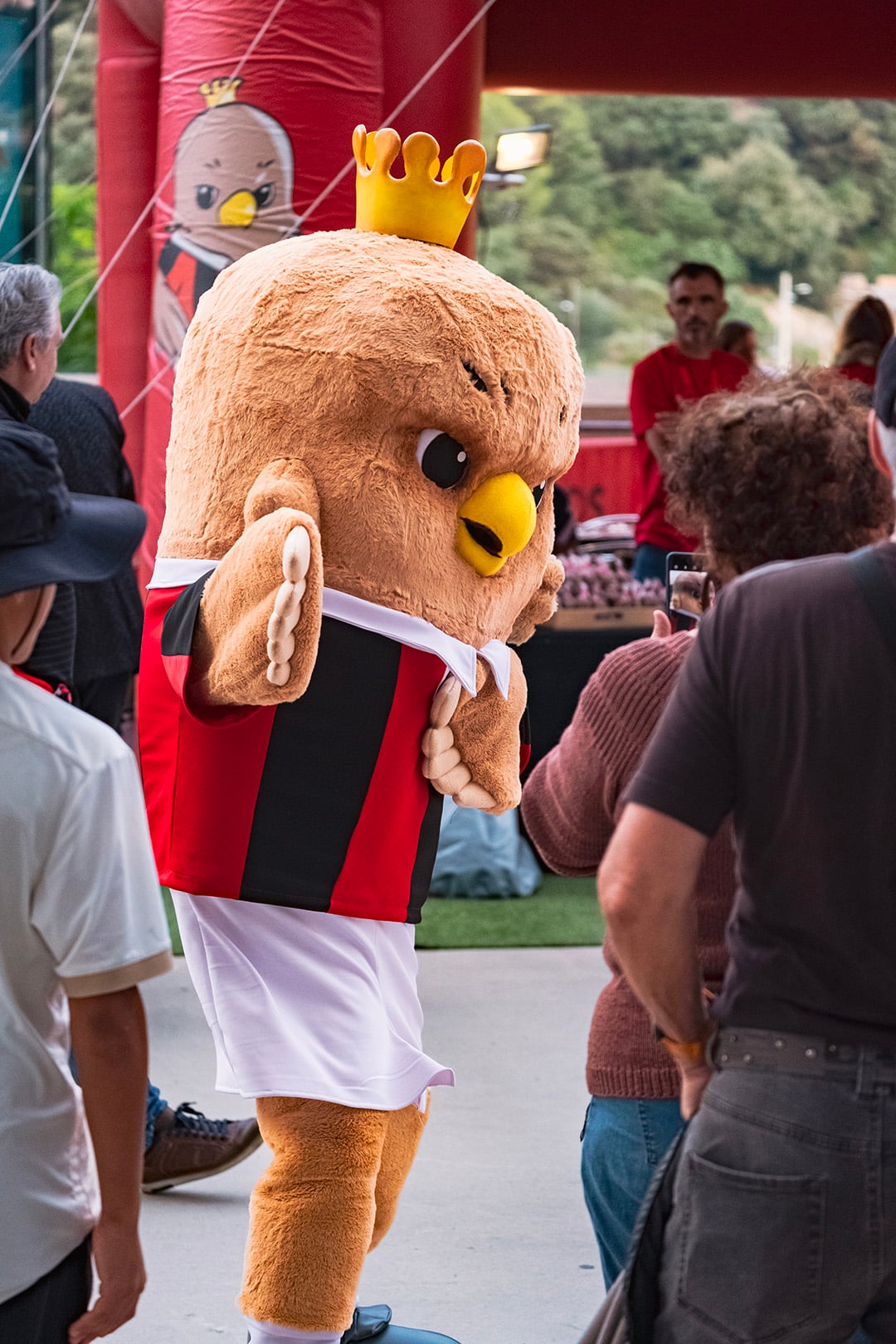
The eagle is the heraldic emblem of the city of Nice and has appeared on the city’s coat of arms since the Middle Ages. The club naturally adopted it as its symbol, and the nickname “Les Aiglons” has become widely used among fans and journalists. The other nickname, “Le Gym,” comes directly from the historical name of the multi-sport club founded in 1904.
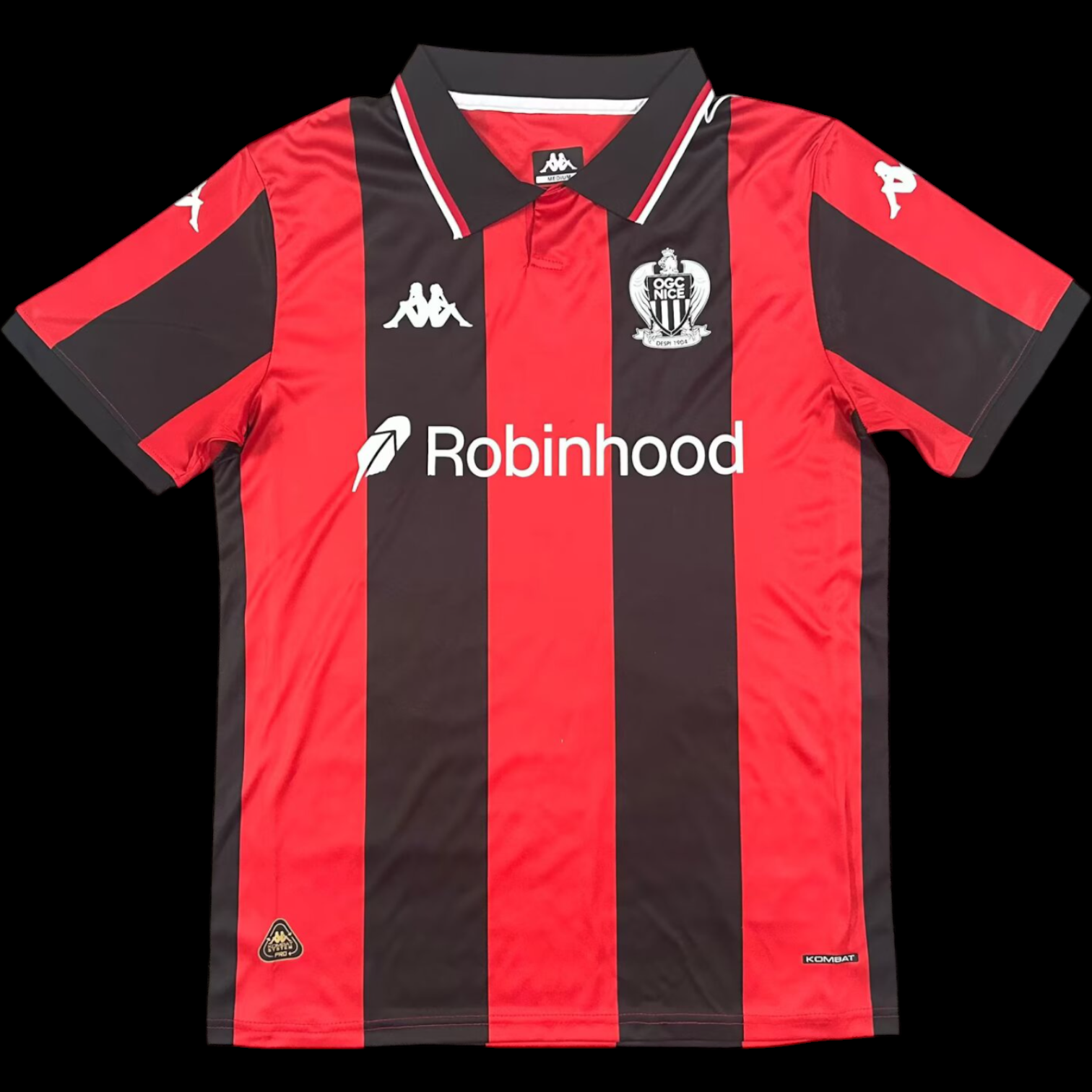
As for colors, red and black were chosen in September 1919, in reference to the city’s flag. This color scheme, combined with the eagle, gives the Gym an instantly recognizable visual identity. It has changed little over the decades, unlike many European clubs that have adjusted their branding to keep up with trends.
To understand how other major French clubs have shaped their visual identities, our article on Les Verts de Saint-Étienne tells the story of how another iconic color in French soccer came to be.
Allianz Riviera: A New Chapter Since 2013
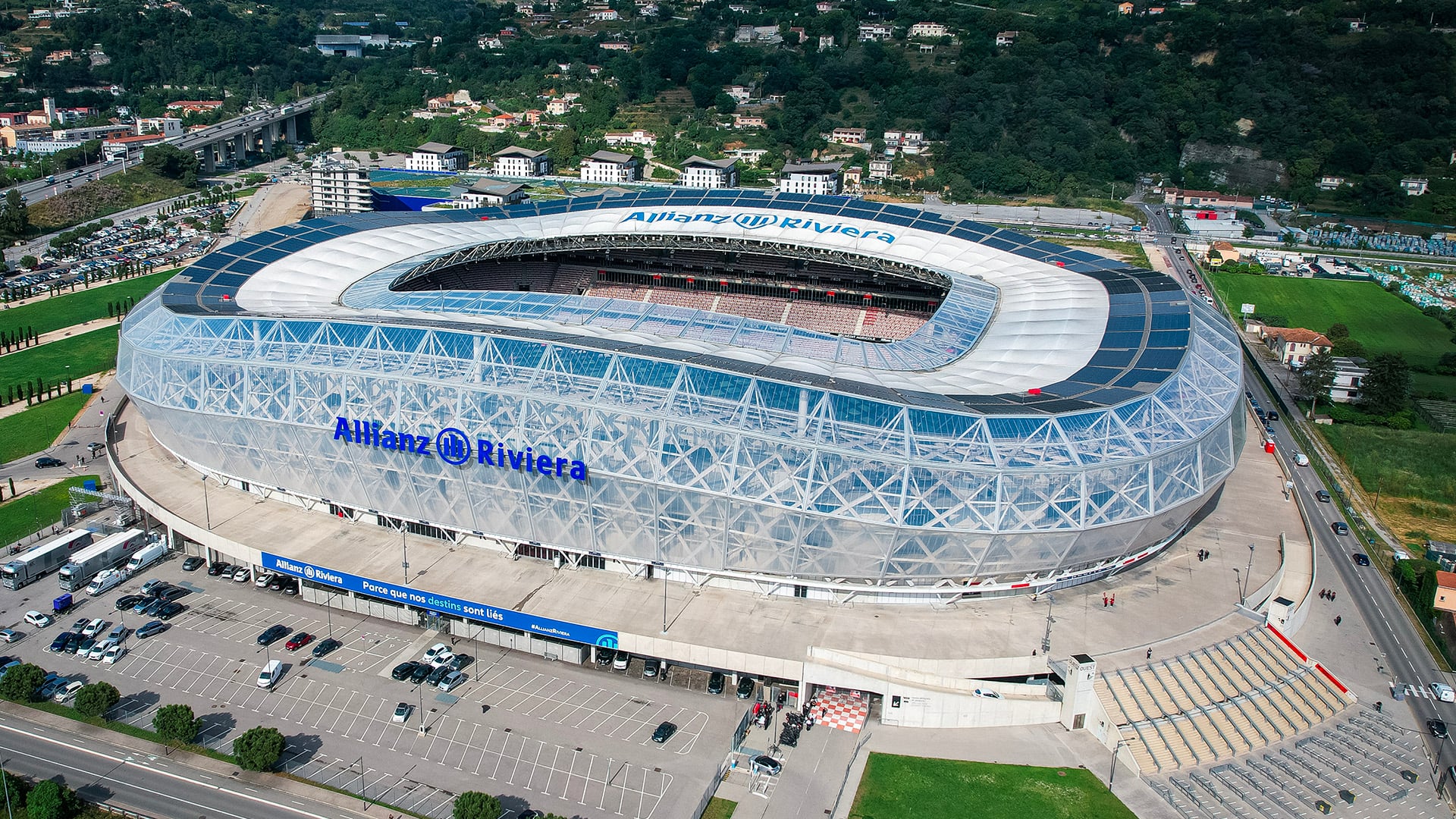
The Allianz Riviera opened its doors on September 22, 2013, a few months after the Ray closed. The new stadium, located in the Var plain in the northwest of the city, seats 36,178 and offers modern amenities. Its roof and solar panels make it one of the most environmentally friendly stadiums in France.
The stadium hosted matches for the 2007 Rugby World Cup, the 2024 Olympic Games (soccer events), and several matches for Euro 2016. For the club, it also marked a significant step up: increased ticket sales, higher commercial revenue, and the ability to more easily host major European matches. The first seasons at the Allianz Stadium coincided with a sporting resurgence under coaches like Lucien Favre, who regularly qualified the club for European competition.
The Allianz Riviera may not have the same charm as the Ray, but it has already begun to write its own story. European matches there have regained a special atmosphere, and fans are gradually making this modern venue their own.
The INEOS Takeover and the Ratcliffe Era
On August 28, 2019, the British group INEOS, owned by billionaire Jim Ratcliffe, became the owner of OGC Nice. This acquisition is part of a broader sports strategy for INEOS, which invests in cycling (Ineos Grenadiers), sailing (America’s Cup), and soccer (including a stake in Manchester United since 2024).
The arrival of INEOS marked a turning point both financially and structurally. The club adopted a more ambitious transfer policy, modernized its training center, and attracted established international players. In the seasons that followed, Nice aimed for regular European qualification, though it did not immediately return to the top of the league table.
The challenge remains to turn this financial project into a sustainable sports strategy. To compare it with other French clubs acquired by foreign investment funds, our article on AS Monaco details Dmitri Rybolovlev’s arrival in 2011 and the upheavals that followed on the Rock.
The Gym Today
OGC Nice is now a top-tier club in Ligue 1, regularly in contention for European qualification. The youth academy continues to produce talented players, the Allianz Riviera provides a solid home, and the INEOS partnership brings additional resources.
The club faces stiff competition from teams backed by Qatari money in Paris, as well as from Monaco, Lyon, and Marseille, depending on the season. But with four league titles and three French Cups to its name, and a century of history behind it, the Gym is one of the cornerstones of French soccer.
Nice fans, deeply attached to their red-and-black identity, are waiting for the club to prove on the field that it can live up to the ambitions set forth by INEOS. The course of the coming seasons will determine whether this era can usher in a new cycle of success at the top, much like the glorious 1950s.
Key Takeaways
- OGC Nice traces its roots back to a multi-sport club founded in 1904, with a soccer division established in 1908.
- The Gym won four French championships in eight seasons: 1951, 1952, 1956, and 1959.
- Three French Cups round out the club's trophy case: 1952, 1954, and 1997.
- The colors red and black were adopted in 1919, in reference to the city's flag.
- The Ray Stadium, the club’s historic home from 1927 to 2013, has been replaced by the Allianz Riviera (capacity: 36,178).
- The INEOS Group, owned by Jim Ratcliffe, acquired the club on August 28, 2019.
- Joaquín Valle remains the club's all-time leading scorer, having scored 339 goals between 1937 and 1948.
Learn more
OGC Nice is part of the long line of French clubs with a storied history. To learn more about other major teams in the south, we recommend our articles on the history of Olympique de Marseille, on AS Monaco and its unique business model, as well as on OL’s seven consecutive titles.
Frequently Asked Questions
In what year was OGC Nice founded?
The original multi-sport club, the Gymnaste Club de Nice, was founded in 1904. The soccer division was established in 1908. Today’s professional OGC Nice traces its roots directly back to that division.
How many French league titles has OGC Nice won?
OGC Nice has won four French league titles, all between 1951 and 1959: 1951, 1952, 1956, and 1959. The club has also won three French Cups in 1952, 1954, and 1997.
Why is Nice called "Le Gym"?
The nickname "Le Gym" comes from the original name of the multi-sport club founded in 1904, the Gymnaste Club de Nice. The other nickname, "Les Aiglons," refers to the eagle that has appeared on the coat of arms of the city of Nice since the Middle Ages.
What is the name of OGC Nice's stadium?
Since September 22, 2013, the club has played its home games at the Allianz Riviera, which has a capacity of 36,178. Prior to that, OGC Nice played at the Stade du Ray, which served as its home stadium for 86 seasons, from 1927 to 2013.
Who owns OGC Nice?
The British group INEOS, owned by billionaire Jim Ratcliffe, has owned the club since August 28, 2019. This acquisition is part of INEOS’s broader sports strategy, as the company also invests in cycling and sailing.
Want to wear the Aiglons' red and black?
We carry all OGC Nice jerseys: home, away, alternate, and retro jerseys that marked the club’s greatest seasons over its century-long history.