
The FC Barcelona jersey is one of the most recognizable in the world. It features vertical navy blue and maroon stripes, an embroidered crest over the heart, and sometimes a central sponsor logo, sometimes not. Since 1899, the home jersey has retained this color scheme, despite some 100 design changes, six main kit manufacturers, and about 30 successive jersey sponsors since 1982. This article traces these 125 years of design, highlighting key moments.
From the cotton jerseys of the early 20th century to today’s high-tech models made from recycled polyester, the Blaugrana jersey tells the story of the evolution of the club, soccer, and the sports apparel industry. This article details that evolution, iconic designs, commercial controversies, and the pieces most sought after by collectors.
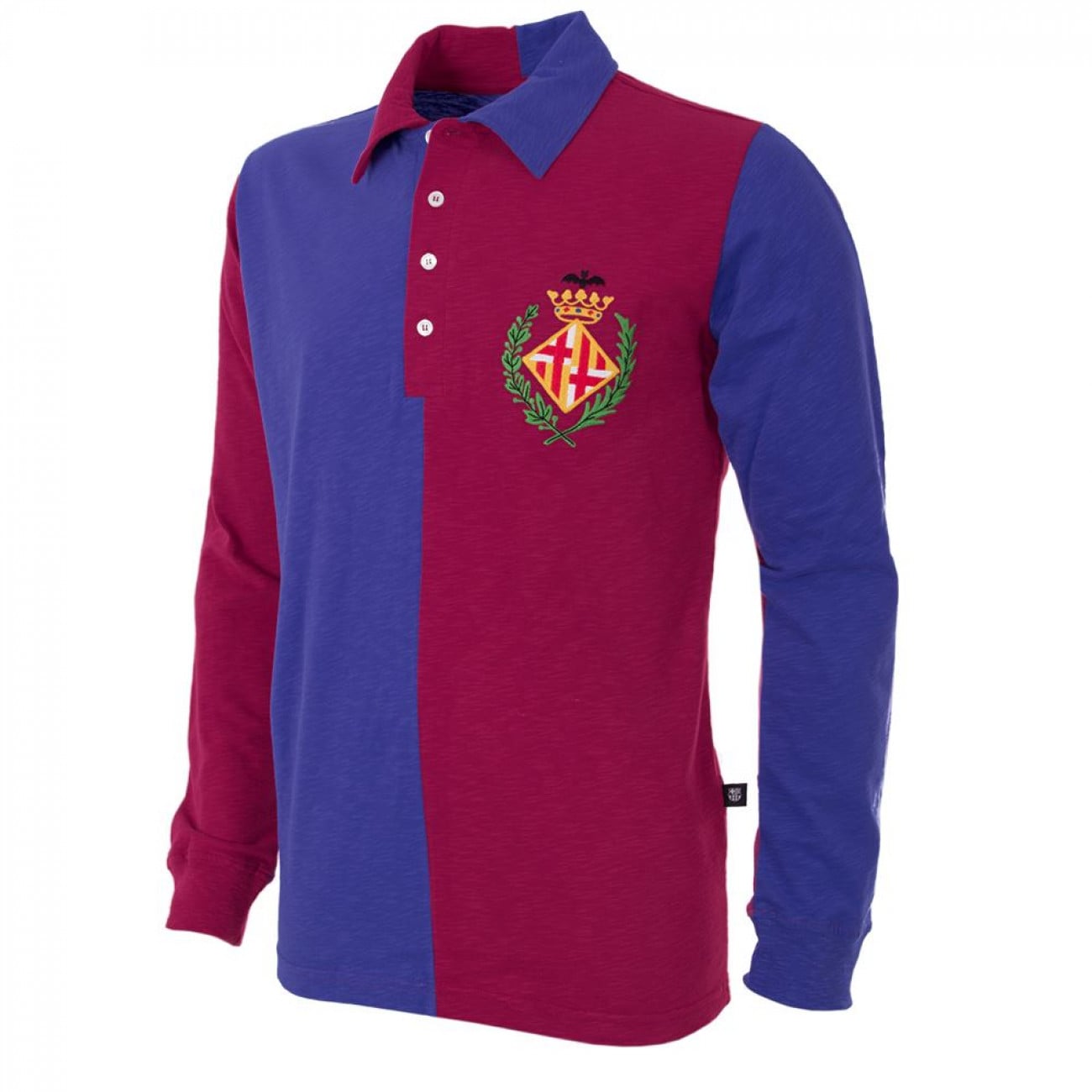
The original jersey from 1899
FC Barcelona’s first jersey appeared when the club was founded on November 29, 1899. It was made of heavy cotton, featuring thin vertical blue and maroon stripes, with a V-neck or, in some models, a laced collar. There was no embroidered crest yet; the main decorative feature was the color combination itself. For more on the origin of these colors, see our article dedicated to the origins of “blaugrana.”
In the early years, players bought their own uniforms. There was no official kit supplier in the modern sense. The jerseys were custom-made by local tailors, which explains the slight variations in design from one player to another. This era of artisanal production lasted well into the 1920s.
The crest first appeared on the jersey in 1910, following a contest organized by the club and won by Carles Comamala. The winning design combines the Cross of Saint George, the Catalan flag, and the Blaugrana colors. It has evolved very gradually since then, but its basic structure has remained unchanged for over a century.
The pre-war era and wide stripes
In the 1920s and 1930s, the stripes on the jersey became wider. The vertical stripes became fewer in number but wider, giving the jersey a more structured look. Cotton remained the primary material, with a loose fit that reflected the sporty aesthetic of the era.
The Spanish Civil War (1936–1939) brought professional soccer to a halt. The club played under very difficult conditions, often wearing patched-up jerseys. The postwar period saw a gradual recovery, but equipment remained basic throughout the 1940s. For historical context, see our article on the history of FC Barcelona.
In the 1950s and 1960s, the cut of the jersey gradually became sleeker. Synthetic fabrics began to appear, though they had not yet become dominant. The stripes remained fairly wide, while the collar evolved into a more modern design. It was during this period that jerseys began to be mass-produced for fans, marking the dawn of apparel merchandising.
The Meyba Era (1982–1992)
In 1982, FC Barcelona signed its first official kit sponsorship deal with the Catalan brand Meyba. It was a pivotal moment: jerseys became commercial products in their own right, with new designs released each season. Meyba’s designs stood out for their simplicity and their adherence to the club’s traditional style.
The Meyba era spans the end of the tenures of coaches such as César Luis Menotti and Cruyff’s arrival on the bench in 1988. The Dream Team’s jerseys (1990–1994) were produced by Meyba during their early seasons and then by Kappa starting in 1992. For more on the sporting context of this period, see our article on the Dream Team.
Meyba jerseys are now highly sought after by collectors. The 1990–1991 jersey (Spanish champions, with Cruyff on the bench) and the 1991–1992 jersey (Spanish and European champions) are among the most coveted items on the vintage jersey market. For currently available versions, see the Barcelona collection in our store.
First Kappa, then Nike: the turning point of 1998
From 1992 to 1998, the team’s kit supplier was Kappa. The designs became more modern, materials evolved to be more breathable, and the cuts became less baggy. This was the era when the first technical jerseys made their debut in world soccer. The 1996–1997 jersey, from Bobby Robson’s final season as manager, is one of the iconic designs of that era.
In 1998, FC Barcelona signed a contract with Nike that remains in effect today, marking more than 25 years of partnership. It is one of the longest-running and most stable kit sponsorship deals in world soccer. The early seasons under Nike saw a surge in design innovation: new materials, breathable technologies, and subtle patterns woven into the stripes.
The Nike era coincides with Barça’s golden age: the Ronaldinho era, the Guardiola era, and the Messi era. All the iconic jerseys of the latest generation feature the Nike Swoosh, which has become an integral part of the club’s visual identity. For recent seasons, our article on Messi at Barça highlights the key seasons.
Jersey sponsors, from TV3 to Spotify
For a long time, FC Barcelona refused to feature a commercial sponsor on its jersey, a rare stance in European soccer. The club cited its status as a nonprofit organization and its identity as the basis for this decision. The first jersey sponsor did not appear until 1990, with TV3, the Catalan public broadcaster, in a move consistent with the club’s “Més que un club” philosophy.
Several institutional sponsors came and went: TV3, Sportal.com, and, briefly, Telefónica. The major turning point came in 2006 with the UNICEF agreement, which marked the culmination of a socially conscious approach (the club pays the organization instead of being paid). See our analysis of the motto “Més que un club” for context.
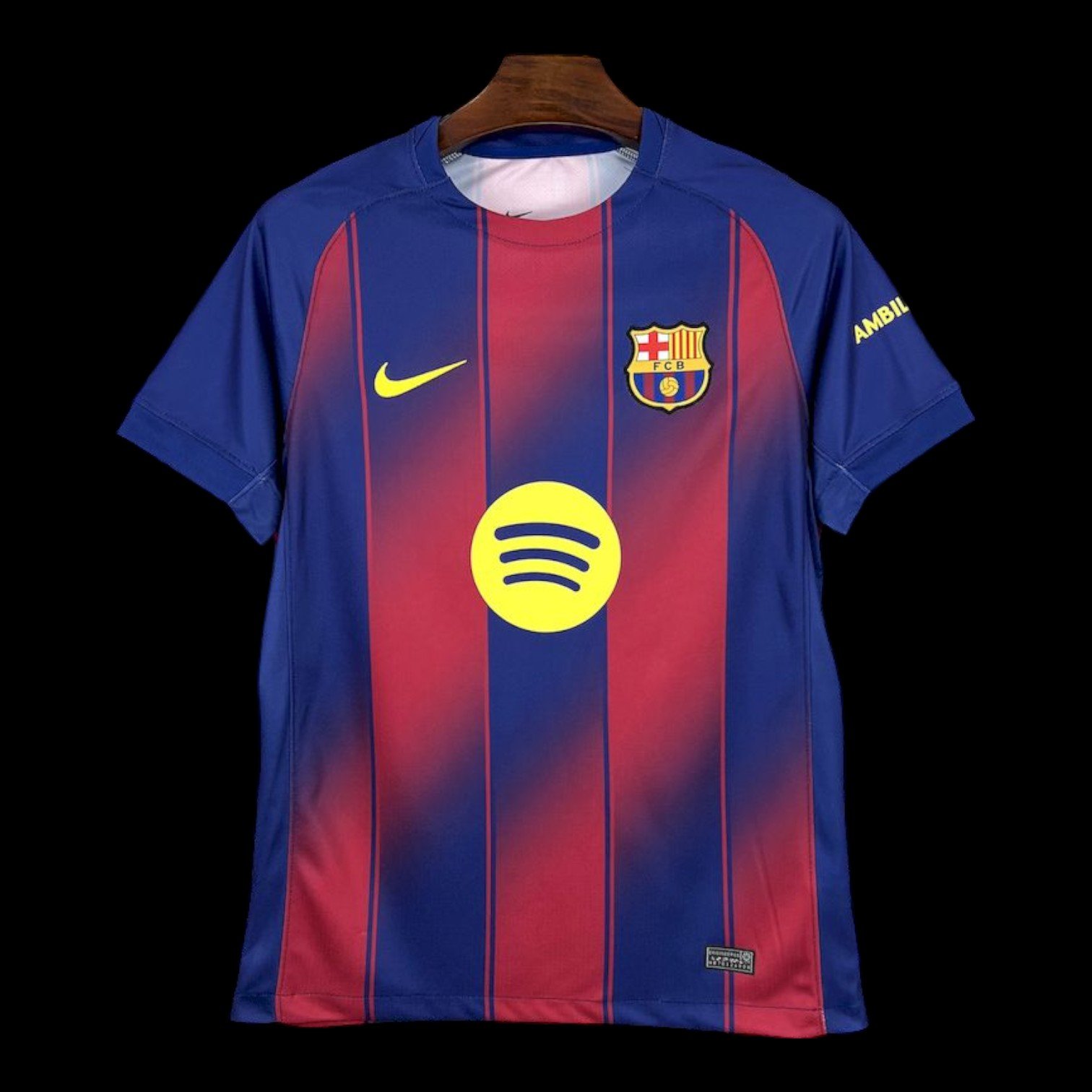
Starting in 2011, the approach changed. Qatar Foundation and then Qatar Airways became the main sponsors, providing substantial funding. Rakuten took over from 2017 to 2022, and then Spotify became the main jersey sponsor in 2022, while also securing the naming rights to Camp Nou (Spotify Camp Nou). This increased commercialization continues to fuel internal debate within the club.
The 2006 UNICEF jersey
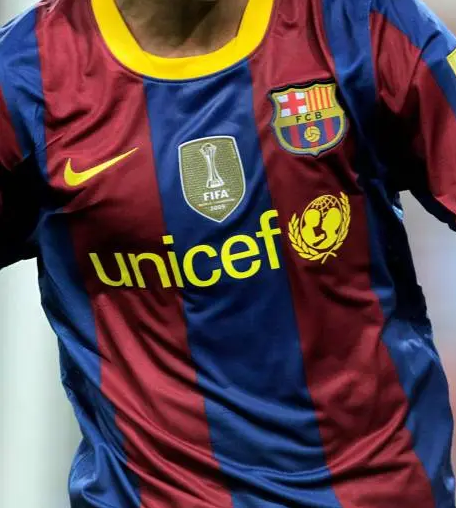
On September 7, 2006, FC Barcelona and UNICEF announced a historic partnership. For five seasons, the UNICEF logo would appear on the Blaugrana jersey, and the club would donate 1.5 million euros annually to the organization. This marked the first time in modern soccer that a club paid to display the logo of a humanitarian cause, rather than the other way around.
The UNICEF-branded jerseys from the 2006–2007 to 2010–2011 seasons quickly became iconic. Guardiola’s treble in 2009 and the second Champions League title in 2011 were won with this logo on the chest. For the treble, see our article on the 2008–2009 season.
Starting in 2011, UNICEF was moved to the back of the jersey, with the Qatari logo taking the front. But the partnership continued, and the image associated with it remains strong in the collective memory of fans. Today, UNICEF jerseys are highly sought-after items on the market for vintage Barcelona jerseys.
Away jerseys and their bold designs
While the home jersey remains sacred, away jerseys have allowed for much bolder designs. For decades, the away jersey was orange, white, or yellow—neutral colors that wouldn’t clash with those of other clubs. But starting in the 2010s, Nike and the club began experimenting with black, neon green, pale pink, and multicolored designs.
The 2018–2019 pink away jersey is one of the best-selling designs of any modern season. The black and blue kit from the 2019-2020 season has been released in several versions. More recently, the alternate kits have incorporated motifs related to Catalan culture (the Sagrada Familia, the flag, and references to Gaudí), which are particularly popular with fans in the region.
This strategy of distinguishing between the home (sacred) and away (creative) environments allows the club to maintain its commercial revenue while respecting traditional norms. It illustrates the delicate balance between historical identity and marketing modernization—an ongoing debate in the institutional life of today’s Barça.
Key Takeaways
- FC Barcelona's home jersey has featured vertical blue and maroon stripes since 1899.
- The crest first appeared on the jersey in 1910, following a contest won by Carles Comamala.
- Meyba was the club's first official equipment supplier from 1982 to 1992.
- Kappa took over from 1992 to 1998, and Nike has been the sponsor since 1998 (a partnership spanning more than 25 years).
- The first jersey sponsor appeared in 1990 with TV3, after decades of refusing any advertising.
- The 2006–2011 UNICEF sponsorship deal remains one of the most unique in modern soccer: the club pays 1.5 million euros a year to display the logo.
- The current sponsors, Spotify (since 2022), signal a more overt commercialization of the jersey.
Learn more
The history of the Blaugrana jersey is part of several stories we’ve documented. We recommend our articles on the origin of the Blaugrana colors, the complete history of FC Barcelona, the motto “Més que un club,” and Cruyff’s Dream Team, which wore Meyba and then Kappa jerseys.
Frequently Asked Questions
Who is FC Barcelona's current equipment supplier?
Nike has been FC Barcelona’s official kit supplier since 1998, marking more than 25 years of continuous partnership. It is one of the longest-running and most stable kit sponsorship deals in world soccer. Before Nike, the club partnered successively with Meyba (1982–1992) and Kappa (1992–1998).
Since when has Barça had a sponsor on its jersey?
FC Barcelona’s first jersey sponsor appeared in 1990: TV3, the Catalan public broadcaster. Prior to that, the club had refused to allow any commercial advertising on its jersey, a rather unusual decision in European soccer. Today, Spotify has been the main sponsor since 2022.
Why is the Barça jersey blue and maroon?
The exact origin of the Blaugrana colors is not formally documented. Three main theories have been debated for 125 years: a legacy of the Witty brothers and their English school, Merchant Taylors’; a tribute to the colors of FC Basel, where Joan Gamper is said to have played; or, more colorfully, a two-tone accountant’s pencil.
What is the UNICEF Barça jersey?
From 2006 to 2011, FC Barcelona displayed the UNICEF logo on its jersey as part of a historic agreement. Instead of receiving payment, the club contributed 1.5 million euros annually to the UN agency. This initiative, unique in modern soccer, embodied the motto “Més que un club.” Since 2011, UNICEF has appeared on the back of the jersey.
Has the home jersey ever changed colors?
No, since 1899, FC Barcelona’s home jersey has remained true to its blue and maroon vertical stripes. Only the proportions of the stripes, the internal patterns, the collar, and the cut have changed over the years, depending on the kit manufacturer and the era. The away jersey, on the other hand, has seen many variations: yellow, white, black, green, orange, and pink.
We have the Barça jersey in stock
The FC Barcelona collection is available in its entirety on Maxi Kits: home, away, and alternate jerseys, as well as player and fan versions, and retro jerseys that pay homage to the club’s greatest seasons.