
Summer 2000. Florentino Pérez had just been elected president of Real Madrid, promising something no one thought possible: signing Luís Figo, FC Barcelona’s playmaker. A few weeks later, the Portuguese star arrived in the Spanish capital for a record transfer fee. The Galácticos project was launched. For six years, Real Madrid would sign one major star per season, driven by a desire for spectacle, marketing, and an unapologetic ambition to dominate the continent.
This article traces the journey of Real Madrid’s “Galácticos,” from Figo’s sensational arrival in 2000 to Florentino Pérez’s resignation in 2006, including the Champions League victory in Glasgow and the subsequent slump. It’s a chapter in history that blends financial success, sporting achievements, and the limitations of a model that eventually ran its course.
The election of Florentino Pérez in July 2000
On July 16, 2000, Florentino Pérez became president of Real Madrid by defeating the incumbent, Lorenzo Sanz. His campaign was built on a spectacular promise: to sign Luís Figo, the reigning Ballon d’Argent winner and FC Barcelona’s star player. At the time, many viewed this promise as a bluff intended to win over the club’s members. No one imagined that Pérez could actually pry Figo away from the Catalans.
Pérez is a Madrid-based businessman and CEO of the ACS construction group. He is well-versed in communications, finance, and high-profile moves. He has a clear vision for Real Madrid: a club that must once again become the benchmark in Europe by relying on the world’s best players, capturing global marketing revenue, and embracing its status as an entertainment enterprise.
Once the election was over, he immediately made good on his promise. A 10-billion-peseta (approximately 60 million euro) buyout clause was triggered for Figo, and the Portuguese star arrived in Madrid a few days later. It was a massive coup. The city of Barcelona erupted in anger, Madrid fans were ecstatic, and the Galácticos project had officially begun.
The strategy: one Galactic per summer
The Pérez method boils down to a simple formula: sign a "Galáctico" every summer. A world-renowned superstar capable of both raising the team’s competitive level and generating massive marketing revenue (jerseys, image rights, sponsors). The idea is to transform Real Madrid into a global brand, much like the major NBA franchises, and to finance transfers through the commercial revenue they generate.
This approach is based on a bold premise: that the world’s best players, when brought together, will produce unstoppable soccer. Pérez is betting on individual quality rather than team balance. An approach that breaks with the Spanish tradition of teams built around a core of homegrown players (the Quinta del Buitre in the 1980s, or the national team formed at La Masia in the 2000s on the Catalan side).
From a sporting perspective, this strategy requires a coach capable of managing massive egos and enforcing a tactical framework. From a financial perspective, it relies on a business model that turns every transfer into a profitable marketing investment. It’s a bold gamble—sometimes brilliant, sometimes disastrous, depending on the year.
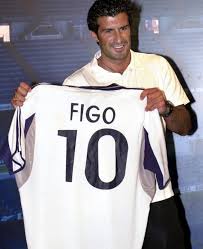
2000: Figo, the sensation at Camp Nou
Luís Figo arrived in Madrid in the summer of 2000 for approximately 60 million euros, a world record at the time. The transfer was seen as an outright betrayal in Barcelona. The Portuguese player had sworn to Catalan fans that he would never leave, and there he was, wearing the white jersey of their historic rival. Every time he returned to Camp Nou, he was greeted with boos and even had a pig’s head thrown at him from the stands during a Clásico in 2002.
On the field, Figo’s arrival helped Real Madrid win La Liga in the 2000–2001 season. The Portuguese player received the Ballon d’Or in late 2000, partly for his performances with Barcelona, but also because he had become the face of the new Real Madrid. His technical skill, pinpoint crosses, and ability to beat his direct defender worked wonders in Madrid.
The Figo move was a massive marketing success. Sales of the white jersey skyrocketed, sponsors were lining up, and the club’s revenue increased significantly. Pérez proved he could deliver on even his wildest promises, and Madrid fans now have complete faith in him moving forward.
2001: Zidane, a record-breaking transfer and the comeback in Glasgow
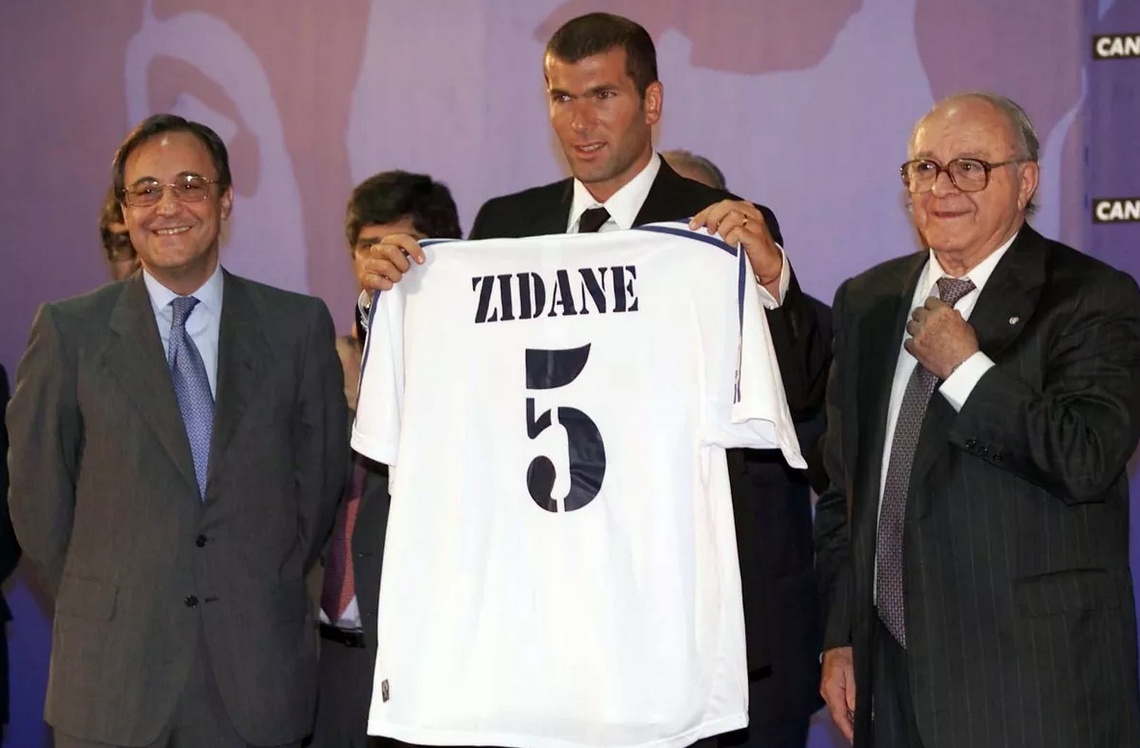
In the summer of 2001, Real Madrid struck again with a major coup. Zinédine Zidane, a two-time Ballon d’Or winner and 1998 World Cup champion with France, left Juventus to join Madrid for approximately €73.5 million. It was a new world transfer record, and no one could have imagined at the time that it would be broken several more times over the course of the decade.
Zidane’s impact is immense, right from his first season. On May 15, 2002, in Glasgow, in the Champions League final against Bayer Leverkusen, the Frenchman scores one of the most beautiful goals in the competition’s history: a left-footed volley into the top corner in the 45th minute. Real won 2-1 and claimed their ninth European Cup, the famous Novena. It was the pinnacle of the Galácticos era.
For many, that final remains the ultimate symbol of what the Galacticos project was capable of achieving at its best: a player unlike any other in the world, capable of turning a final on its head with a single extraordinary move. Pérez felt vindicated, the club was at the top of its game, and the strategy seemed to have been proven right by the results.
2002: Ronaldo, "The Phenomenon" in white
In the summer of 2002, after Brazil’s World Cup victory and his own title as the tournament’s top scorer, Ronaldo Nazário joined Real Madrid from Inter Milan for approximately €45 million. He was 25 years old, had just won another Ballon d’Or, and was the ideal striker to complete Florentino Pérez’s vision.
Ronaldo had an exceptional 2002–2003 season, which culminated in another La Liga title (the club’s 29th). He scored goals by the bucketful, sometimes with disarming simplicity thanks to his positioning. The Figo-Zidane-Ronaldo trio ran riot against European defenses, and Real Madrid seemed poised for a long-term reign of dominance.
However, his presence alone will not be enough to offset the imbalances emerging within the team. The defense is aging, the midfield lacks ball-winning midfielders, and the arrival of the fourth Galáctico will only exacerbate these weaknesses rather than address them.
2003: Beckham, the global icon who upsets the balance
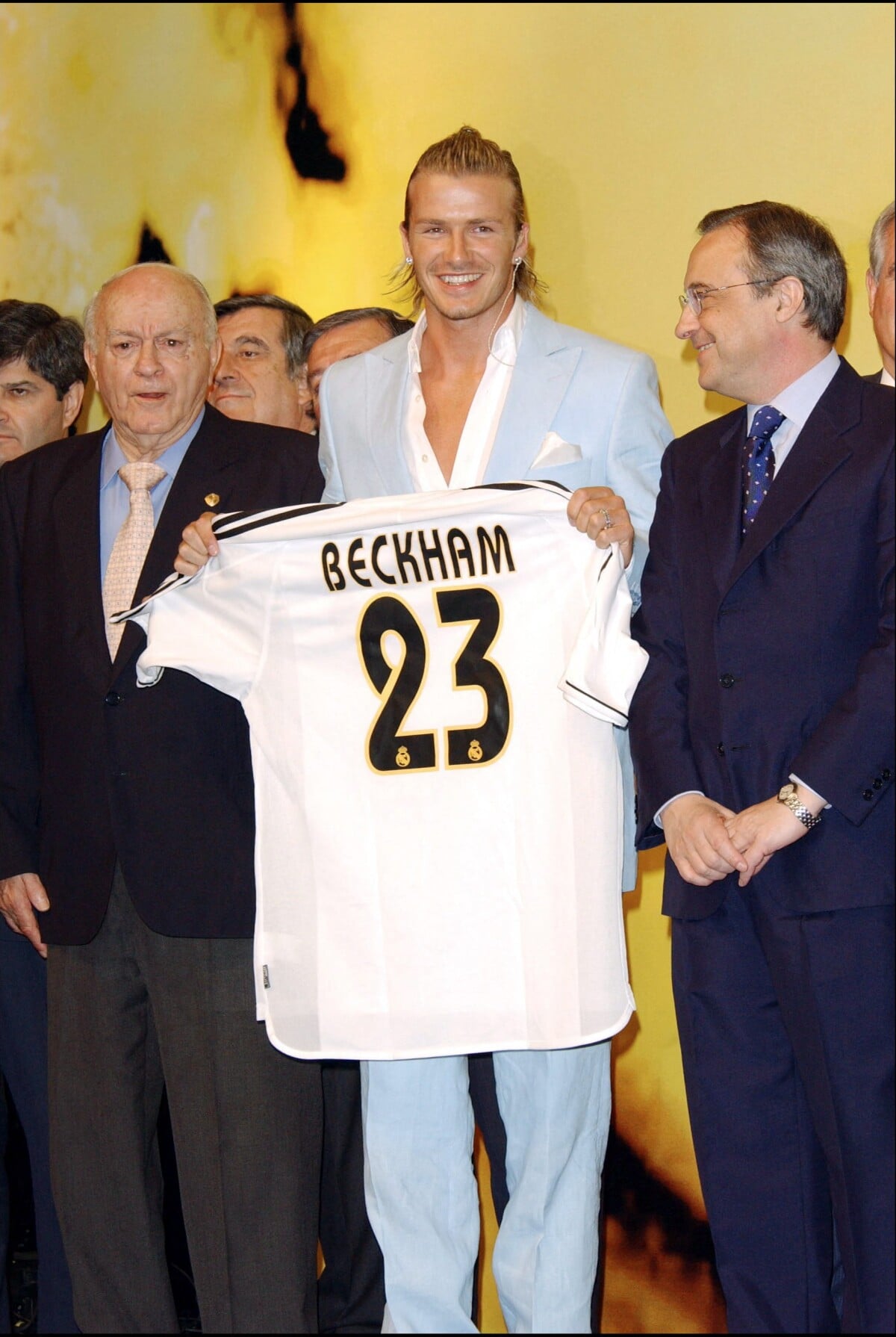
In the summer of 2003, Real Madrid signed David Beckham from Manchester United for approximately €37.5 million. At the time, the Englishman was the biggest marketing star in world soccer, married to a Spice Girl and featured in every major global advertising campaign. His arrival in Madrid was a global sensation, and sales of jerseys bearing Beckham’s name broke records around the world.
From a sporting perspective, the decision raises questions. The team needed a defensive midfielder following the departure of Claude Makélélé, who was sold to Chelsea that summer. Instead, they signed another attacking midfielder—one who, moreover, played in the same position as Figo and Zidane. The imbalance became glaringly obvious: too many forwards, not enough ball-winning midfielders, and a defense that was struggling against the best European teams.
This decision is often seen as the turning point that derailed the "Galacticos" project. The 2003–2004 season got off to a flying start with a commanding lead in La Liga, but Real Madrid collapsed in the spring and finished fourth. The disappointment was immense, and the slump that followed would last three seasons.
The rough patch and Pérez's downfall
From 2003 to 2006, Real Madrid failed to win a single major trophy. This was a situation unseen in a long time for a club accustomed to dominating La Liga and Europe. Coaches came and went in rapid succession (Carlos Queiroz, José Antonio Camacho, Mariano García Remón, Vanderlei Luxemburgo, Juan Ramón López Caro), but none of them managed to turn things around.
The club’s image is also deteriorating. The Galácticos, still stars in their own right, seem to be playing in exhibition mode, lacking defensive intensity and team spirit. The Spanish press points to strategic confusion, and the socios are beginning to protest. Pérez gradually loses political control of the club and eventually resigns on February 27, 2006.
This collapse serves as a lesson in the limitations of the original Galacticos project. Simply signing individual stars isn’t enough to build a winning team. Without tactical balance and unsung heroes to do the dirty work, the world’s best talents end up canceling each other out instead of complementing one another.
The Return of the Galácticos in 2009: Cristiano Ronaldo and Kaká
Florentino Pérez returned as president in June 2009 and immediately relaunched the "Galácticos 2.0" project. Cristiano Ronaldo arrived from Manchester United for approximately €94 million, setting a new world record. Kaká joined from AC Milan for approximately €67 million. These two transfers alone cost more than the entire budget of several major European clubs.
This second iteration of the project would prove far more successful on the field. By relying on Cristiano Ronaldo as the focal point of the attack and rounding out the roster with well-rounded players (Xabi Alonso, Sami Khedira, Mesut Özil, Karim Benzema), Pérez gradually built the team that would go on to win four Champions League titles between 2014 and 2018, including the famous European treble.
To understand the rest of this story, we’ve written an article about Florentino Pérez, the visionary president who built the modern Real Madrid. And to place the Galácticos within the club’s long history, our article on Real Madrid’s 120th anniversary traces the club’s entire journey since 1902.
Key Takeaways
- Florentino Pérez was elected president of Real Madrid in July 2000 on the promise of signing Luís Figo.
- The Galacticos strategy involves signing one global superstar each summer to propel the club to the top in both sports and marketing.
- Four landmark transfers: Figo in 2000 (€60 million), Zidane in 2001 (€73.5 million), Ronaldo in 2002 (€45 million), and Beckham in 2003 (€37.5 million).
- Trophies from the early years: La Liga titles in 2000–2001 and 2002–2003, and the 2002 Champions League in Glasgow thanks to Zidane’s game-winning goal.
- From 2003 to 2006, Real Madrid failed to win any major trophies, suffering from tactical instability and a revolving door of coaches.
- Florentino Pérez resigned on February 27, 2006, marking the end of the first Galacticos era.
- Pérez returned in 2009 with Cristiano Ronaldo (€94 million) and Kaká (€67 million), a second wave of signings that would lead to four Champions League titles between 2014 and 2018.
Learn more
The Galácticos era is part of Real Madrid’s long history. To explore other chapters, we recommend our articles on Florentino Pérez and his vision as a president-builder, on Santiago Bernabéu —whose strategy of signing star players inspired Pérez—and on the complete history of Real Madrid since its founding in 1902. For the previous generation, the article on the Quinta del Buitre describes a radically different model.
Frequently Asked Questions
Who are Real Madrid's Galácticos?
The Galácticos refer to the superstar players signed by President Florentino Pérez starting in 2000, at a rate of one top player per summer. The four iconic figures of the first era are Luís Figo (2000), Zinédine Zidane (2001), Ronaldo Nazário (2002), and David Beckham (2003).
Why do we talk about the Galactics?
The term refers to those global stars considered the best players in the world at their respective positions, signed for record-breaking sums to drive both Real Madrid’s sporting and marketing initiatives. The strategy was to secure these signings one after another to build an unbeatable team.
What is the record for the first Galactiques era?
Two La Liga titles (2000–2001 and 2002–2003), a Champions League title in 2002 in Glasgow against Bayer Leverkusen, featuring Zinedine Zidane’s iconic volley, an Intercontinental Cup, and a European Super Cup. No major trophies between 2003 and 2006.
Why did the Galactiques project fail between 2003 and 2006?
Several factors: tactical imbalance within the team (too many forwards, no defensive midfielder following Claude Makélélé’s departure), a lack of a solid defensive backbone, a revolving door of coaches, and the president’s gradual loss of authority. Florentino Pérez eventually resigned on February 27, 2006.
Was there a second Galactic era?
Yes, starting in 2009 when Florentino Pérez returned as president. He signed Cristiano Ronaldo (for €94 million from Manchester United) and Kaká (for €67 million from AC Milan). This second era resulted in four Champions League titles between 2014 and 2018.
Want to add a Real Madrid jersey to your collection?
All Real Madrid jerseys are available in the store: home, away, and third jerseys, as well as player and fan editions, and retro jerseys that evoke the "Galacticos" era of the 2000s.